


A virtual CFO for manufacturing companies is a part-time finance executive who runs the plant's cost system, cash planning and capital decisions without a full-time salary. In 2026 the job centers on standard costs and variance reporting, inventory rules tied to the $32 million gross receipts test, and the decisions that follow from new factory and research expensing.
Most small and mid-sized manufacturers have a bookkeeper or controller who closes the month. What they often lack is someone who turns those numbers into pricing, purchasing and investment decisions. A virtual CFO for manufacturing companies fills that gap remotely, usually working from the same ERP and general ledger as the internal team. If the general role is new to you, our explainer on what a virtual CFO does, what it costs and how to choose one covers the basics. This article focuses on the parts of the job that are specific to a plant.
A service business sells hours. A manufacturer buys materials, holds them, converts them with labor and overhead, holds finished goods, and then waits for customers to pay. Every step ties up cash, and every step creates a cost that has to be measured and assigned to a product.
That creates three problems a general finance adviser may not be set up for. Product margins depend on how overhead is assigned, so a weak costing method can make a losing product look profitable. Inventory sits on the balance sheet at a value that drives both reported profit and taxable income. And capital spending on machines and buildings is large, lumpy and now heavily shaped by the 2025 tax law.
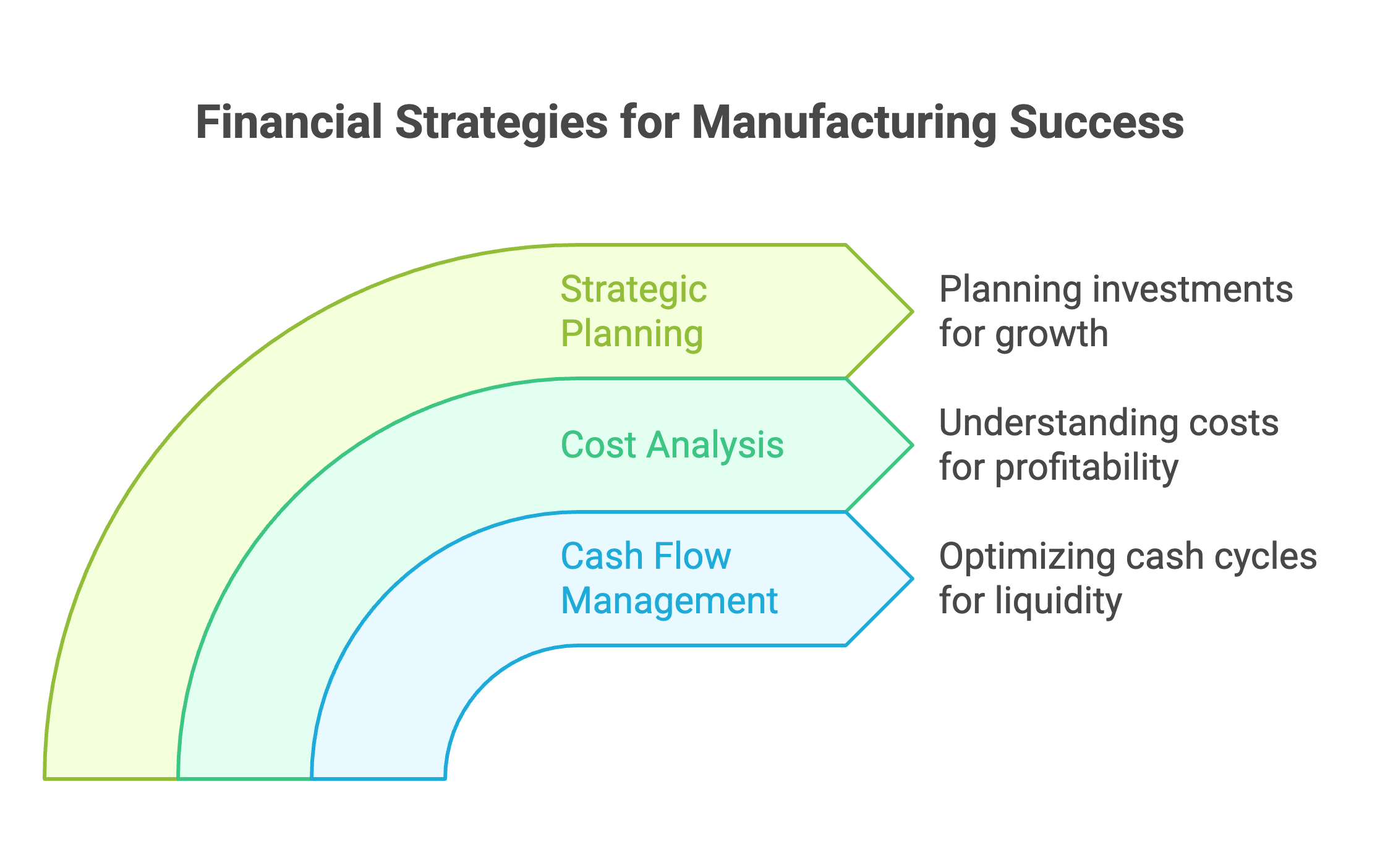
The day-to-day close and reporting can be handled by a controller. Our comparison of a fractional controller vs a fractional CFO shows where one role ends and the other begins. For a manufacturer, the CFO side owns the cost model, the cash forecast and the capital plan.
Standard costing is usually the first system a virtual CFO for manufacturing companies builds or repairs. Each product gets a standard cost per unit for materials, direct labor and applied overhead, based on expected prices and expected usage. Actual costs are then compared with standard each month, and the differences, called variances, show where money was gained or lost.
The overhead rate inside the standard depends on the allocation base chosen, such as machine hours or direct labor hours. The trade-offs between bases are covered in our guide to manufacturing overhead allocation methods.
A plant makes a bracket with this standard cost per unit:
| Cost element | Standard quantity | Standard rate | Standard cost per unit |
|---|---|---|---|
| Steel | 2.5 lb | $4.00 per lb | $10.00 |
| Direct labor | 0.5 hours | $30.00 per hour | $15.00 |
| Applied overhead | 0.5 labor hours | $20.00 per hour | $10.00 |
| Total | $35.00 |
In October the plant produced 10,000 brackets. It used 26,000 lb of steel bought at $4.20 per lb and paid for 5,300 direct labor hours at $29.50 per hour.
| Variance | Calculation | Amount |
|---|---|---|
| Material price | ($4.20 minus $4.00) x 26,000 lb | $5,200 unfavorable |
| Material quantity | (26,000 lb minus 25,000 lb) x $4.00 | $4,000 unfavorable |
| Labor rate | ($29.50 minus $30.00) x 5,300 hours | $2,650 favorable |
| Labor efficiency | (5,300 hours minus 5,000 hours) x $30.00 | $9,000 unfavorable |
| Net material and labor variance | $15,550 unfavorable |
The check is simple. Standard material and labor for 10,000 units is $250,000. Actual spending was $109,200 for steel and $156,350 for labor, or $265,550, which is $15,550 over standard.
The numbers point to different owners. The steel price variance belongs to purchasing and may justify a price increase or a new supplier. The quantity and efficiency variances belong to the shop floor, where scrap, setup time or an aging machine are common causes. The favorable labor rate is small and may simply reflect newer, lower paid staff, which could also explain the extra hours. A virtual CFO's job is to put these figures in front of the right people within days of month end and track whether they improve. Our article on variance analysis best practices covers how to report them.
Standard costs also matter for tax. The Treasury regulation on inventory costing for manufacturers permits the standard cost method if the taxpayer reallocates a pro rata portion of net overhead and direct production cost variances to the goods in ending inventory. Variances that are not significant compared with total actual indirect production costs for the year need not be allocated, unless the business allocates them in its financial reports. In practice, leaving large net unfavorable variances in cost of goods sold at year end can understate ending inventory on the tax return, so the CFO should size the variances before the year closes.
Inventory is usually a manufacturer's largest current asset after receivables, and its value depends on which costs are capitalized into it. Under the uniform capitalization rules of Section 263A, a producer must include the direct costs of property and its "proper share of those indirect costs (including taxes)" in inventory. Costs such as purchasing, warehousing, quality control and part of factory administration move from expense into the balance sheet and only reach cost of goods sold when the goods are sold.
Section 263A(i) switches these rules off for a taxpayer, other than a tax shelter, that meets the gross receipts test of Section 448(c). For tax years beginning in 2026, Revenue Procedure 2025-32 sets that test for a corporation or partnership at average annual gross receipts of $32,000,000 or less for the three tax years ending with the prior year. That figure is adjusted for inflation each year, so it should be checked again for 2027.
| Item | Average gross receipts of $32M or less (2026) | Above $32M |
|---|---|---|
| Section 263A uniform capitalization | Exempt | Applies; indirect costs capitalized into inventory |
| Inventory method | Simplified small business methods available under Section 471(c) | Full inventory accounting under Section 471 |
| What the CFO tracks | Three-year revenue average and how close the plant is to the line | UNICAP cost pools, absorption ratios and book to tax differences |
For a growing plant, the CFO's work here is mostly forecasting. If next year's three-year average will cross $32 million, the plant will need UNICAP calculations, method change filings and possibly new cost pools in the ERP. Those take months to build, so the forecast should flag the crossing a year ahead. The mechanics of costing and valuing stock are covered in our guide to inventory accounting for manufacturers, and the full set of 2026 tax choices is in our 2026 guide to tax planning for manufacturers.
The 2025 tax law added an elective 100% deduction for new factory space. Under Section 168(n), the first year allowance equals 100 percent of the adjusted basis of qualified production property. In broad terms, that is the part of a US nonresidential building used as an integral part of manufacturing, production or refining of tangible products, whose original use begins with the taxpayer, where construction begins after January 19, 2025 and before January 1, 2029, and the building is placed in service before January 1, 2031.
The statute excludes space used for offices, administrative services, lodging, parking, sales, research, software development or engineering. Recapture can apply if, within 10 years of the placed in service date, the space stops being used in a qualified production activity and is put to another productive use.
For a virtual CFO, this changes the expansion model in three practical ways:
The definitions and open questions are covered in more detail in our article on qualified production property depreciation. The election itself, together with bonus depreciation on equipment, is a tax planning decision that belongs with the plant's tax adviser.
Many manufacturers do research without calling it that. Engineers designing a new product, or production staff testing a new process, can generate research or experimental expenditures. For tax years beginning after December 31, 2024, the IRS confirms in its summary of One Big Beautiful Bill provisions that taxpayers may deduct domestic research or experimental expenditures paid or incurred during the year, or elect to capitalize and amortize them over at least 60 months. Foreign research costs are still amortized over 15 years, and amounts spent to acquire or improve land or depreciable property are not eligible.
The CFO's contribution is cost tracking. Engineering and process development hours need project codes in payroll and the ERP during the year, so the deduction and any research credit rest on records that were made at the time. Our article on how the One Big Beautiful Bill Act changed Section 174 explains the transition rules.
Cash in a manufacturer moves through raw materials, work in process, finished goods and receivables before it comes back. The cash conversion cycle measures that loop as days inventory outstanding plus days sales outstanding minus days payables outstanding.
A virtual CFO usually works this cycle through a rolling cash forecast tied to the production schedule and purchase orders. Typical actions include setting reorder points by part, negotiating supplier terms that match production lead times, reviewing customer credit limits before large orders ship, and timing large material buys against expected collections. Our guide to working capital management strategies covers the levers in more depth.
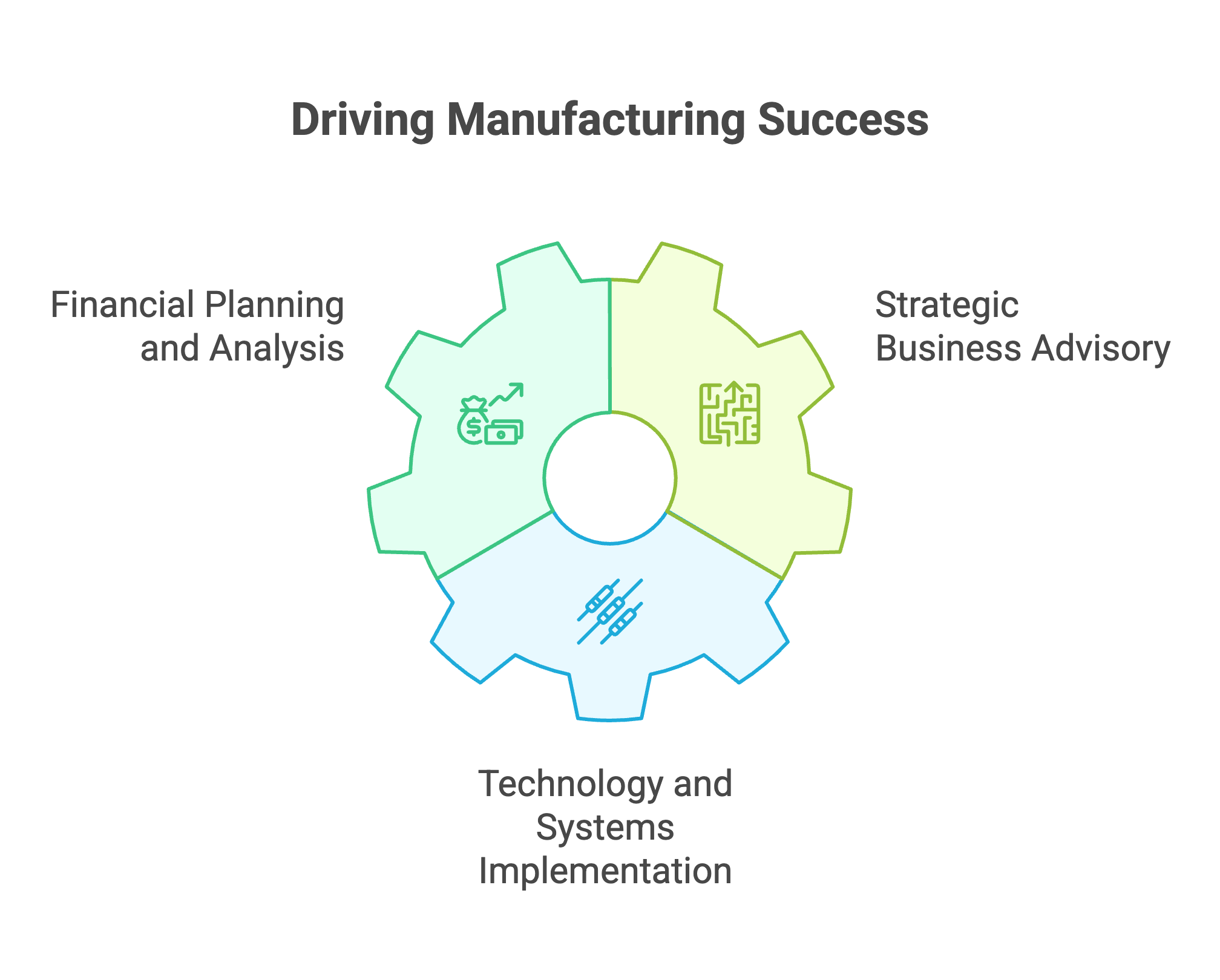
The cost model and the cash forecast only work if the ERP captures the right data. A virtual CFO often reviews bills of materials, routings and labor reporting so standard costs reflect how products are actually built. A monthly package for a manufacturer typically shows gross margin by product line, the variance summary, inventory turns and the cash forecast against plan. The controller or an outsourced reporting team usually prepares it, and the CFO reviews it with the owners.
Common triggers for a manufacturer include a three-year revenue average approaching $32 million, a planned plant expansion, a new product line with engineering spend, a lender asking for covenant reporting, or margins falling without a clear cause. Cost depends on scope and hours, and our breakdown of outsourced CFO cost by company size shows how engagements are usually priced by revenue band.
What does a virtual CFO for manufacturing companies do that a controller does not? A controller closes the books and produces accurate statements. A virtual CFO uses those statements to set standard costs, explain variances, forecast cash around production and plan capital spending, and works with the tax adviser on decisions such as UNICAP readiness and factory expensing.
How far ahead should a manufacturer plan for crossing the $32 million test? Ideally a full year. For 2026 the Section 448(c) threshold is $32,000,000 of average annual gross receipts over the three prior tax years, and crossing it brings Section 263A uniform capitalization into play. Building UNICAP cost pools and filing any method changes takes months, so the cash and revenue forecast should show the crossing well before it happens.
Can a manufacturer use standard costs for tax inventory? Yes. Treasury regulations allow the standard cost method if a pro rata portion of net variances is reallocated to ending inventory. Variances that are not significant compared with total actual indirect production costs for the year need not be allocated, unless the financial reports allocate them.
What does a virtual CFO add to a plant expansion? The CFO builds the expansion model: construction timing, the split between production and excluded space, financing and the after-tax cash flow. For Section 168(n), construction must begin after January 19, 2025 and before January 1, 2029, with the building placed in service before January 1, 2031, so the timeline and the floor plan both affect the numbers. The election itself is decided with the tax adviser.
What reports should a virtual CFO for manufacturing companies deliver each month? A typical package covers gross margin by product line, the variance summary against standard cost, inventory turns, the rolling cash forecast against plan and progress on capital projects. The controller usually prepares the statements and the CFO explains what changed and what to do about it.
Madras Accountancy supports US manufacturers and the CPA firms that serve them with bookkeeping, cost and inventory reporting, cash forecasting and part-time CFO support. To talk through your plant's cost system or capital plan, contact our team.

The section 4960 excise tax is 21% of nonprofit pay over $1M. From 2026 it covers all employees. See the medical carve-outs, Form 4720 and a worked example.

The paid family and medical leave tax credit is permanent from 2026. See the 12.5% to 25% rates, the premium option, the 6-month rule and how Form 8994 works.

Opportunity zones become permanent in 2027 under the One Big Beautiful Bill. See the new deferral, rural bonus, and the 2026 handoff.