

.png)

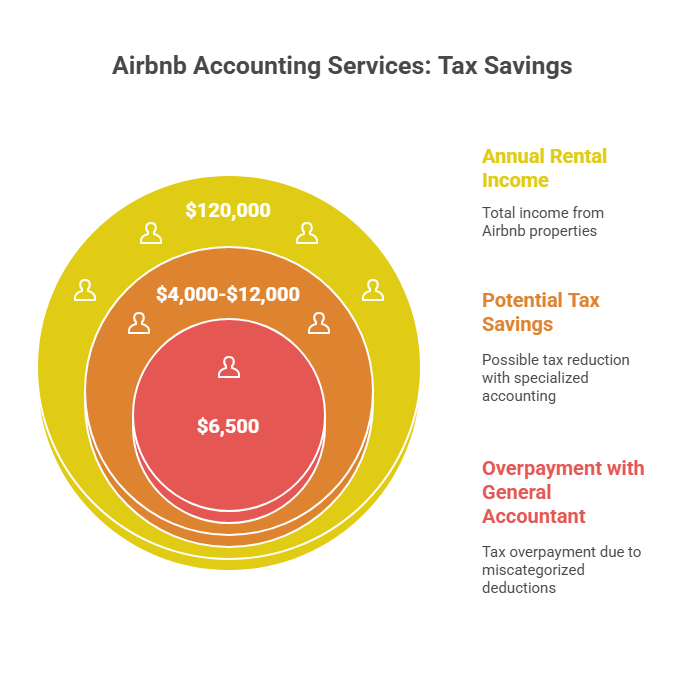
Airbnb accounting services provide specialized bookkeeping and tax management for short-term rental hosts. These services track rental income, cleaning fees, platform commissions, and occupancy taxes while categorizing deductible expenses. Professional Airbnb accountants reconcile payments from multiple platforms, ensuring accurate financial records that reduce tax liabilities by $4,000-$12,000 annually for hosts earning $75,000+ in rental income.
You manage three Airbnb properties generating $120,000 annually. Tax season arrives with transaction reports, receipts, and platform statements everywhere. Your general accountant miscategorizes $8,000 in deductions and fails to track occupancy taxes. Total overpayment: $6,500.
This happens constantly. Specialized Airbnb accounting saves 6-8 hours weekly plus thousands through proper categorization and compliance.
Airbnb businesses face unique challenges. Short-term rentals generate daily transactions, guest payments, cleaning fees, Airbnb commissions (3% host service fee), occupancy taxes. A single property might produce 100+ transactions monthly versus 1-2 for traditional rentals.
Tax treatment differs dramatically. The IRS classifies active short-term rental management (average stays under seven days with substantial services) as non-passive business income, unlocking unlimited loss deductions against W-2 income. Missing this classification costs $3,000-$8,000 annually.
Occupancy tax compliance varies by jurisdiction. LA charges 14% TOT, SF 14% + registration, NYC 14.75%. Airbnb collects in many locations, but hosts remain liable for accuracy.
Platform reconciliation demands precision. Airbnb deposits net amounts after deducting commissions and taxes. Your bank shows $2,800 while the booking generated $3,500 gross, proper accounting reconciles these differences daily.
Automated Tracking: Software integrates with Airbnb, Vrbo, and Booking.com, automatically importing reservations and payouts. Services categorize income streams and expense categories. Daily reconciliation ensures books match platform deposits, eliminating 6-8 hours of weekly spreadsheet work.
Expense Categorization: Professional bookkeeping services categorize expenses correctly, mortgage interest, property taxes, insurance, utilities, cleaning, supplies, repairs, maintenance, depreciation. The critical distinction: repairs (immediately deductible) versus improvements (depreciated over 27.5 years).
Occupancy Tax Management: Services track rates by jurisdiction, monitor Airbnb's collection status, and file required returns. In cities where Airbnb doesn't collect, accountants calculate taxes, prepare filings, and maintain documentation. This prevents $5,000-$15,000 penalties.
Financial Reporting: Monthly reports show property-level profitability, gross bookings, occupancy rates, expenses, net income. Annual P&L statements organize for Schedule E or C filing, reducing CPA time by $500-$1,500.
Traditional rental accounting tracks 1-2 monthly rent payments. Airbnb processes 10-30 separate bookings monthly, each with unique dates, cleaning fees, and adjustments, 15-20x more transactions.
Tax classification provides advantages. Traditional rentals are passive income (limiting loss deductions). Active short-term rentals with average stays under seven days escape passive loss limitations entirely. Hosts meeting material participation deduct unlimited losses against W-2 or business income.
Expense granularity differs. Long-term rentals have monthly deductions. Airbnb expenses happen daily, laundry, toiletries, supplies. Proper tracking captures $3,000-$8,000 in additional deductions annually.
Not Tracking Expenses Properly: Many hosts mix business and personal transactions. Open dedicated accounts exclusively for Airbnb. Hosts also miss deductible expenses, mileage (67 cents per mile in 2025), home office deductions, cell phone percentage, and professional services.
Misclassifying Tax Status: Not claiming short-term rental business status costs most. If you meet material participation requirements (500+ hours annually), your income qualifies as active business income, unlocking Section 199A's 20% QBI deduction plus unlimited loss deductions. Avoiding common accounting mistakes becomes critical as you scale.
Ignoring Occupancy Tax Compliance: Assuming Airbnb handles all taxes creates liability. Many jurisdictions require separate registrations even when Airbnb collects taxes. Hosts discover $10,000+ in back taxes during audits.
Portfolio Triggers: Single-property hosts earning under $40,000 might manage DIY. At 2-3 properties or $75,000+ income, professional services pay for themselves. Managing 5+ properties demands specialized accounting.
Calculate breakeven: Services costing $3,600 annually but saving $8,000 in taxes plus 300 hours equals $4,400 net benefit.
Complexity Indicators: Hire specialists for multiple cities with different occupancy taxes, multiple platforms, cleaning staff, or real estate professional status. Understanding tax compliance requirements becomes essential when quarterly payments exceed $1,000.
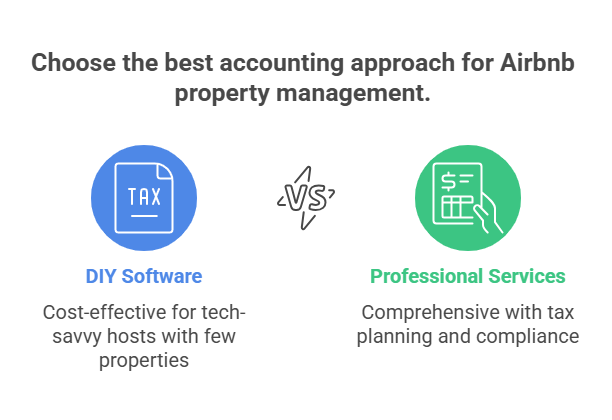
DIY Software: Platforms like Stessa and Landlord Studio offer Airbnb integration, $10-$50 monthly per property. These work for tech-savvy hosts managing 1-3 properties but don't provide tax planning, ensure compliance, or defend audits.
Professional Services: Full-service accounting costs $200-$400 monthly per property plus $800-$1,500 annually for tax prep. Includes reconciliation, occupancy tax filings, reporting, and strategic planning. The cost to outsource varies, but most hosts see 2:1 to 4:1 ROI.
Hybrid Approach: Some hosts use software for daily tracking while hiring CPAs for tax planning, reducing costs to $150-$250 monthly with professional expertise.
We've provided accounting for 150+ short-term rental properties since 2015, specializing in multi-property Airbnb hosts. Our team understands platform reconciliation, occupancy tax compliance across 30+ jurisdictions, and strategic tax planning.
We maintain automated bookkeeping integrated with Airbnb, Vrbo, and Booking.com. Clients average $7,500 in annual tax savings through proper classification and expense optimization. As an offshore partner, we provide specialized expertise at cost structures that scale with your portfolio.
Do I need an accountant for one Airbnb property?
If you earn $30,000+ annually or want to optimize tax treatment, professional guidance pays for itself. Hosts earning under $20,000 with simple operations might start with DIY software.
What's the best accounting software for Airbnb hosts?
For multi-property hosts, Stessa and Landlord Studio offer strong integration. Single-property hosts find QuickBooks Self-Employed sufficient. Pair software with annual CPA review at minimum.
Can I deduct mortgage and property taxes?
Yes. Mortgage interest and property taxes are fully deductible. If you use part of your home, deduct the percentage used for rentals. Dedicated Airbnb properties deduct 100%.
How do I handle occupancy taxes Airbnb doesn't collect?
Research local requirements, register with tax authorities, calculate owed taxes monthly, and file as required. Professional services handle this automatically.
What accounting method should Airbnb hosts use?
Most use cash-basis accounting, reporting income when received and expenses when paid. This simplifies bookkeeping and aligns with IRS requirements for small businesses.
Can I deduct cleaning supplies and linens?
Absolutely. All supplies consumed by guests, toiletries, cleaning products, linens, towels, are 100% deductible as business expenses.
Do I need separate bank accounts for each property?
Not required. One dedicated business account for all Airbnb properties works well, with accounting software tracking property-level detail.
How often should I review financial statements?
Monthly reviews identify trends and support pricing decisions. Quarterly reviews with your accountant ensure compliance. Annual-only reviews miss optimization opportunities.
Airbnb hosts managing multiple properties waste 6-8 hours weekly on manual bookkeeping while missing $4,000-$12,000 in annual tax savings. Specialized accounting automates tracking, ensures occupancy tax compliance, and optimizes tax treatment.
Start by opening a dedicated business bank account. Choose Airbnb-specific software or request proposals from professional services.
Contact Madras Accountancy to discuss how Airbnb accounting services support your short-term rental business. We'll identify immediate tax-saving opportunities tailored to your portfolio.
Section 4960's 21% excise tax now reaches far more nonprofit employees. See who is a covered employee in 2026 and what changed.

The Section 45S paid family leave credit is permanent for 2026 with new options. See who qualifies, the amounts, and how to claim it.
Opportunity zones become permanent in 2027 under the One Big Beautiful Bill. See the new deferral, rural bonus, and the 2026 handoff.



