



Bay Area real estate accounting provides specialized financial management for property investors in San Francisco, Oakland, San Jose, and Silicon Valley. These services handle California-specific tax compliance, 1031 exchanges, and Proposition 13 tracking while navigating the Bay Area's unique market dynamics. Specialized CPAs reduce tax liabilities by 35-40% on average through strategic planning addressing California's 13.3% top income tax rate and local transfer taxes reaching 3%.
You bought a duplex in Oakland for $1.2 million and a condo in SF for $850,000. Your general accountant missed California's passive loss limitations, didn't optimize cost segregation, and failed to track transfer tax implications. Total overpayment: $18,000 annually.
This plays out constantly in the Bay Area where property values and tax complexity exceed national norms.
The Bay Area presents unique accounting challenges. California imposes the nation's highest state income tax (13.3% top bracket) on rental income, plus local city taxes. Property transfer taxes range from 1.1% in San Jose to 3% in Oakland for properties above $5 million.
Proposition 13 limits annual property tax increases to 2% but creates complex basis tracking. California doesn't conform to federal tax code, bonus depreciation, Section 179 limits, and NOL deductions all differ.
Bay Area property values create outsized tax consequences. Median SF home prices hit $1.3 million, meaning depreciation and 1031 exchange decisions involve six-figure tax impacts. CPAs specializing in Bay Area real estate save clients $15,000-$35,000 annually.
Property-Level Management: Firms maintain separate books for each Bay Area property. Monthly statements show regional cost variations, $45-65 per square foot annual expenses in SF versus $30-40 in San Jose. Software integrates with Bay Area property management companies.
California Tax Compliance: CPAs file federal returns plus California-specific forms (Schedule CA, FTB 3801, FTB 3885). California requires separate calculations for virtually every federal provision. San Francisco business registration tax applies to rental activities generating $500,000+ gross receipts.
Strategic Planning: Cost segregation studies produce exceptional results due to high values. A $2 million SF building might generate $300,000-$400,000 in accelerated depreciation, saving $135,000-$180,000 in combined taxes in year one.
CPAs structure 1031 exchanges given Bay Area sale proceeds often exceed $2-3 million, creating $300,000-$600,000 capital gain exposure. Real estate professional status helps Silicon Valley employees offset rental losses against W-2 income, saving $25,000-$50,000 annually.
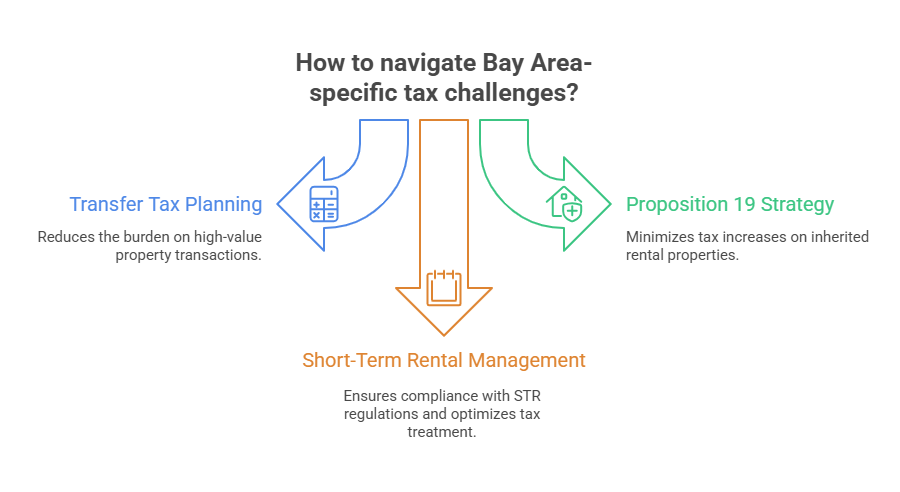
Transfer Taxes: SF charges 2.5% on properties $5-10 million, 3% above $10 million. Oakland adds 1.5-3% depending on value. On a $12 million SF property, transfer tax hits $345,000, proper planning reduces this burden.
Proposition 19: Since 2021, Prop 19 limits parent-child property transfer exclusions to primary residences below $1 million. Bay Area investors inheriting rentals face immediate reassessment, creating massive property tax increases.
Short-Term Rentals: San Francisco limits STRs to 90 days annually for non-hosted stays. Oakland requires STR permits with 12% TOT. Managing finances for high-value Bay Area properties requires tracking these regulations while optimizing tax treatment.
Regional Expertise: Look for CPAs where 50%+ of clients are Bay Area real estate investors. Ask about Prop 13 basis tracking and California conformity differences. Request references from investors with similar portfolios.
Technology: Bay Area accounting requires cloud-based systems with real-time dashboards. Integration with local property management software eliminates errors. Confirm they collaborate with Bay Area attorneys, estate planners, and 1031 intermediaries.
Pricing: Expect $300-$600 monthly per property plus $1,200-$3,000 for annual tax prep. For high net worth individuals with diverse holdings, comprehensive CFO services run $3,000-$8,000 monthly for portfolios above $10 million.
California-Federal Differences: California doesn't conform to federal bonus depreciation or Section 179 limits. Investors claiming maximum federal deductions without California adjustments face FTB audits averaging $8,000-$15,000.
Transfer Tax Neglect: Selling a $4 million Oakland property without planning wastes $100,000+ in avoidable transfer taxes.
Prop 13 Errors: Failing to track improvements creates reassessment risk. Proper documentation prevents $15,000-$40,000 annual property tax increases.
Value Thresholds: Properties below $800,000 might work with general CPAs. Above $1 million, specialized services pay for themselves. For portfolios exceeding $5 million, professional accounting becomes essential.
Specialized services cost $8,000-$15,000 more annually but save $25,000-$60,000 through Bay Area tax planning, 3:1 to 6:1 returns.
Immediate Need: Hire specialists for 1031 exchanges, multi-city Bay Area properties, sales above $2 million, or when pursuing real estate professional status with tech W-2 income. CFO advisory services become valuable when scaling portfolios aggressively.
We've provided real estate accounting for 300+ Bay Area properties since 2015, specializing in San Francisco, Oakland, San Jose, and Silicon Valley. Our team understands California tax conformity, Prop 13 complexities, and local transfer taxes.
We maintain property-level books integrated with Bay Area property management platforms. Our clients average $22,000 in annual tax savings through cost segregation, 1031 exchanges, and California-federal optimization. As an offshore accounting partner, we provide Bay Area expertise without typical San Francisco CPA premium pricing.
How does California tax treatment differ from federal for real estate?
California doesn't conform to federal bonus depreciation, limits Section 179 to $25,000 (versus $1.22 million federal), and calculates NOLs differently. These differences require separate California adjustments on virtually every rental return.
What are typical Bay Area accounting costs?
Expect $300-$600 monthly per property plus $1,200-$3,000 per annual return. A three-property Bay Area portfolio runs $12,000-$25,000 annually, typically returning 3-5x through tax savings.
Do I need separate accounting for SF, Oakland, and San Jose properties?
One specialized firm handles all Bay Area properties, tracking city-specific requirements through unified systems. Bay Area specialists manage San Francisco business tax, Oakland transfer taxes, and San Jose regulations simultaneously.
How does Prop 13 affect rental accounting?
Prop 13 limits assessed value increases to 2% annually. CPAs track basis adjustments to prevent reassessment triggers and maintain documentation for capital gain calculations. Proper tracking saves $10,000-$30,000 annually.
Should Bay Area investors use LLCs?
Most use LLCs for liability protection. However, California charges $800 minimum franchise tax per LLC annually. CPAs balance liability protection against administrative costs based on property values.
How do transfer taxes affect 1031 exchanges?
Transfer taxes apply despite tax deferral on capital gains. On a $5 million SF property, expect $125,000 in transfer taxes even with successful 1031 exchange.
Can tech employees offset rental losses?
Yes, if you qualify as a real estate professional (750+ hours annually, more than any other work). Many Silicon Valley investors meet this through active management. CPAs document hours to defend status during audits.
How often should investors meet with their CPA?
Quarterly meetings work for most, reviewing performance, estimates, and opportunities. Bay Area market volatility warrants more frequent communication during transactions. Monthly touchpoints make sense for portfolios above $10 million.
Bay Area real estate investors face tax complexity exceeding national norms. Specialized accounting expertise returns 3-5x its cost through strategic planning addressing California rates, local transfer taxes, and Prop 13 intricacies.
Request a portfolio review from Bay Area CPAs this week. Bring prior returns, property addresses, and questions.
Contact Madras Accountancy to optimize your San Francisco, Oakland, and San Jose investments with Bay Area real estate accounting expertise.

Section 4960's 21% excise tax now reaches far more nonprofit employees. See who is a covered employee in 2026 and what changed.

The Section 45S paid family leave credit is permanent for 2026 with new options. See who qualifies, the amounts, and how to claim it.

Opportunity zones become permanent in 2027 under the One Big Beautiful Bill. See the new deferral, rural bonus, and the 2026 handoff.