


Quick Answer: Colorado real estate accounting companies provide specialized services for property managers, developers, investors, and brokers including bookkeeping, tax planning, 1031 exchange coordination, cost segregation studies, and financial analysis. Firms experienced in real estate understand depreciation schedules, passive activity loss limitations, and Colorado-specific tax requirements. Monthly services typically cost $300-$800 for bookkeeping plus $500-$2,000 for annual tax preparation, with offshore partnerships reducing costs by 40%.
Colorado's real estate market demands specialized accounting expertise that general practitioners can't provide. Property depreciation schedules, 1031 exchange coordination, cost segregation opportunities, and passive activity loss limitations require accountants who understand real estate transactions daily, not once-a-year tax preparation.
Real estate accounting requires industry-specific knowledge beyond standard bookkeeping and tax preparation. Colorado's property tax rates, local transfer taxes, and state income tax treatment of rental income create complexities that generalist accountants often miss.
Depreciation dominates real estate tax strategy. Residential rental properties depreciate over 27.5 years, commercial properties over 39 years. A $550,000 Denver rental property generates $20,000 in annual depreciation deductions, $200,000 over its first decade. Cost segregation studies identify components depreciating faster, appliances, carpeting, landscaping, accelerating these deductions by $50,000-$200,000.
1031 like-kind exchanges allow investors to defer capital gains taxes by reinvesting proceeds into replacement properties. Colorado follows federal rules with no additional state requirements, but coordination demands precision. Miss the 45-day identification deadline or 180-day closing deadline by one day, and the entire transaction becomes taxable. Understanding 1031 exchange rules and state-specific requirements protects your investment strategy.
Passive activity loss limitations restrict most rental property owners to $25,000 in annual deductible losses (phasing out at $100,000-$150,000 modified AGI). Real estate professionals qualifying under IRS standards, 750+ hours annually in real estate activities, exceeding 50% of total working time, deduct unlimited losses. Proper hour tracking and documentation separate qualifying professionals from restricted investors.
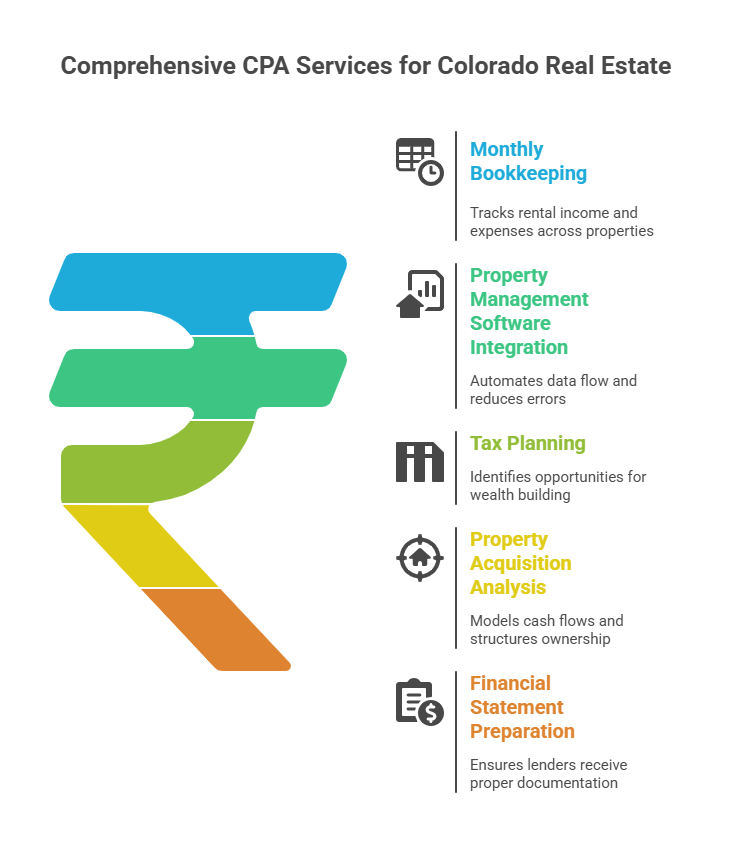
Specialized CPA firms offer monthly bookkeeping tracking rental income, security deposits, maintenance expenses, and capital improvements across multiple properties. Integration with property management software, AppFolio, Buildium, Rent Manager, automates data flow and reduces manual entry errors.
Tax planning separates reactive compliance from strategic wealth building. Proactive CPAs identify year-end opportunities: timing acquisitions for maximum depreciation, structuring entities to optimize passive activity losses, planning cost segregation for immediate deductions, and coordinating 1031 exchanges. Property acquisition analysis models projected cash flows, calculates after-tax returns, and structures ownership to minimize future taxes. Firms experienced with financial statement preparation and analysis ensure lenders receive properly formatted documentation.
Denver-area firms charge $300-$800 monthly for bookkeeping covering 3-10 rental properties, plus $100-$150 per additional property. Transaction volume matters more than property count. Annual tax preparation ranges from $500-$2,000 depending on entity complexity, sole proprietors with Schedule E pay less than multi-entity partnerships requiring Forms 1065 and K-1 preparation.
Cost segregation studies cost $3,000-$10,000 but typically generate $50,000-$200,000 in accelerated deductions. 1031 exchange coordination runs $1,500-$3,000. Offshore accounting partnerships reduce costs 40% while maintaining quality. Understanding outsourced accounting service costs and structures helps evaluate provider options.
Strategic depreciation management maximizes deductions. Beyond standard depreciation, bonus depreciation allows immediate expensing of qualifying improvements, HVAC, roofs, windows. Colorado follows federal rules, providing first-year deductions worth 60% of qualifying costs in 2024.
Entity structure optimization reduces tax burden. S-corporations reduce self-employment taxes for professionals earning $100,000+ through reasonable salary strategies. Timing strategies shift income and deductions between years, collecting December rent in January moves income forward, pre-paying January property taxes in December accelerates deductions. Working with experts in comprehensive tax planning strategies ensures optimal decisions. Opportunity Zone investments in designated Colorado census tracts defer capital gains until 2026 and eliminate taxes on appreciation after 10 years.
Experience in real estate separates advisors from processors. Ask what percentage of clients operate in real estate and request references from similar portfolios. Firms serving 50+ real estate clients understand seasonal cash flows, tenant turnover impacts, and property tax appeals that generalists miss.
Technology integration eliminates manual data entry consuming 10-15 hours monthly. Firms connecting to property management software, banks, and mortgage servicers provide real-time access enabling responsive decisions. Response time matters during time-sensitive transactions, you can't wait three days during 1031 exchanges or acquisition due diligence. Proactive communication distinguishes strategic partners from reactive processors through quarterly updates, legislative alerts, and optimization recommendations.
Offshore partnerships combine U.S. CPA oversight with offshore team efficiency, reducing costs 40% while maintaining quality. Scalability advantages emerge as portfolios grow, adding properties costs fractionally compared to hiring local staff. Time zone advantages provide extended working hours, delivering completed work by morning and accelerating month-end cycles from 10 days to 3-5 days. Specialized expertise concentrates in offshore centers where bookkeeping, tax, and analysis specialists develop deep real estate expertise. Learn about offshore bookkeeping benefits and implementation for real estate portfolios.
Since 2015, Madras Accountancy has provided comprehensive accounting services for Colorado real estate developers, property managers, investors, and brokers. Our offshore teams handle monthly bookkeeping, tax preparation, financial statement preparation, and specialized services including 1031 exchange coordination and cost segregation analysis.
We serve clients across Denver, Colorado Springs, Boulder, and Fort Collins with dedicated teams understanding Colorado's unique requirements, state income tax treatment, local property taxes, and recording fees. Our systematic approach tracks depreciation across multiple properties, maintains separate entity accounting, and ensures compliance with both federal and Colorado regulations.
Technology integration connects us directly to property management platforms, bank accounts, and loan servicers, eliminating manual data entry and accelerating month-end processes. Real-time dashboards provide instant portfolio visibility, supporting responsive investment decisions rather than backward-looking financial reports.
Colorado real estate CPA firms provide specialized services including bookkeeping, tax planning, cost segregation studies, 1031 exchange coordination, passive activity loss tracking, property acquisition analysis, and financial statement preparation. Firms experienced in real estate understand depreciation schedules, rental income reporting, and Colorado-specific tax requirements that general accountants often miss.
Monthly bookkeeping for real estate clients typically costs $300-$800 depending on transaction volume. Tax preparation ranges from $500-$2,000 for rental properties with multiple units. Specialized services like cost segregation studies ($3,000-$10,000) or 1031 exchange coordination ($1,500-$3,000) add to base fees. Offshore partnerships can reduce ongoing costs by 40% while maintaining quality.
Colorado real estate professionals deduct mortgage interest, property taxes, insurance, repairs and maintenance, property management fees, advertising costs, professional fees, home office expenses (for qualifying agents), vehicle mileage, and continuing education. Depreciation on rental properties provides substantial deductions, 27.5 years for residential, 39 years for commercial. Cost segregation accelerates these deductions significantly.
Local Colorado CPAs offer face-to-face meetings and direct state knowledge, but typically charge 40-60% more than offshore partnerships. Offshore firms like Madras Accountancy combine Colorado-licensed CPA oversight with offshore team efficiency, reducing costs while maintaining compliance. For portfolios with 5+ properties or businesses processing 100+ transactions monthly, offshore solutions provide better scalability and value.
Evaluate real estate-specific experience (ask for client count in your property type), tax planning proactivity (not just compliance), software integrations (QuickBooks, property management systems), response times, and pricing structure. Request references from similar-sized portfolios. Firms specializing in real estate understand nuances like 1031 exchanges, cost segregation, and passive activity limitations that generalists miss.
Cost segregation identifies property components that depreciate faster than the building, like carpeting, appliances, and landscaping. Instead of 27.5-year depreciation, these items depreciate over 5, 7, or 15 years, accelerating tax deductions. Properties worth $500,000+ typically benefit. Studies cost $3,000-$10,000 but often generate $50,000-$200,000 in accelerated deductions, creating immediate tax savings.
Colorado follows federal passive activity loss rules. Real estate professionals qualifying under IRS standards (750+ hours annually in real estate, more than 50% of working time) can deduct unlimited losses against other income. Others face $25,000 annual loss limits (phasing out at $100,000-$150,000 modified AGI). Proper documentation and hour tracking are essential for audit protection.
Yes. Madras Accountancy provides comprehensive real estate accounting services for Colorado property owners, developers, and CPA firms. Our offshore teams handle bookkeeping, tax preparation, 1031 exchange coordination, and cost segregation analysis at 40% lower costs than traditional firms. We've served real estate clients since 2015 with dedicated teams understanding Colorado tax requirements and compliance needs.
Successful real estate investing requires accounting partners who understand your industry's unique challenges and opportunities. Start by evaluating your current accounting relationship, does your provider proactively suggest tax strategies, or simply process historical transactions?
Madras Accountancy offers consultations for Colorado real estate professionals evaluating their accounting services. We'll review your portfolio structure, identify missed deduction opportunities, and demonstrate how specialized expertise and offshore efficiency deliver superior results at lower costs.

Section 4960's 21% excise tax now reaches far more nonprofit employees. See who is a covered employee in 2026 and what changed.

The Section 45S paid family leave credit is permanent for 2026 with new options. See who qualifies, the amounts, and how to claim it.

Opportunity zones become permanent in 2027 under the One Big Beautiful Bill. See the new deferral, rural bonus, and the 2026 handoff.