


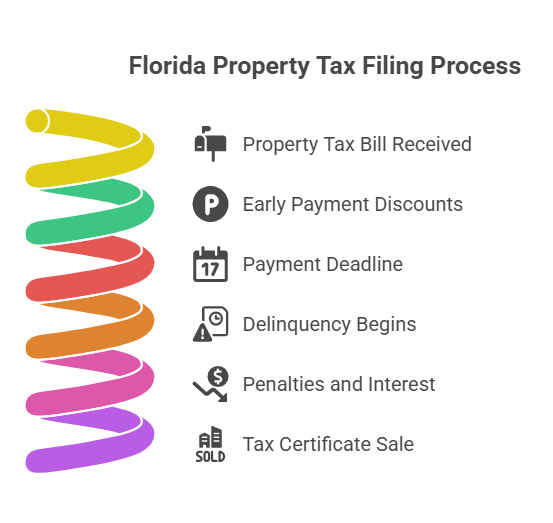
Florida property taxes become payable on November 1 each year and are due in full by March 31 of the following year. Payments not postmarked by March 31 become delinquent on April 1, triggering penalties and interest charges. Florida offers early payment discounts of 4% (November), 3% (December), 2% (January), and 1% (February) for property owners who pay before the March 31 deadline.
You just received your Florida property tax bill in November. Miss the deadline and you'll face penalties, interest, and potentially a tax certificate sale. Pay early and you could save hundreds through Florida's discount system.
Understanding Florida's property tax deadlines saves property owners an average of $400-800 annually through early payment discounts while avoiding the 3% penalty plus monthly interest on delinquent accounts. Whether you own a Miami condo, Orlando rental, or Jacksonville commercial building, knowing these critical dates protects your investment.
Florida property taxes are payable beginning November 1 when tax bills are mailed. The final deadline for payment without penalty is March 31. Any payments not received or postmarked by March 31 become delinquent on April 1, triggering a 3% penalty plus 1.5% monthly interest.
Florida property taxes are paid in arrears, taxes assessed for 2024 aren't due until November 1, 2024, and become delinquent April 1, 2025 if unpaid. According to Florida Statutes Section 197.122, taxes become "due and payable" on November 1 or when the tax collector receives the certified roll from the property appraiser.
Florida rewards early payment with graduated discounts calculated as a percentage of the total tax bill. For a $5,000 tax bill, maximum November savings reach $200.
November: 4% discount (saves $200 on $5,000 bill). December: 3% discount (saves $150). January: 2% discount (saves $100). February: 1% discount (saves $50). March: No discount. March 31 is the firm deadline, any payment not received or postmarked by this date triggers penalties. Proper tax compliance calendar management ensures you never miss Florida's critical deadlines.
On April 1, all unpaid Florida property taxes become delinquent. A 3% penalty is automatically added plus 1.5% monthly interest (18% annually). For a $5,000 tax bill, penalties and interest reach $150 in the first month and continue growing.
For delinquent real estate taxes, Florida counties conduct annual tax certificate sales beginning on or before June 1. Investors purchase tax certificates representing liens on properties with unpaid taxes. Once sold, property owners must redeem the certificate by paying the face amount plus interest (up to 18% annually) to the certificate holder. Understanding audit preparation and documentation helps if facing collection actions.
Tax certificates represent valid first liens. If not redeemed within two years, certificate holders can apply for a tax deed, potentially resulting in loss of property ownership. For delinquent tangible personal property taxes, the tax collector processes warrants in April authorizing seizure of business property.
Florida offers a property tax installment plan allowing eligible property owners to spread payments across four quarterly installments with discounts. Applications must be filed by April 30 for the following tax year.
Payment schedule: First installment due June 30 (6% discount), second installment September 30 (4.5% discount), third installment December 31 (3% discount), fourth installment March 31 (no discount). Missing any payment results in removal from the plan and full balance becomes due without discounts. Eligibility typically requires homestead exemption status.
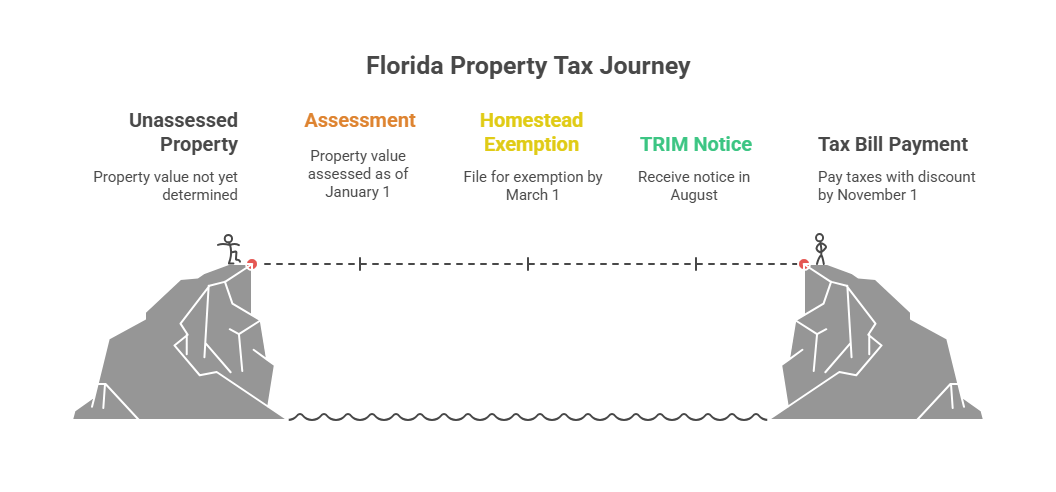
Beyond the November-March payment window, several critical property tax deadlines affect Florida property owners annually.
January 1: Assessment date. Property taxes assessed based on January 1 property value and ownership. March 1: Homestead exemption deadline. New exemptions must be filed by March 1 to apply to current year taxes. Homestead exemption reduces taxable value by up to $50,000. August: TRIM notices mailed notifying property owners of assessed values and proposed millage rates. September 18: Value appeal deadline (25 days after TRIM mailing) to file Value Adjustment Board petitions. October: Property appraisers certify final tax rolls to tax collectors. November 1: Tax bills mailed, officially beginning the payment period with 4% discount available.
Property taxes equal assessed value multiplied by the millage rate, minus exemptions. County property appraisers determine assessed values based on January 1 valuations. Florida's Save Our Homes caps annual homestead assessment increases at 3%, while non-homestead properties face increases up to 10% annually.
Millage rates represent the tax levy per $1,000 of assessed value. For example, a total millage rate of 20.5 means $20.50 per $1,000 of value. For a $300,000 property: $300,000 ÷ 1,000 × 20.5 = $6,150 annual taxes. Rates include county, school district, city (if applicable), and special districts. Maintaining accurate bookkeeping services for property records ensures proper tracking across multiple properties.
Florida businesses pay tangible personal property tax on equipment, furniture, and fixtures valued over $25,000. Business owners must file tax returns (DR-405) with the county property appraiser by April 1 listing all property owned as of January 1. Late filing incurs a 10% penalty, increasing to 15% after June 1 and 25% after September 1.
Tangible personal property tax bills are issued in November with the same discount schedule and March 31 deadline. Delinquent taxes face the same 3% penalty plus 1.5% monthly interest. The tax collector issues warrants in April authorizing seizure of business assets to satisfy tax debt.
Yes. All 67 Florida counties accept online property tax payments through their tax collector websites. Online payments typically incur a small convenience fee (2-2.5% for credit cards, $1-3 for e-checks). Online payments made by 11:59 PM on discount deadline dates qualify for that month's discount.
When March 31 falls on a Saturday, Sunday, or legal holiday, the deadline extends to the next business day for in-person payments at the tax collector's office by 5 PM. For mailed payments, the postmark date determines timeliness, payments postmarked March 31 (even if a weekend) are considered timely.
No. Unlike income taxes, Florida property taxes don't require estimated quarterly payments. However, if you have a mortgage, your lender typically collects monthly amounts into an escrow account and pays the tax collector directly when bills are due, often targeting November for the 4% discount.
Most Florida county tax collector websites offer online payment verification where you can check payment status using your property parcel number. If paying by mail, send via certified mail with return receipt to confirm delivery. Keep canceled checks or payment confirmations for your records.
Yes. Property taxes paid on real estate are deductible on federal income tax returns for taxpayers who itemize deductions (Schedule A). The total state and local tax (SALT) deduction is capped at $10,000 annually under current federal law. Professional tax planning strategies help maximize deductions while ensuring compliance.
Property taxes are typically prorated at closing between buyer and seller. Since Florida property taxes are paid in arrears for the prior year, the seller is responsible for taxes covering their ownership period, while the buyer assumes responsibility for their ownership period. Title companies handle the prorated calculation at closing.
Florida's property tax system rewards early payment with significant discounts while penalizing late payment with steep penalties. Mark these critical dates on your calendar: November 1 (bills mailed, 4% discount begins), March 1 (homestead exemption deadline), March 31 (final payment deadline), and April 1 (delinquency date).
Property owners managing multiple properties or businesses with tangible personal property should implement systematic tracking. Since 2015, Madras Accountancy has helped U.S. CPA firms and their clients manage property tax compliance, tax planning, and bookkeeping services efficiently. Our offshore accounting model delivers professional-quality tax deadline management at 40% lower costs than traditional firms, ensuring you never miss deadlines or discount opportunities.
Need help managing Florida property tax deadlines and compliance? Contact Madras Accountancy today to learn how our specialized accounting services keep your property taxes organized, compliant, and optimized for maximum savings.
Section 4960's 21% excise tax now reaches far more nonprofit employees. See who is a covered employee in 2026 and what changed.

The Section 45S paid family leave credit is permanent for 2026 with new options. See who qualifies, the amounts, and how to claim it.

Opportunity zones become permanent in 2027 under the One Big Beautiful Bill. See the new deferral, rural bonus, and the 2026 handoff.