


A Georgia real estate accounting firm specializes in helping property investors, developers, brokers, and agents maximize tax deductions through cost segregation studies, opportunity zone investments, entity structuring, and Georgia-specific tax credits. These specialized CPA services typically save Georgia real estate professionals $18,000 to $45,000 annually while ensuring compliance with state and federal regulations.
Your Atlanta real estate business is thriving, but when tax season arrives, you realize generic accountants don't understand real estate's unique challenges. You're overpaying thousands because your CPA doesn't know Georgia's opportunity zone benefits, can't optimize cost segregation, or mishandles depreciation.
Georgia's robust real estate market, with Atlanta metro values growing 6-9% annually and statewide transactions exceeding $65 billion in 2024, creates significant tax implications requiring specialized expertise. The difference between a general accountant and a qualified real estate CPA means $18,000 to $45,000 in additional annual savings.
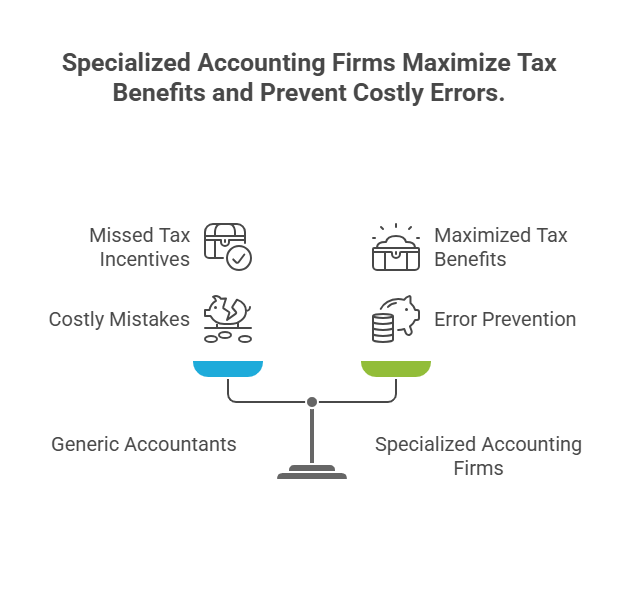
Real estate taxation in Georgia presents unique opportunities and complexities. The state offers opportunity zone tax incentives, investment tax credits, and specific depreciation strategies that generic accountants routinely miss.
Common mistakes cost Georgia investors $10,000-15,000 per property annually: failing to leverage opportunity zone benefits, misclassifying repairs versus improvements, not documenting real estate professional status, overlooking Georgia investment tax credits, and poor entity structuring. A specialized accounting firm prevents these errors while identifying strategies generic CPAs don't know exist.
Qualified Georgia CPAs provide comprehensive strategies beyond basic compliance. Services include optimizing Schedule E filing, advising on entity structure, implementing proactive tax planning strategies that reduce overall burden, and navigating multi-state compliance.
Cost segregation studies deliver exceptional ROI. Standard depreciation spans 39 years (commercial) or 27.5 years (residential). Cost segregation reclassifies 25-35% of components into 5, 7, or 15-year categories. For a $2.8 million Atlanta building, this generates $95,000-140,000 in additional first-year deductions, worth $24,000-35,000 in immediate tax savings.
Opportunity zone consulting unlocks powerful Georgia benefits. Georgia has 260 designated zones, primarily in Atlanta, Columbus, Savannah, and Augusta. Investing capital gains into Qualified Opportunity Funds allows deferral until 2026, 10% reduction of original gain, and complete elimination of appreciation after 10 years. Your CPA structures investments properly and ensures compliance.
Georgia investment tax credit guidance helps manufacturers and telecommunications companies claim credits worth 1-8% of qualified investment. Real estate developers building facilities for qualifying industries can assist tenants in maximizing these credits, enhancing property value.
State income tax ranges from 1-5.75%, significantly lower than neighboring states. For professionals generating $400,000 net income, this saves $8,000-12,000 annually. Georgia requires attention to intangible recording tax (up to $3 per $1,000 of secured debt) and real estate transfer tax ($1 per $1,000 of value).
Property taxes vary by county. Fulton (Atlanta) averages 1.08%, DeKalb 1.15%. For a $1.5 million property, this creates $16,200-17,250 annual taxes. Strategic appeals and exemptions reduce burdens. Your CPA coordinates with specialists to file timely appeals.
Pass-through entity tax (PTET) elections benefit Georgia partnerships and S-corps. By electing PTET, entities pay state tax at the entity level, allowing members to claim credits against the $10,000 federal SALT cap. This bypasses SALT limitations, saving $3,000-8,000 annually.
Single-member LLCs provide liability protection with pass-through taxation, ideal for smaller investors with 1-4 properties. Georgia charges $50 annually for LLC registration. Multi-member LLCs and partnerships offer flexibility for joint ventures with strategic tax allocations. Georgia requires partnerships to file Form 700 annually, and proper bookkeeping services ensure accurate tracking of capital accounts.
S-corporations benefit active agents and brokers. Taking W-2 salary and distributing remaining profits as dividends avoids 15.3% self-employment tax. For an Atlanta realtor earning $250,000, S-corp structuring saves $22,000-28,000 annually. Your Georgia CPA should analyze property types, income, and growth to recommend optimal structure.
Combining opportunity zones with cost segregation creates exceptional benefits. Invest deferred capital gains into opportunity zone properties, then apply cost segregation to accelerate depreciation. A $3.5 million opportunity zone development in Atlanta with cost segregation might generate $450,000 in accelerated depreciation, worth $110,000-135,000 in tax savings.
Real estate professional status combined with short-term rentals unlocks significant advantages. Properties rented for average stays under 7 days with substantial services aren't subject to passive loss limitations. Atlanta investors operating short-term rentals leverage this to shelter $75,000-150,000 in other income.
Understanding Section 179 deductions and bonus depreciation on furnishings and equipment enhances savings for furnished rentals and real estate offices.
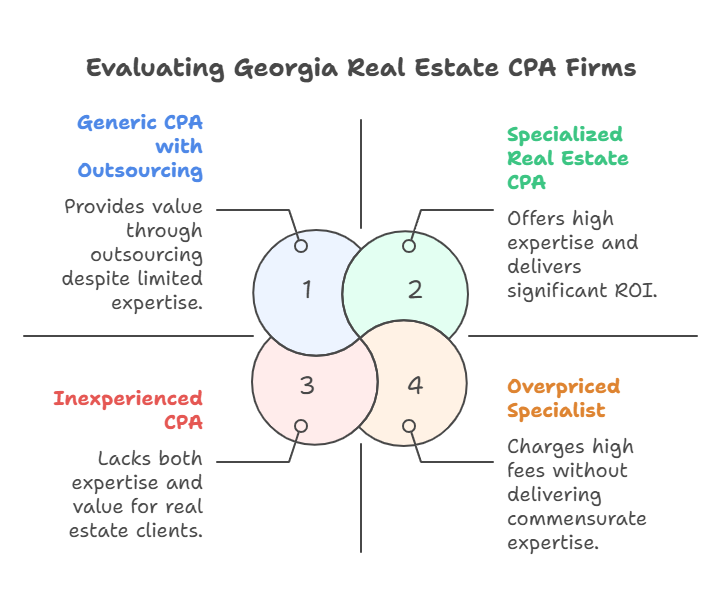
Look for CPAs with proven real estate experience (6-10 references), expertise in opportunity zones and cost segregation, familiarity with Georgia PTET and state credits, and understanding of Atlanta-area dynamics. Many top firms leverage outsourced accounting solutions for competitive pricing.
Essential questions: How many Georgia real estate clients do you serve? What's your opportunity zone experience? How do you handle PTET elections? Can you coordinate property tax appeals? What's your documentation process for real estate professional status?
Avoid CPAs offering generic advice, lacking Georgia-specific knowledge, unable to provide audit representation, or charging suspiciously low fees. Pricing: $1,800-4,000 (1-5 properties), $5,000-10,000 (6-15 properties), $12,000-30,000+ (large portfolios). Quality services deliver 4-6x ROI.
Georgia investors with specialized CPAs consistently save 35-50% more compared to generic accountants.
Typical scenario: A $2.3 million Atlanta rental generating $165,000 net income before depreciation. Standard depreciation ($60,000) creates $105,000 taxable income and a $32,000-38,000 combined tax bill.
With a specialized firm implementing cost segregation ($6,000) that reclassifies $820,000 into accelerated categories, you generate an additional $82,000 in first-year depreciation. Combined with PTET election, proper structuring, and maximized deductions, taxable income drops to $12,000-18,000. Tax liability falls to $6,000-10,000, saving $22,000-32,000 in year one. Cost segregation benefits continue 5-7 years, creating $75,000-110,000 in cumulative savings.
Opportunity zone investments provide even more dramatic benefits. Investing a $1.5 million capital gain defers $360,000-420,000 in federal taxes until 2026, reduces the original gain by 10% ($36,000-42,000), and potentially eliminates all taxes on appreciation after 10 years.
Hire immediately when you've acquired your first property, are considering opportunity zones, own 3+ properties, face an audit, or generate significant income but are uncertain about maximizing Georgia benefits. Year-round advisory generates superior results with quarterly strategy sessions, acquisition timing advice, estimated payment calculations, and legislative updates.
Smaller portfolios (1-5 properties) cost $1,800-4,000 annually. Mid-size investors (6-15 properties) pay $5,000-10,000. Large portfolios with opportunity zones run $12,000-30,000+. Specialized firms save Georgia clients $18,000-45,000 annually, delivering 4-6x ROI through Georgia-specific strategies and credits.
Georgia has 260 designated opportunity zones where investors can defer and reduce capital gains by investing in Qualified Opportunity Funds. Benefits include deferral until 2026, 10% reduction of original gain, and complete elimination of appreciation after 10 years. Your CPA structures investments and ensures compliance.
Yes, LLCs provide liability protection separating personal assets from property risks, critical for Georgia investors. Georgia charges $50 annually for LLC registration. Tax treatment remains pass-through (Schedule E) for single-member LLCs. As portfolios grow, discuss S-corp or partnership structures with your CPA.
Pass-through entity tax elections allow partnerships and S-corps to pay Georgia tax at the entity level, creating state tax credits for members that bypass the $10,000 federal SALT deduction cap. For high-income professionals, this saves $3,000-8,000 annually by effectively deducting full Georgia taxes.
Yes. As an offshore accounting partner to U.S. CPA firms since 2015, Madras Accountancy delivers specialized Georgia real estate services, tax preparation, cost segregation coordination, opportunity zone planning, and bookkeeping, at 40% lower costs while maintaining CPA-level quality and Georgia tax law expertise.
Georgia's real estate market offers tremendous wealth-building opportunities through opportunity zones, cost segregation, and state-specific incentives. Most investors overpay $12,000-40,000 annually without specialized accounting expertise.
A qualified Georgia real estate accounting firm pays for itself many times over through opportunity zone structuring, cost segregation studies, PTET elections, strategic entity planning, and year-round advisory preventing costly mistakes.
Since 2015, Madras Accountancy has helped U.S. CPA firms and their real estate clients reduce tax liabilities while maintaining full compliance. Our offshore model delivers CPA-quality services at 40% lower costs, without sacrificing expertise or results.
Ready to stop overpaying on real estate taxes? Contact Madras Accountancy today for a consultation on how our specialized Georgia real estate accounting services can save you tens of thousands this tax year.
Related read: maximize tax.

Section 4960's 21% excise tax now reaches far more nonprofit employees. See who is a covered employee in 2026 and what changed.

The Section 45S paid family leave credit is permanent for 2026 with new options. See who qualifies, the amounts, and how to claim it.

Opportunity zones become permanent in 2027 under the One Big Beautiful Bill. See the new deferral, rural bonus, and the 2026 handoff.