



The IRS treats regular house flippers as "dealers" who pay ordinary income tax (10%-37% based on 2025 tax brackets) plus 15.3% self-employment tax on profits. Unlike investors who hold property long-term, dealers cannot access capital gains rates or 1031 exchanges. The classification depends on your frequency of flips, intent at purchase, and whether flipping constitutes your primary business. This means a flipper earning $80,000 in profit pays approximately $32,000 in combined federal taxes, far more than the $12,000 an investor would pay at long-term capital gains rates.

The IRS uses dealer versus investor classification to determine how your house flipping profits are taxed. Dealers are individuals who regularly buy and sell properties as their primary business activity. The IRS treats these properties as inventory, similar to how a retailer treats products on shelves. Profits are taxed as ordinary business income.
Investors, by contrast, buy properties to hold for appreciation or rental income. They pay preferential capital gains tax rates ranging from 0%-20% depending on income level. The IRS examines several factors including frequency and continuity of sales, your intent at purchase, holding period, and whether you made improvements to increase resale value. If you flip multiple properties annually and this represents your main income source, you'll almost certainly be classified as a dealer. For real estate investors managing multiple revenue streams, understanding how to read and understand financial statements becomes essential for tracking profitability across different properties and investment strategies.
House flipping profits face two layers of taxation. First, you pay ordinary income tax at 2025 federal rates ranging from 10% to 37% based on your total taxable income. For example, single filers earning $50,000-$100,000 pay 22%, while those earning over $626,350 pay the top 37% rate.
Second, you owe 15.3% self-employment tax on net profits up to $168,600 (2025 threshold). This covers Social Security (12.4%) and Medicare (2.9%). You can deduct half of the self-employment tax as an adjustment to income. Additionally, you'll owe state income tax in most states, adding another 3%-13% depending on location. Combined federal, self-employment, and state taxes can consume 40%-55% of your flipping profits before you factor in the costs of materials, labor, and financing.
Maximizing deductions is critical to reducing your tax burden. Direct renovation costs including materials, labor, building permits, and contractor fees are fully deductible. Financing costs such as loan interest, origination fees, and points paid to lenders reduce your taxable income.
Property-related expenses during ownership include real estate taxes, insurance, utilities, and HOA fees. Professional services like legal fees, accounting costs, and real estate commissions are deductible. Vehicle expenses can be claimed at 70 cents per mile for 2025 business travel. Office expenses including rent, internet, phone, and supplies qualify if you maintain a dedicated workspace. Most costs are capitalized into the property's cost basis and deducted when sold, though operating expenses may be immediately deductible. Proper expense tracking through organized bookkeeping systems is essential, consider implementing the right accounting method for your flipping business to ensure accurate tracking and maximum deductions.
Yes. If you expect to owe $1,000 or more in taxes, the IRS requires quarterly estimated payments using Form 1040-ES. Payments are due April 15, June 15, September 15, and January 15 of the following year. Calculate your estimates based on expected annual net profit multiplied by your combined tax rate (federal income tax + self-employment tax + state tax).
For example, if you expect $100,000 in net flipping profit and face a combined 45% tax rate, you'll owe approximately $45,000 annually, or $11,250 per quarter. Underpaying quarterly taxes triggers penalties of 0.5% per month on the unpaid amount, plus interest. Many flippers struggle with cash flow timing since renovation costs occur months before sale profits arrive. Setting aside 40%-50% of each flip's profit immediately for taxes prevents year-end shortfalls.
No. The IRS explicitly prohibits using 1031 exchanges for properties held primarily for resale. Since dealers hold inventory rather than investment property, flipped houses don't qualify for this tax deferral strategy. The 1031 exchange is designed for investors who hold properties long-term for rental income or appreciation.
Attempting to use a 1031 exchange on a flip can disqualify the entire transaction and trigger immediate tax liability plus penalties. Some flippers try converting flips to rentals by holding them for 1-2 years after renovation, but this requires demonstrating clear investment intent and may not work if you flip multiple properties simultaneously. The IRS examines the totality of circumstances, not just the holding period.
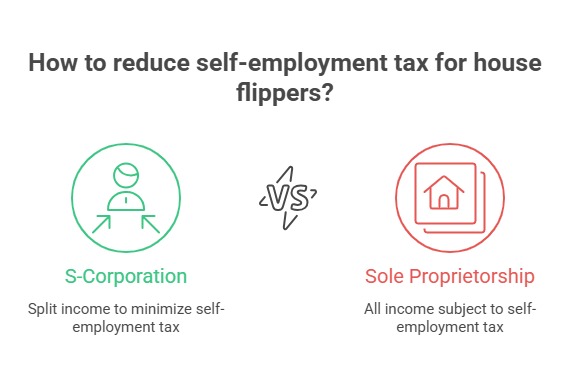
The most effective strategy is electing S-Corporation status for your flipping business. With an S-Corp, you split income between a reasonable salary (subject to self-employment tax) and distributions (avoiding self-employment tax).
For example, if you earn $100,000 annually from flips, paying yourself a $40,000 salary and taking $60,000 as distributions saves approximately $9,180 in self-employment taxes.
However, S-Corps require additional administrative work including payroll processing, quarterly payroll tax filings, and separate business tax returns. The strategy typically makes sense once you're netting $50,000+ annually. Another approach is hiring family members for legitimate work like project management, bookkeeping, or property staging. Their wages are deductible business expenses, and if they're your children under 18, they avoid Social Security and Medicare taxes. For flippers scaling their operations and considering entity structures, exploring the key differences between C Corps and S Corps helps determine the optimal tax structure for your specific situation.
Meticulous record-keeping protects you during audits and maximizes deductions. Maintain separate bank accounts for each flip to cleanly track income and expenses. Keep all receipts for materials, labor, permits, and services paid. Document vehicle mileage logs showing business travel to properties, suppliers, and contractors.
Track your time spent on each project to demonstrate active business participation. Retain purchase agreements, closing statements, renovation contracts, and sale documents for at least seven years. Use accounting software to categorize expenses by property and generate profit/loss statements for each flip. Photograph properties before, during, and after renovation to document improvement costs. The IRS can audit returns up to three years back (six years for substantial underreporting), so comprehensive records are your best defense. Professional accounting support that includes preparation for potential tax audits can save significant stress and money if the IRS questions your returns.
The IRS classifies regular house flippers as dealers, not investors. This means your properties are treated as inventory rather than capital assets. Profits are taxed as ordinary income at your regular tax bracket rate (10%-37% for 2025) plus 15.3% self-employment tax. The classification depends on factors including frequency of flips, intent at purchase, holding period, and whether flipping is your primary business activity.
House flipping profits are subject to 15.3% self-employment tax, which covers Social Security (12.4%) and Medicare (2.9%). This applies to net profits after deducting business expenses. For 2025, the Social Security portion applies to the first $168,600 of net earnings. You can deduct half of your self-employment tax (7.65%) as an adjustment to income, representing the employer's share.
Generally, no. If the IRS classifies you as a dealer who regularly flips houses, your profits are taxed as ordinary income regardless of how long you hold the property. The only way to potentially qualify for capital gains treatment is to hold the property for investment purposes (such as renting it for over a year) and demonstrate clear intent to hold rather than flip. However, this strategy requires careful documentation and may not work if you flip multiple properties annually.
House flippers can deduct direct renovation costs (materials, labor, permits), loan interest and financing fees, property taxes and insurance during renovation, utilities and maintenance, legal and accounting fees, marketing and real estate commissions, vehicle expenses (70 cents per mile for 2025), and office expenses. These costs are typically capitalized into the property's basis and deducted when sold, though some operating expenses may be immediately deductible.
Yes. If you expect to owe $1,000 or more in taxes, you must make quarterly estimated tax payments using IRS Form 1040-ES. Payments are due April 15, June 15, September 15, and January 15 of the following year. Failure to pay quarterly taxes can result in underpayment penalties. Calculate estimates based on your expected annual net profit from flips, including both income tax and self-employment tax.
No. The IRS generally prohibits using 1031 exchanges for properties held primarily for resale. Since house flippers are classified as dealers holding inventory, not investors holding capital assets, the properties don't qualify for 1031 treatment. This tax deferral strategy is reserved for long-term investment properties, not short-term flips. Using it incorrectly can disqualify the exchange and trigger unexpected tax liability.
The most effective strategy is electing S-Corporation status for your flipping business. With an S-Corp, you pay yourself a reasonable salary subject to self-employment tax, but additional profits are taken as distributions that avoid the 15.3% self-employment tax. For example, if you earn $100,000 flipping houses, paying yourself a $40,000 salary and taking $60,000 as distributions saves approximately $9,180 in self-employment taxes annually.
Yes, Madras Accountancy provides tax preparation and planning services for real estate investors and house flippers. Since 2015, we've helped investors structure their businesses to minimize tax liability, track deductible expenses, prepare quarterly estimated taxes, and file accurate tax returns. Our team understands dealer classification rules and strategies to legally reduce your tax burden while maintaining IRS compliance.
IRS rules classify regular house flippers as dealers subject to ordinary income tax rates (10%-37%) plus 15.3% self-employment tax, potentially consuming 40%-55% of profits. Unlike investors, flippers cannot access preferential capital gains rates or 1031 exchanges. Minimize your tax burden through meticulous expense tracking, quarterly estimated payments, and strategic entity structuring like S-Corporation election. Professional tax guidance is essential for navigating these complex rules and maximizing after-tax profits.
About Madras Accountancy: We've provided tax preparation and planning services to real estate investors since 2015. Our team helps house flippers minimize tax liability through proper entity structuring, expense tracking, and quarterly tax planning. Contact us to ensure your flipping business remains profitable after taxes.

Section 4960's 21% excise tax now reaches far more nonprofit employees. See who is a covered employee in 2026 and what changed.

The Section 45S paid family leave credit is permanent for 2026 with new options. See who qualifies, the amounts, and how to claim it.

Opportunity zones become permanent in 2027 under the One Big Beautiful Bill. See the new deferral, rural bonus, and the 2026 handoff.