

Direct Answer: A Nevada LLC for rental property protects your personal assets from lawsuits while offering tax advantages like no state income tax on rental income. However, you'll need to register as a foreign LLC in the state where your property is located, which adds complexity and fees. For most rental property owners, forming an LLC in your property's home state is simpler and equally protective unless you own multiple properties across several states.
Last month, a landlord in Texas called us after a tenant sued for $200,000 following a slip-and-fall accident. His personal savings, vehicles, and home were all at risk because he owned the rental property in his own name. One LLC could have prevented that exposure entirely.
If you're investing in rental properties, the structure you choose determines whether a lawsuit wipes out your net worth or simply affects one property. Nevada's reputation for business-friendly laws makes it attractive, but the reality is more nuanced than marketing materials suggest. Here's what 200+ real estate investors have learned working with our tax team since 2015.
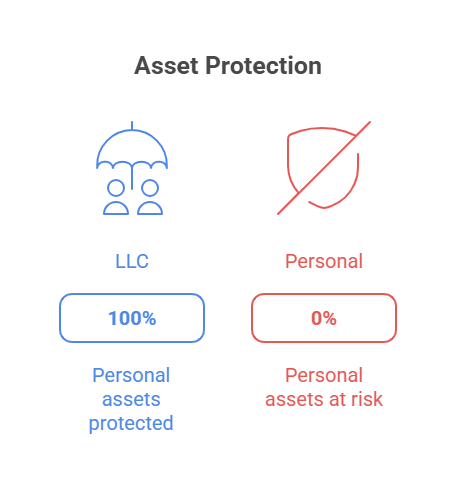
A Nevada LLC (limited liability company) is a legal business structure that separates your personal assets from your rental property. When you form an LLC, the company owns the property, not you personally. This means if a tenant sues over an injury or breach of contract, they can only pursue the LLC's assets (the rental property and its bank account), not your personal savings, home, or other investments.
Nevada specifically has become popular because it charges no state income tax, offers strong privacy protections for LLC owners, and has no franchise tax on LLCs that don't do business in Nevada. The state also allows operating agreements that provide additional asset protection through charging order protections.
Here's how it works: You file Articles of Organization with the Nevada Secretary of State ($75 filing fee), create an operating agreement, obtain an EIN from the IRS, and open a separate bank account for the LLC. The entire process takes 1-2 weeks if you handle it yourself, or 3-5 business days using expedited services.
However, there's a critical catch most property owners miss: If your rental property is located outside Nevada, you must also register as a foreign LLC in that state. This means you're paying fees in two states and maintaining compliance in both jurisdictions.
The primary draw is tax savings. Nevada has no state income tax on your rental income. If you're earning $50,000 annually from rental properties and live in California (13.3% top tax rate), that difference feels substantial. But the reality requires closer examination.
Most property owners don't actually save on taxes by using a Nevada LLC. Your rental property's location determines where you owe taxes, not your LLC's formation state. A property in Colorado generates Colorado-sourced income, which Colorado will tax regardless of where your LLC was formed. You'll still need to file Colorado tax returns and pay Colorado taxes.
The real benefits of Nevada LLCs come from three specific situations. First, if you own rental properties in multiple states, one Nevada LLC can hold them all while you register as a foreign LLC in each property's state. This centralizes your structure. Second, if you're planning estate planning strategies, Nevada's strong charging order protections provide additional creditor protection. Third, Nevada offers privacy, your name doesn't appear in public records if you use a registered agent.
For most single-property owners or investors with properties in one state, these benefits rarely justify the additional complexity and cost. You're better served by implementing proper tax planning strategies within your home state's LLC structure.
The upfront filing fee is $75 for standard processing or $125 for 24-hour expedited service with the Nevada Secretary of State. You'll also need a registered agent in Nevada ($100-300 annually), and you must file an Initial List of Managers within 30 days ($150 fee).
Annual maintenance includes Nevada's Business License renewal ($200) and the Annual List filing ($150). If your property is in another state, add that state's foreign LLC registration fee ($100-300 initially) plus annual report fees ($50-150).
Real example: A client with one rental property in Arizona formed a Nevada LLC. Total first-year costs reached $925 ($75 Nevada filing + $150 registered agent + $150 initial list + $200 business license + $200 Arizona foreign LLC + $150 Arizona annual report). An Arizona LLC would have cost $285 total.
Additionally, many property owners need professional help navigating dual-state compliance. Most CPA firms charge $500-800 annually to handle the tax filings across multiple states. We've found that unless you own properties in 3+ states, the administrative burden outweighs the benefits.
Nevada LLCs use pass-through taxation by default. Your rental income, expenses, and depreciation flow through to your personal tax return on Schedule E. The LLC itself doesn't pay federal taxes, you do. This is identical to LLCs formed in any other state.
The crucial factor is source-based taxation. States tax income generated within their borders. Your rental property in Georgia produces Georgia-sourced income, which Georgia taxes at 5.75% regardless of your LLC's home state. You cannot avoid this by forming a Nevada LLC.
Where Nevada helps: If you're a Nevada resident with Nevada rental properties, you pay zero state income tax. Compare this to California residents (up to 13.3%), New York (10.9%), or Oregon (9.9%). But if you're a California resident with California properties, you're paying California taxes no matter what.
The IRS treats all LLCs the same for federal tax purposes. You'll still report rental income, deduct mortgage interest, claim depreciation, and take advantage of the 20% qualified business income deduction if you qualify. Your single-member LLC taxation strategy remains identical whether formed in Nevada or elsewhere.
One legitimate tax advantage: Nevada has no franchise tax on passive entities. California charges an $800 minimum franchise tax annually on all LLCs. If you're a California resident who can legitimately conduct rental business through Nevada, you might save this fee, but only if you're not doing business in California, which is rare.
This is the most common question we receive. The answer depends entirely on your risk tolerance and portfolio size.
The strategy of one LLC per property provides maximum asset protection. If a tenant sues over an issue at Property A, they can only pursue assets in LLC-A. Your other properties remain protected in separate LLCs. Real estate investors with 5+ properties worth $500,000+ each often use this approach.
However, each additional LLC multiplies your costs and complexity. Three properties mean three registered agents ($300-900/year), three annual reports ($450/year), three business licenses in Nevada ($600/year), plus foreign LLC registrations in each property's state. You're looking at $2,000-3,000 annually in administrative costs before accounting for tax preparation.
The alternative is one LLC holding multiple properties. This reduces costs dramatically but increases risk exposure. If one property generates a lawsuit that exceeds your insurance coverage, all properties within that LLC could be at risk.
Most investors find the sweet spot at this threshold: properties under $300,000 in value can share an LLC, while properties above $500,000 warrant their own entities. Your insurance coverage matters too, if you carry $2 million in umbrella coverage plus property-specific policies, one LLC can be sufficient for a smaller portfolio.
An emerging option is Nevada's Series LLC structure, which allows you to create separate "series" within one LLC, each with isolated liability. However, not all states recognize series LLCs, and the tax treatment remains unclear in many jurisdictions. Unless you have 8+ properties, the administrative complexity outweighs the benefits.
The biggest disadvantage is dual-state compliance. You'll maintain good standing in Nevada while also filing foreign LLC paperwork in your property's state. Miss an annual report deadline in either state, and you risk administrative dissolution. We've seen investors lose their liability protection entirely because they missed a $150 filing deadline.
Mortgage complications present another challenge. When you transfer a rental property to an LLC, your lender may call the loan due through the "due-on-sale" clause. While most lenders don't enforce this for single-member LLCs where you're the sole owner, you'll typically need to sign a new personal guarantee anyway, which reduces your liability protection.
Getting a new mortgage in an LLC's name is even harder. Most conventional lenders require 20-25% down payments and charge 0.5-1% higher interest rates for LLC-owned properties compared to personally-owned properties. On a $300,000 rental property, that's $1,500-3,000 in additional annual interest costs.
Transfer taxes add another expense when moving an existing property into an LLC. States like Pennsylvania charge 2% of the property value as a transfer tax. On a $400,000 property, you're paying $8,000 just to get the asset protection benefits. Some states offer exemptions for transfers to single-member LLCs where you're the sole owner, but this varies by jurisdiction.
Insurance costs often increase when you switch from personal ownership to an LLC. Commercial property insurance premiums run 10-30% higher than landlord policies for individually-owned properties. However, proper liability coverage is essential regardless of structure, an LLC doesn't replace insurance, it supplements it.
Start by filing Articles of Organization with the Nevada Secretary of State online at nvsilverflume.gov. You'll need to choose a unique business name ending in "LLC," provide a Nevada registered agent address, and pay the $75 filing fee. Your LLC is officially formed once you receive your filing confirmation, typically within 1-2 business days for online submissions.
Within 30 days, you must file an Initial List of Managers with the Nevada Secretary of State ($150 fee). This lists who controls the LLC and establishes your annual renewal date. Many investors miss this deadline, which triggers penalties and potential administrative dissolution.
Next, apply for an EIN (Employer Identification Number) through the IRS website. This is free and takes 10 minutes. You'll need this number to open a bank account and file tax returns. Even if you have no employees, your LLC needs its own EIN, you cannot use your personal Social Security number.
Create an LLC operating agreement even though Nevada doesn't require one. This internal document establishes ownership percentages, management structure, and procedures for adding members or dissolving the LLC. Without this, Nevada's default statutory rules apply, which may not match your intentions. A basic operating agreement template costs $50-200, or your attorney can draft a custom version for $500-1,500.
Open a separate business bank account for your LLC. Never mix personal and LLC funds, this is called "piercing the corporate veil" and can eliminate your liability protection entirely. Every rent payment should deposit into the LLC account, and every property expense should pay from it.
If your rental property is located outside Nevada, file foreign LLC registration in that state within 30-90 days (deadlines vary by state). This legitimizes your LLC's ability to own property and conduct business in that jurisdiction. Costs range from $100-300 depending on the state.
Finally, update your property deed to transfer ownership from your personal name to the LLC. This requires a quitclaim deed or warranty deed filed with your county recorder's office. Many investors work with a real estate attorney for this step ($300-800) to ensure proper title transfer. Before transferring, notify your mortgage lender and get written consent to avoid triggering the due-on-sale clause.
For most rental property owners, forming your LLC in the state where your property is located makes more sense than Nevada. You'll pay one set of fees, maintain one compliance schedule, and avoid foreign LLC registration entirely.
Consider actual numbers: A rental property owner in Colorado with one property faces annual costs of $10 (Colorado LLC renewal) plus $50-100 (registered agent if desired). Compare this to a Nevada LLC registered as a foreign LLC in Colorado: $200 (Nevada business license) + $150 (Nevada annual list) + $150 (registered agent) + $50 (Colorado foreign LLC renewal) = $550 annually. That's $540 more per year with zero additional benefits.
Nevada makes strategic sense in three specific scenarios. First, if you own properties in multiple states, one Nevada LLC can serve as a holding company with foreign registrations in each property state. Second, if you're a Nevada resident with Nevada properties, you benefit from no state income tax on rental income. Third, if privacy is a priority and you're willing to pay for it, Nevada's anonymous LLC structure protects your identity from public records.
Some states offer competitive advantages over Nevada. Wyoming charges just $60 for LLC formation and $60 annually, significantly cheaper than Nevada's $200 annual business license. Delaware provides strong legal precedent and a specialized business court system. Choosing the right state for property taxes matters more than choosing the right LLC formation state in most cases.
The key question is whether your portfolio justifies the complexity. If you own 1-2 properties in the same state, form your LLC there. If you own 5+ properties across 3+ states, a Nevada holding company structure might streamline your operations. The crossover point where Nevada makes financial sense is roughly 3 properties in 3 different states, assuming each property generates $30,000+ in annual net income.
Yes, but you must register your Nevada LLC as a foreign LLC in the state where your property is located. This means paying fees and maintaining compliance in both Nevada and your property's state. Most property owners find it simpler and cheaper to form an LLC directly in the state where the property is located.
Nevada requires a $200 Business License renewal and a $150 Annual List filing each year, totaling $350. Add $100-300 for a registered agent service. If your property is in another state, you'll also pay that state's foreign LLC annual fees ($50-150). Total annual costs typically run $500-800 for out-of-state property owners.
No. All LLCs use pass-through taxation for federal purposes, regardless of formation state. Your rental income, expenses, and depreciation flow through to your personal tax return on Schedule E. Nevada's lack of state income tax only benefits Nevada residents with Nevada properties, you still owe taxes in the state where your rental property is located.
It depends on your portfolio value and risk tolerance. Separate LLCs provide maximum asset protection (one property's lawsuit can't affect others) but multiply costs and complexity. Properties worth under $300,000 can typically share one LLC if you carry adequate insurance. Properties above $500,000 often warrant their own entities. Most investors balance protection with practicality based on total portfolio value.
Nevada assesses late fees and can administratively dissolve your LLC after extended non-compliance. Once dissolved, you lose liability protection, lawsuits can reach your personal assets. The Annual List is due on your LLC's anniversary month ($150), and the Business License renewal is due annually ($200). Set calendar reminders for both to maintain good standing.
Yes, but it's more difficult and expensive. Most conventional lenders require 20-25% down payment for LLC-owned properties and charge 0.5-1% higher interest rates. You'll typically need to personally guarantee the loan anyway, which reduces your liability protection. Many investors purchase properties personally, then transfer to an LLC after closing with lender consent.
Not required, but recommended for complex situations. Basic LLC formation is straightforward ($75-125 filing fee online), but proper setup requires an operating agreement, EIN application, bank account setup, and potentially a property deed transfer. Attorneys charge $500-1,500 for full-service formation. Understanding key compliance deadlines helps you stay organized whether you DIY or hire professionals.
No. An LLC provides limited liability protection, meaning your personal assets are generally protected from business debts and lawsuits against the LLC. However, you remain personally liable for your own negligence or illegal actions. An LLC doesn't replace adequate property insurance, you need both. Most successful landlords carry $1-2 million in umbrella coverage in addition to LLC protection.
A Nevada LLC works best for investors with multi-state portfolios who value privacy and want centralized management across properties. For most rental property owners with 1-3 properties in the same state, you'll save money and complexity by forming an LLC in your property's home state instead.
The decision hinges on your specific situation: portfolio size, property values, risk tolerance, and whether you're willing to maintain dual-state compliance. Run the actual numbers, formation costs, annual fees, tax preparation, and insurance, before deciding. In our experience working with 200+ real estate investors since 2015, roughly 15% find Nevada advantageous, while 85% benefit more from local LLC formation.
Whatever structure you choose, proper setup and ongoing compliance are critical. An LLC without a separate bank account, operating agreement, or current registration provides zero protection when you need it most. If you're managing rental properties across multiple states and need expert guidance on tax-efficient structuring, our team at Madras Accountancy can help you evaluate whether Nevada or another jurisdiction makes strategic sense for your portfolio.

Section 4960's 21% excise tax now reaches far more nonprofit employees. See who is a covered employee in 2026 and what changed.

The Section 45S paid family leave credit is permanent for 2026 with new options. See who qualifies, the amounts, and how to claim it.

Opportunity zones become permanent in 2027 under the One Big Beautiful Bill. See the new deferral, rural bonus, and the 2026 handoff.