



An Oregon real estate CPA firm specializes in accounting, tax planning, and financial advisory services specifically designed for property investors, developers, property managers, and real estate professionals operating in Oregon. These firms understand Oregon's unique tax landscape, including the state's property tax limitations under Measure 5 and Measure 50, transit taxes, and commercial activity tax considerations that impact real estate businesses. This expertise matters because real estate transactions involve complex tax treatment, entity structuring decisions, and compliance requirements that general accountants often miss.
Oregon real estate professionals face unique challenges: Portland's arts tax, Metro's supportive housing services tax, varying local option levies across counties, and Oregon's graduated income tax rates up to 9.9%. Whether you're flipping properties in Hillsboro, managing apartment complexes in Portland, or developing commercial projects in Bend, specialized CPA guidance determines whether your deals generate profit or create unexpected tax liabilities. Here's what you need to know about working with a real estate-focused CPA firm in Oregon.
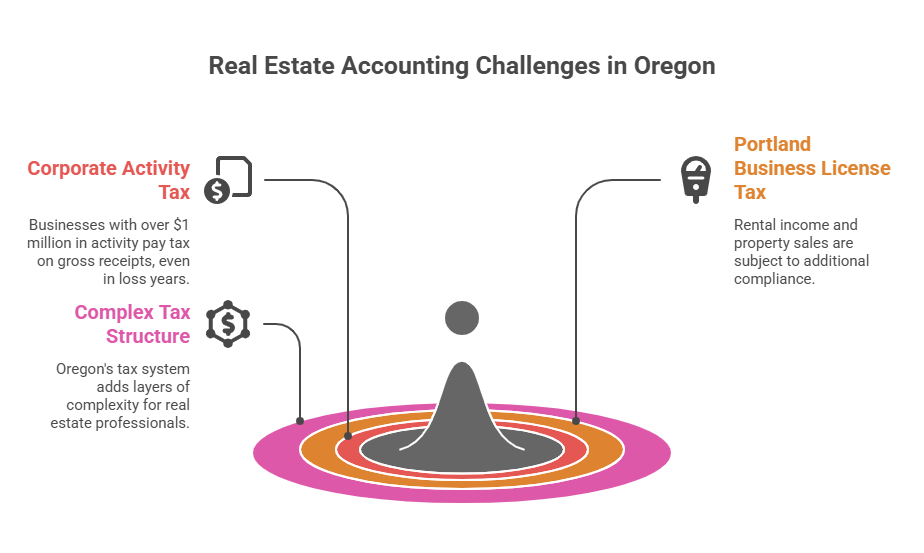
Real estate accounting requires tracking property-level income and expenses, handling depreciation schedules spanning decades, managing 1031 exchanges, and navigating partnership distributions for syndicated deals. Unlike retail or service businesses with straightforward income recognition, real estate involves capital improvements versus repairs, cost segregation studies, and passive activity loss limitations that significantly impact tax liability.
Oregon adds state-specific complexity through its tax structure. The state imposes Corporate Activity Tax (CAT) on businesses with over $1 million in commercial activity, calculated on gross receipts, not profit. For real estate developers and property management companies, this means tax liability even in loss years. Portland's business license tax applies to both rental income and property sales, creating additional compliance requirements missed by CPAs unfamiliar with Oregon's layered tax environment.
Real estate professionals also deal with unique entity structuring needs. Most investors hold properties in LLCs for liability protection, but Oregon charges $100 annual LLC fees that multiply quickly across multiple properties. CPAs specializing in real estate help clients determine when single-member LLCs make sense, when to consolidate properties under one entity, and how to structure partnerships for syndication deals while maintaining favorable tax treatment.
Depreciation presents another specialized area. Residential rental properties depreciate over 27.5 years, commercial over 39 years, but cost segregation studies can accelerate depreciation on components like flooring, electrical, and landscaping. A $2 million apartment building might generate $150,000 in first-year depreciation instead of $72,000 through proper cost segregation, tax savings of $20,000+ annually for high-income investors. Real estate CPAs coordinate these studies and ensure compliance with IRS regulations.
Real estate CPAs develop strategies that minimize tax liability across federal, state, and local levels while ensuring compliance with Oregon Department of Revenue requirements. This involves timing income recognition, maximizing deductions, structuring transactions favorably, and planning for major events like property sales or estate transitions.
Oregon's graduated income tax system reaches 9.9% for income over $125,000 (single filers). Real estate investors generating substantial rental income or capital gains need proactive planning to manage their tax bracket. CPAs help clients time property sales across tax years, utilize installment sales to spread income, and structure 1031 exchanges to defer capital gains, strategies requiring months of preparation, not last-minute filing adjustments.
For property managers and real estate brokerages, understanding comprehensive tax planning strategies helps minimize quarterly estimated tax payments while avoiding underpayment penalties. Oregon requires estimated payments if you expect to owe $1,000+ in state tax. Real estate professionals with variable income, large commissions one quarter, slow sales the next, need quarterly projections to optimize cash flow while staying compliant.
Real estate professionals qualifying as real estate professionals under IRS guidelines can deduct rental losses against W-2 income, avoiding passive activity loss limitations. This requires 750+ hours annually in real estate activities and material participation in rental operations. CPAs document these hours, structure activities to meet requirements, and handle the complex reporting that saves high-income investors $15,000-$50,000 annually in tax.
Portland's specific tax environment adds another layer. The city's business license tax applies to gross receipts, with rates varying by business type. Property management companies pay different rates than real estate brokerages. The Metro supportive housing services tax charges 1% on high-income earners ($125,000 for individuals, $200,000 for joint filers) and 1% on businesses with $5 million+ in gross receipts. Real estate CPAs factor these local taxes into overall planning, preventing surprises at tax time.
Specialized real estate CPA firms offer property-level accounting, tax preparation for multiple entities, transaction structuring advice, entity formation guidance, financial reporting for investors or lenders, and strategic advisory for portfolio growth. The best firms go beyond compliance, providing insights that drive investment decisions and operational improvements.
Monthly or quarterly bookkeeping at the property level reveals which investments perform and which drain resources. Real estate investors often discover they're subsidizing one property with profits from others, impossible to identify without proper accounting. CPAs set up systems tracking income and expenses by property, generating reports showing cash flow, operating margins, and return on investment for each asset.
Transaction support makes a significant difference in deal outcomes. Before purchasing an investment property, CPAs analyze projected returns, identify tax implications, recommend entity structures, and model various financing scenarios. A $500,000 fourplex purchase might generate 8% cash-on-cash return with traditional financing but 12% using different entity structures and tax strategies. This analysis happens before closing, not after discovering suboptimal structures.
For firms managing complex portfolios or growing rapidly, outsourcing accounting functions provides dedicated expertise without the overhead of full-time staff. This approach works particularly well for property management companies processing hundreds of monthly transactions or developers juggling multiple projects simultaneously.
Year-end tax planning sessions should occur in October or November, leaving time to implement strategies before December 31. CPAs review projected income, identify opportunities for accelerated depreciation, suggest timing for property sales or purchases, and coordinate with financial advisors on retirement contributions or other tax-advantaged moves. Waiting until January means missing opportunities that required fourth-quarter action.
Section 1031 exchanges let real estate investors defer capital gains tax by reinvesting proceeds into like-kind property. Oregon real estate CPAs coordinate the 45-day identification period, 180-day closing deadline, qualified intermediary selection, and proper documentation to ensure exchanges meet IRS requirements and defer both federal and Oregon state capital gains.
Oregon's capital gains tax mirrors federal treatment, gains are taxed as ordinary income at rates up to 9.9%. Selling a property with $400,000 in appreciation creates $39,600 in Oregon tax plus federal liability. A properly executed 1031 exchange defers this tax indefinitely, allowing investors to reinvest the full proceeds into larger properties, building wealth faster through compounding.
The exchange process requires precision. Investors have 45 days from sale closing to identify replacement properties, a tight timeline in competitive markets. CPAs help clients identify backup properties, understand the three-property rule (any three properties regardless of value), 200% rule (unlimited properties up to 200% of relinquished property value), and 95% rule. Missing identification deadlines disqualifies the exchange, triggering immediate tax liability.
Partial exchanges happen when investors need cash from a sale. If you sell a $1 million property and only reinvest $900,000, the $100,000 difference ("boot") is taxable. CPAs model various scenarios, showing tax implications of taking cash versus using mortgage refinancing before or after the exchange to access funds without triggering tax. These strategies require coordinated timing between sale, exchange, and financing.
Oregon doesn't have special state-level exchange programs, but CPAs ensure clients don't inadvertently create Oregon-specific issues. For instance, exchanging into out-of-state property requires understanding how that affects Oregon tax filing requirements. Selling Oregon rental property and buying California property doesn't eliminate Oregon tax obligations on the gain, proper planning addresses multi-state implications before executing transactions.
Property management companies need trust accounting systems, proper segregation of owner funds versus management fees, accurate 1099 reporting for contractors and owners, sales tax compliance for taxable services, and financial reporting that satisfies both owners and lenders. Oregon law requires specific trust account handling that creates liability if mismanaged.
Trust accounting represents the highest-risk area for property managers. Oregon requires property managers to deposit all owner funds, rent, security deposits, tenant charges, into separate trust accounts within one banking day of receipt. Commingling trust funds with operating accounts violates Oregon Real Estate Agency rules and creates serious liability. CPAs set up proper trust accounting systems, reconcile accounts monthly, and ensure compliance with three-way reconciliation requirements.
Property management companies must issue 1099-NEC forms to property owners receiving $600+ in annual net proceeds. This seems straightforward but becomes complex when management fees, repairs, and other expenses reduce the owner's net below $600, requiring judgment on whether a 1099 is needed. Additionally, contractors performing repairs need 1099s if paid $600+ annually. CPAs track these thresholds, prevent missing required forms (triggering penalties), and handle backup withholding when contractors don't provide W-9s.
For property management firms with employees handling maintenance or leasing activities, understanding efficient payroll processing across multiple locations prevents compliance issues. Oregon's paid leave program, local income taxes in various jurisdictions, and workers' compensation requirements create complexity that grows with staff headcount.
Some property management services, like pest control, landscaping, or cleaning performed directly, might trigger sales tax obligations in specific situations. While most property management fees aren't subject to Oregon sales tax (Oregon doesn't have general sales tax), certain taxable services exist. CPAs help managers identify which activities create reporting obligations and ensure proper classification.
Investors should engage real estate CPAs when acquiring their first rental property, before major transactions, when holding 3+ properties, if generating $100,000+ in annual rental income, when considering real estate professional status, or when facing IRS audit. The complexity and tax implications of real estate investments justify specialized expertise even for smaller portfolios.
First-time rental property buyers need entity structuring guidance before closing. Holding property in your personal name versus an LLC creates different liability protection and tax consequences. Oregon charges $100 annual LLC fees, so the decision involves weighing liability protection against ongoing costs. CPAs analyze your specific situation, income level, other assets, property type, to recommend appropriate structures rather than generic advice.
Investors crossing 3-4 properties reach complexity where DIY bookkeeping becomes counterproductive. You're spending 10-15 hours monthly on data entry instead of finding deals or managing properties. Property-level accounting, depreciation schedules, and multi-entity tax returns justify professional help. The 5-8 hours you save monthly, redirected toward investment activities, typically generates more value than CPA costs.
Real estate investors generating substantial income, $100,000+ annually across their portfolio, face tax planning opportunities that dwarf CPA fees. Strategies like cost segregation studies, entity restructuring, or maximizing deductions easily save $10,000-$30,000 annually in tax. At this income level, not working with a specialized CPA means leaving significant money on the table.
When facing IRS audit or Oregon Department of Revenue examination, having an experienced CPA becomes essential. Real estate audits often focus on depreciation claims, passive activity losses, or improper expense deductions. CPAs represent clients during audits, produce organized documentation, and negotiate with examiners, preventing costly mistakes and unnecessary tax assessments. Understanding proper audit preparation procedures minimizes stress and ensures favorable outcomes.
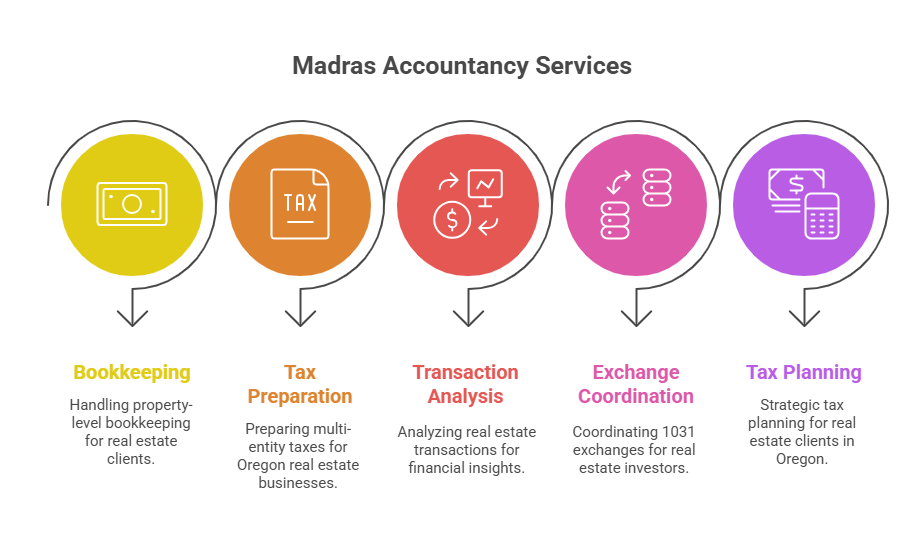
Madras Accountancy provides specialized real estate accounting services for Oregon investors, developers, property managers, and real estate professionals. We handle property-level bookkeeping, multi-entity tax preparation, transaction analysis, 1031 exchange coordination, and strategic tax planning for clients across Portland, Bend, Eugene, and throughout Oregon.
Our team understands Oregon's unique tax environment, from Portland's local taxes to statewide CAT implications for larger portfolios. We work with clients holding 2-50 properties, managing everything from single-family rentals to commercial developments. Monthly financial reporting shows property-level performance, consolidated portfolio views, and key metrics investors need for decision-making.
We coordinate with qualified intermediaries on 1031 exchanges, ensuring documentation meets IRS requirements and timelines are met. Our tax planning approach focuses on minimizing combined federal and Oregon tax liability, not just compliance. We proactively identify opportunities for cost segregation, entity restructuring, or strategic timing of transactions that reduce your tax bill by thousands annually.
For property management companies, we provide trust accounting systems, proper 1099 reporting, financial reporting for property owners, and compliance support that protects your license and reduces liability. Our offshore partnership model delivers CPA-supervised work at costs significantly below traditional firms, allowing us to serve mid-sized portfolios that larger firms consider too small and providing better value than local practices charging premium rates.
Real estate CPA fees vary based on portfolio complexity. Single-property investors might pay $800-$1,500 annually for tax preparation. Investors with 3-5 properties typically spend $2,000-$4,000 for monthly bookkeeping and tax preparation. Larger portfolios (10+ properties) or property management companies might invest $5,000-$15,000 annually for comprehensive services including monthly accounting, tax planning, and advisory. Most firms offer monthly retainer arrangements spreading costs throughout the year rather than lump-sum fees.
General CPAs handle basic tax returns but often miss real estate-specific opportunities like cost segregation studies, proper passive activity loss treatment, or optimal entity structuring for multi-property portfolios. Real estate CPAs understand Section 1031 exchanges, real estate professional status qualification, and property-specific depreciation rules that general practitioners encounter infrequently. The difference often shows in tax savings, specialized CPAs typically identify $5,000-$20,000+ in annual tax reductions for mid-sized portfolios that general accountants miss.
Yes, experienced real estate CPAs handle multi-state portfolios, preparing tax returns in multiple jurisdictions and coordinating state-specific requirements. However, they typically partner with local CPAs or use national tax software to ensure compliance with each state's unique rules. For Oregon residents owning out-of-state properties, your CPA files non-resident returns in property states and claims credits on your Oregon return for taxes paid elsewhere, preventing double taxation.
Absolutely. Pre-purchase consultation costs $300-$800 but saves thousands by identifying optimal entity structure, analyzing deal economics accurately, and planning tax strategy before closing. CPAs model projected returns, explain tax implications, recommend financing structures, and help you avoid costly mistakes like buying in your personal name when an LLC makes more sense or missing passive loss limitations that affect your tax benefit assumptions.
CPAs determine if your real estate activities trigger CAT requirements (businesses with $1 million+ in commercial activity), calculate quarterly payments, identify available subtraction, and ensure proper reporting. For property management companies and developers, CAT applies to gross receipts, potentially creating tax liability even during loss years. Proper planning involves timing transactions, understanding which receipts qualify for exclusion, and coordinating with your overall tax strategy.
Maintain all income documentation (rent payments, late fees), expense receipts (maintenance, repairs, insurance, property taxes), mortgage statements, tenant lease agreements, and security deposit records for at least seven years. Oregon requires property managers to retain trust account records for six years. For depreciation purposes, keep closing documents, improvement invoices, and cost segregation studies until seven years after you sell the property, as these affect capital gains calculations.
Only if you qualify as a real estate professional under IRS rules, requiring 750+ annual hours in real estate activities and more time in real estate than any other business activity. If you don't qualify, rental losses are passive and can only offset passive income, not W-2 wages or business income. However, you can deduct up to $25,000 in passive losses if your adjusted gross income is below $100,000, phasing out completely at $150,000. CPAs help you determine eligibility and document qualifying activities.
No, real estate CPAs typically handle both since your personal return includes rental income from Schedule E. Separating these creates inefficiency and potential inconsistencies. Your real estate activities flow through to your personal return (Form 1040), so one CPA managing both ensures integrated tax planning, considers your overall tax picture, and coordinates timing strategies across all income sources.
Madras Accountancy delivers specialized CPA services for Oregon real estate investors, property managers, developers, and real estate professionals. Our team combines deep real estate expertise with efficient offshore delivery, providing premium service at competitive rates. We handle monthly accounting, multi-entity tax preparation, 1031 exchange coordination, and proactive tax planning that reduces your liability while ensuring compliance with Oregon's complex tax environment. Schedule a consultation to discuss how we support your real estate goals and streamline your accounting operations.

Section 4960's 21% excise tax now reaches far more nonprofit employees. See who is a covered employee in 2026 and what changed.

The Section 45S paid family leave credit is permanent for 2026 with new options. See who qualifies, the amounts, and how to claim it.

Opportunity zones become permanent in 2027 under the One Big Beautiful Bill. See the new deferral, rural bonus, and the 2026 handoff.



