


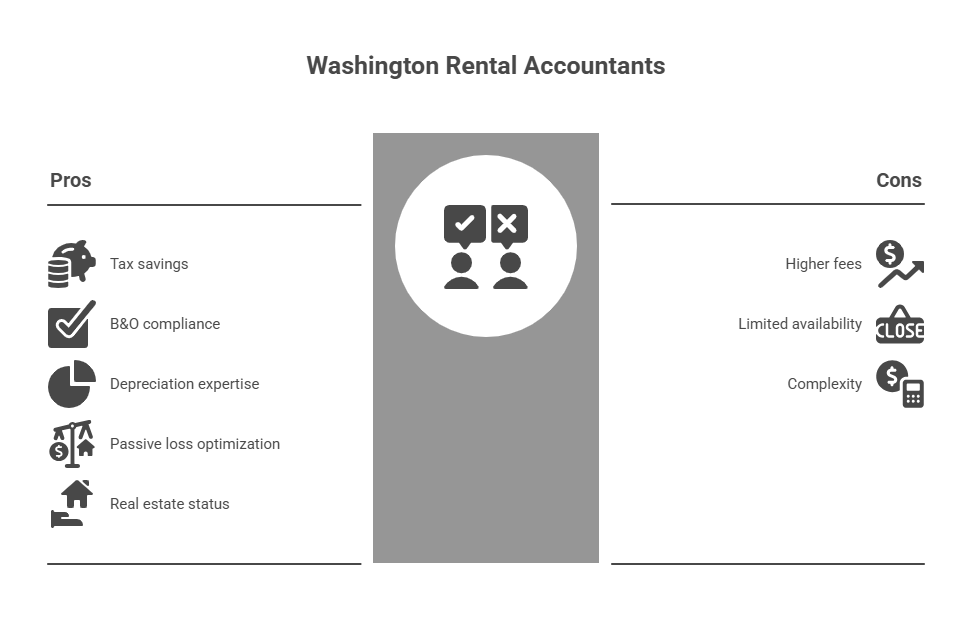
Washington rental property accountants specialize in helping landlords and real estate investors maximize tax deductions through depreciation strategies, cost segregation studies, passive loss optimization, and Washington B&O tax compliance. These specialized CPAs typically save Washington property owners $12,000 to $35,000 annually while navigating the state's unique tax environment including no income tax but complex B&O and excise tax requirements.
Your Seattle rental properties generated $180,000 last year, but tax season reveals you're overpaying by thousands. Your general accountant doesn't understand Washington's B&O tax, can't maximize depreciation, or misses real estate professional status documentation. You're leaving $10,000-20,000 on the table.
Washington's unique tax structure, no state income tax but B&O tax on rental activities, high property values averaging $800,000+ in Seattle/Bellevue, and complex passive loss rules, demands specialized expertise. The difference means $12,000 to $35,000 in additional annual tax savings.
Washington rental property taxation differs dramatically from other states. While no state income tax creates advantages, landlords face B&O tax on short-term rentals, real estate excise tax (1.28% in King County), and complex federal compliance around depreciation and passive activities.
Common mistakes cost Washington landlords $8,000-15,000 per property annually: misunderstanding B&O tax for short-term rentals, failing to implement cost segregation, not documenting real estate professional status, overlooking rental expense deductions, and poor entity structuring. Specialized accountants prevent these errors.
Qualified accountants deliver comprehensive strategies beyond Schedule E filing. Services include optimizing rental expense tracking, advising on LLC versus S-corp structure, implementing proactive tax planning strategies, and handling B&O tax compliance for short-term rentals.
Cost segregation studies provide exceptional ROI. Standard depreciation spans 27.5 years. Cost segregation reclassifies 25-40% of components into 5, 7, or 15-year categories. For a $750,000 Seattle rental, this generates $90,000-130,000 in additional first-year deductions, worth $22,000-32,000 in immediate federal tax savings.
Real estate professional status qualification (750+ hours annually in real estate) unlocks unlimited loss deductions against other income, bypassing the $25,000 passive loss limitation. Your accountant documents qualifying hours and defends status during audits.
Washington B&O tax compliance is critical for short-term rentals. Rentals under 30 days face B&O tax (typically 0.471% in Seattle) plus sales tax collection. Long-term rentals (30+ days) generally avoid B&O tax. Your accountant determines classification, registers you with Washington Department of Revenue, and manages quarterly filing requiring accurate bookkeeping services.
No state income tax means rental income isn't taxed at the state level, a massive advantage over California (9-13%) or Oregon (5-9.9%). For landlords generating $150,000 net rental income, this saves $7,500-19,500 annually compared to neighboring states.
However, Washington imposes B&O tax on short-term rental gross receipts. For Seattle Airbnb operators generating $100,000, B&O tax costs approximately $471 annually plus sales tax collection (10.35%) complexity. Real estate excise tax (REET) in King County totals 1.78% of sale price. For a $900,000 sale, REET costs $16,020, strategic 1031 exchanges defer this burden.
Property taxes vary by location. King County averages 0.92%, Pierce County 1.08%. For a $750,000 rental, this creates $6,900-8,100 annual property taxes, fully deductible against rental income.
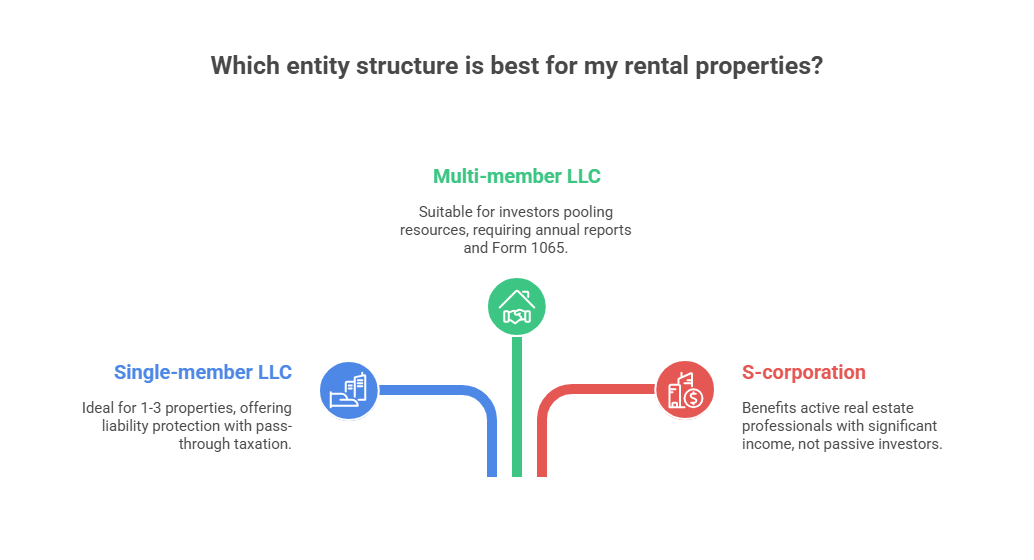
Single-member LLCs provide liability protection with pass-through taxation, ideal for 1-3 properties. Washington charges $60 formation plus $71 annual reports. Multi-member LLCs suit investors pooling resources, requiring annual reports and Form 1065 filing. S-corporations rarely benefit passive rental investors but help active real estate professionals with significant income.
Combining cost segregation with bonus depreciation creates powerful first-year deductions. With 60% bonus depreciation in 2024, a $900,000 Bellevue rental with cost segregation might generate $400,000 in accelerated depreciation, worth $100,000-120,000 in tax savings.
Short-term rental strategies with material participation bypass passive loss limitations. Properties rented for average stays under 7 days with substantial services aren't subject to passive rules. Seattle investors operating furnished short-term rentals leverage this to shelter $50,000-100,000 in W-2 income. Understanding Section 179 deductions and bonus depreciation on furnishings enhances savings.
Look for CPAs with proven rental experience (5-8 references), expertise in cost segregation and B&O tax, familiarity with Seattle/Tacoma markets, and IRS passive activity knowledge. Many top accountants leverage outsourced accounting solutions for competitive pricing.
Essential questions: How many Washington rental clients do you serve? What's your cost segregation experience? How do you handle B&O tax for short-term rentals? Can you document real estate professional status? What's your depreciation maximization process?
Pricing ranges from $1,200-2,800 (1-3 properties) to $3,500-7,000 (4-10 properties) to $8,000-18,000 (large portfolios). Quality services deliver 4-7x ROI through identified savings.
Washington rental property owners working with specialized accountants consistently save 30-45% more compared to self-filing or using general CPAs.
Typical scenario: A $725,000 Seattle rental generating $48,000 net income before depreciation. Standard depreciation ($26,400) creates $21,600 taxable income and a $5,400-6,500 federal tax bill.
With a specialized accountant implementing cost segregation ($5,500) that reclassifies $290,000 into accelerated categories, you generate an additional $58,000 in first-year depreciation. Combined with proper expense maximization, real estate professional status documentation, and strategic planning, taxable income becomes negative ($10,000-15,000). These losses offset other income, creating tax savings of $7,500-10,000 in year one. Cost segregation benefits continue 5-7 years, creating $65,000-95,000 in cumulative tax savings.
Short-term rental optimization provides additional benefits. A Seattle Airbnb operator generating $85,000 gross income with $55,000 in expenses (including depreciation after cost segregation) shows $30,000 in losses. With proper material participation documentation, these losses offset $30,000 in W-2 income, saving $7,500-9,000 in federal taxes while maintaining cash flow from the rental.
Hire immediately when you've acquired your first rental property, operate short-term rentals requiring B&O tax compliance, own 3+ properties and spend excessive time on tax prep, face an IRS audit, or are unsure whether you're maximizing Washington-specific advantages like the no-income-tax benefit combined with federal deduction strategies.
Year-round advisory generates superior results with quarterly check-ins reviewing acquisitions, dispositions, and planning opportunities, advising on timing of improvements for maximum tax benefit, calculating estimated federal tax payments, and adjusting strategies based on tax law changes.
Smaller portfolios (1-3 properties) cost $1,200-2,800 annually. Mid-size investors (4-10 properties) pay $3,500-7,000. Large portfolios with cost segregation run $8,000-18,000. Specialized accountants save Washington landlords $12,000-35,000 annually, delivering 4-7x ROI through Washington-specific tax strategies.
Long-term rentals (30+ days) generally don't pay B&O tax. Short-term rentals (under 30 days) are subject to B&O tax under the retailing classification (typically 0.471% in Seattle) plus sales tax collection responsibilities. Your accountant determines proper classification and manages compliance.
Yes. LLCs provide liability protection separating personal assets from rental property risks. Washington charges $60 formation plus $71 annual reports. Tax treatment remains pass-through (Schedule E) for single-member LLCs. As portfolios grow, discuss multi-member LLCs or other structures with your CPA.
Engineers and CPAs identify building components qualifying for accelerated 5, 7, or 15-year depreciation instead of 27.5-year schedules. Studies cost $4,500-12,000 and generate $70,000-150,000 in additional first-year deductions for typical Seattle-area properties, creating $17,000-37,000 in immediate tax savings.
Yes, with limitations. Up to $25,000 in rental losses can offset other income if you actively participate and your modified adjusted gross income is under $100,000 (phasing out to $150,000). Real estate professionals with 750+ hours of material participation can deduct unlimited losses against any income.
Yes. As an offshore accounting partner to U.S. CPA firms since 2015, Madras Accountancy delivers specialized Washington rental property services, tax preparation, cost segregation coordination, B&O tax compliance, and bookkeeping, at 40% lower costs while maintaining CPA-level quality and Washington tax law expertise.
Washington's no-income-tax environment combined with federal depreciation strategies creates exceptional wealth-building opportunities for rental property investors. Most landlords overpay $8,000-25,000 annually without specialized accounting expertise in cost segregation, passive activity rules, and B&O tax compliance.
A qualified Washington rental property accountant pays for itself many times over through cost segregation studies, real estate professional status documentation, B&O tax management, strategic entity structuring, and year-round advisory preventing costly mistakes.
Since 2015, Madras Accountancy has helped U.S. CPA firms and their rental property clients reduce tax liabilities while maintaining full compliance. Our offshore model delivers CPA-quality services at 40% lower costs, without sacrificing expertise or results.
Ready to stop overpaying on rental property taxes? Contact Madras Accountancy today for a consultation on how our specialized Washington rental property accounting services can save you tens of thousands this tax year.

Section 4960's 21% excise tax now reaches far more nonprofit employees. See who is a covered employee in 2026 and what changed.

The Section 45S paid family leave credit is permanent for 2026 with new options. See who qualifies, the amounts, and how to claim it.

Opportunity zones become permanent in 2027 under the One Big Beautiful Bill. See the new deferral, rural bonus, and the 2026 handoff.



