


Direct Answer: Partnerships and S corporations report rental income using IRS Form 8825, which details rental real estate income and expenses. This form attaches to Form 1065 (partnerships) or Form 1120-S (S corps), and the net income or loss flows through to partners via Schedule K-1. The form reports gross rental income, deductible expenses, depreciation, and calculates net rental real estate income or loss for each property.
You've structured your rental property business as a partnership or S corporation for liability protection and tax benefits. Now you're facing tax season and discovering that rental income reporting differs significantly from individual property ownership. The form you need is Form 8825, and understanding how to complete it accurately determines whether you maximize deductions or leave thousands in tax savings on the table.
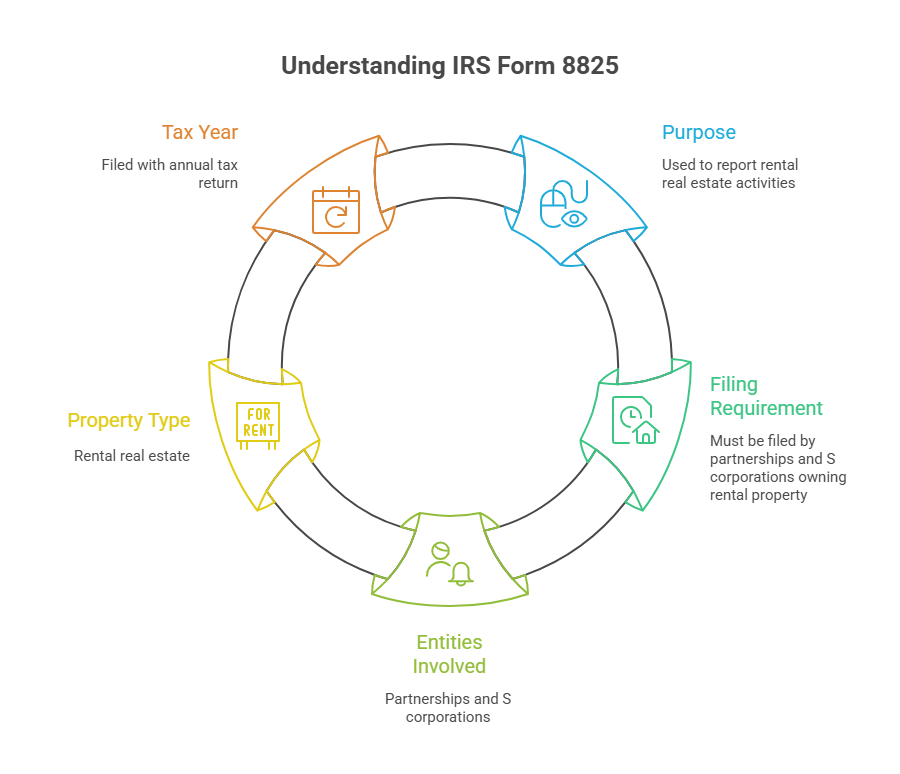
Form 8825, titled "Rental Real Estate Income and Expenses of a Partnership or an S Corporation," is the IRS form used by business entities to report rental real estate activities. Any partnership or S corporation that owns rental property must file this form with their annual tax return.
This requirement applies to multi-member LLCs taxed as partnerships, traditional partnerships, and S corporations. The form captures all rental real estate income and expenses, including net income or loss from rental activities that flow through from other partnerships, estates, or trusts where your entity is a partner or beneficiary.
Single-member LLCs and sole proprietors do not use Form 8825. Instead, they report rental income on Schedule E of Form 1040. C corporations also don't use Form 8825—they report rental income directly on Form 1120.
The form accommodates up to eight properties. If your partnership or S corporation owns more than eight rental properties, you must attach additional copies of Form 8825 to report the excess properties.
Both forms report rental real estate income and expenses, but they serve different entity types. Schedule E is used by individual taxpayers who personally own rental properties, while Form 8825 is filed by partnerships and S corporations that own rental properties.
The reporting structure differs significantly. Schedule E results flow directly to an individual's Form 1040, affecting their personal adjusted gross income. Form 8825 results flow to the entity's tax return (Form 1065 or Form 1120-S), then distribute to partners or shareholders via Schedule K-1.
There are minor expense category differences. Schedule E includes separate lines for mortgage interest and other interest, plus a dedicated management fees category. Form 8825 combines all interest into one category and includes a wages and salaries line that Schedule E lacks.
The choice between forms depends entirely on your ownership structure, not preference. Multi-member LLCs, partnerships, and S corporations must use Form 8825. Individual owners use Schedule E.
Before starting Form 8825, gather comprehensive documentation for each rental property. You'll need the physical address and property type for each property, gross rental income received during the tax year, all deductible expenses organized by category, depreciation calculations and schedules, and records of any capital gains or losses from property dispositions.
The IRS requires detailed reporting of fair rental days and personal use days for each property. Fair rental days are days the property was rented at market rate with clear income-generating intent. Personal use days include any time partners, shareholders, or their families used the property, or times it was rented below market rate.
Accurate record-keeping throughout the year simplifies Form 8825 preparation. Many partnerships benefit from professional bookkeeping services that maintain organized rental property records to ensure nothing falls through the cracks at tax time.
Form 8825 consists of three main sections. The first section captures basic property information. List each property's physical address, property type, and the number of fair rental days and personal use days. Properties are designated by columns A through H on the form.
The second section reports income and expenses for each property. Line 2 reports gross rental income, which includes all rent payments received during the tax year. This encompasses regular monthly rent, advance rent payments, lease cancellation fees, and expenses paid by tenants on your behalf.
Lines 3 through 15 detail deductible expenses by category: advertising costs to find tenants, auto and travel expenses related to property management, cleaning and maintenance, commissions paid to property managers or agents, insurance premiums for property coverage, legal and professional fees, mortgage interest and other interest expenses, repairs that maintain current property condition, supplies purchased for property maintenance, taxes including property taxes and payroll taxes, utilities paid by the landlord, wages and salaries for property management staff, and depreciation calculated on Form 4562.
Understanding which expenses qualify as deductions and which must be capitalized requires expertise. Working with professionals experienced in rental property tax planning strategies ensures you claim every legitimate deduction while maintaining IRS compliance.
Depreciation represents one of the most valuable deductions for rental property owners. The IRS allows partnerships and S corporations to depreciate residential rental properties over 27.5 years and commercial properties over 39 years.
Depreciation for rental properties owned by the partnership or S corporation is calculated on Form 4562, then reported on Line 14 of Form 8825. This depreciation flows through to partners or shareholders on their Schedule K-1, reducing their taxable income.
Property improvements also qualify for depreciation. Capital improvements that extend property life, increase value, or adapt the property to new uses must be depreciated rather than deducted immediately. Track each improvement's placed-in-service date and basis separately for accurate depreciation calculations.
Some improvements qualify for accelerated depreciation schedules. HVAC systems, for example, may depreciate over shorter periods as personal property rather than real property. Cost segregation studies can identify components eligible for faster depreciation, creating immediate tax benefits.
After calculating gross rental income and subtracting all deductible expenses, Line 17 shows the net income or loss for each property. The final section totals all properties and adds any net gains or losses from property dispositions reported on Form 4797.
Line 20a captures net income or loss from rental real estate activities where your partnership or S corporation is a partner or beneficiary. This includes amounts reported on Schedule K-1s received from other entities. Line 20b requires identifying each entity by name and employer identification number.
The total net rental real estate income or loss transfers to the entity's tax return. For partnerships filing Form 1065, the amount goes to Schedule K, Line 2. For S corporations filing Form 1120-S, it goes to the corresponding line on that form's Schedule K.
Each partner or shareholder receives a Schedule K-1 showing their share of the rental income or loss. Partners report this amount on Part II of their personal Schedule E, which flows to their Form 1040. This pass-through structure means the entity doesn't pay tax on rental income—the tax obligation passes to individual partners or shareholders.
The most common error is confusing which expenses belong on Form 8825 versus the main business return. Form 8825 is exclusively for rental real estate activities. Income or deductions from non-rental business activities, portfolio income, Section 179 expense deductions, and commercial revitalization deductions must be reported separately on Form 1065 or Form 1120-S.
Many partnerships fail to properly separate personal use from rental use. When partners or shareholders use rental properties personally, that time must be documented and reported. Properties used personally for more than 14 days or 10% of rental days (whichever is greater) face special limitations on loss deductions.
Depreciation errors cost partnerships thousands annually. Forgetting to claim depreciation, using incorrect useful lives, or failing to depreciate property improvements all reduce legitimate deductions. The IRS considers depreciation "allowed or allowable," meaning you face depreciation recapture taxes when selling even if you never claimed the deduction.
Inadequate documentation creates problems during IRS audits. Every deduction claimed on Form 8825 requires supporting documentation—receipts, invoices, bank statements, and records proving the expense relates to rental property management. For guidance on maintaining audit-ready records, consider consulting with tax professionals who specialize in preparing businesses for tax audits.

The IRS classifies most rental real estate as passive activity for tax purposes. This classification significantly impacts how losses are deducted. Passive activity losses can only offset passive income—they cannot reduce earned income from wages or active business income.
If your partnership's rental activities generate a loss reported on Form 8825, that loss passes through to partners on Schedule K-1. However, individual partners may face limitations on deducting their share of the loss based on their personal tax situations.
Partners with adjusted gross income below $100,000 may deduct up to $25,000 in passive rental losses against ordinary income if they actively participate in property management. This allowance phases out for AGI between $100,000 and $150,000.
Real estate professional status changes everything. Partners who qualify as real estate professionals under IRS rules can treat rental losses as non-passive, allowing full deduction against all income types. Qualification requires spending more than 750 hours annually in real property trades or businesses and more than half of working hours in those activities.
Understanding these rules requires expertise in both partnership taxation and rental property regulations. Professional guidance from firms experienced in comprehensive tax planning and preparation helps partnerships structure activities to maximize available deductions.
Form 8825 attaches to the partnership or S corporation return, so it follows those filing deadlines. Partnerships filing Form 1065 must file by March 15 for calendar year entities. S corporations filing Form 1120-S also face a March 15 deadline for calendar year filers.
Entities can request automatic six-month extensions using Form 7004. This extends the filing deadline to September 15 for calendar year entities. However, the extension applies only to filing the return—any tax owed remains due by the original deadline.
Late filing carries penalties. The IRS charges penalties per partner or shareholder per month for late partnership or S corporation returns. For a partnership with four partners filing three months late, penalties can reach several thousand dollars.
Partners and shareholders receive Schedule K-1s from the entity. These K-1s should arrive before individual tax filing deadlines (April 15 for most taxpayers). When partnerships or S corporations file late, partners face challenges meeting their own filing deadlines.
No, single-member LLCs are disregarded entities for tax purposes and must use Schedule E on Form 1040 to report rental income, just like sole proprietors. Form 8825 is only for multi-member LLCs taxed as partnerships, traditional partnerships, and S corporations.
If your partnership or S corporation is a partner in another partnership that owns rental property, you'll receive a Schedule K-1 showing your entity's share of rental income or loss. Report this amount on Line 20a of Form 8825 and identify the issuing entity on Line 20b.
Form 8825 excludes income or deductions from non-rental business activities, portfolio income (interest, dividends, capital gains from securities), Section 179 expense deductions, commercial revitalization deductions, and items that must be reported separately to partners or shareholders on Schedule K-1.
No, one Form 8825 reports up to eight properties in columns A through H. Each property's income and expenses are reported separately by column. If your entity owns more than eight properties, attach additional Form 8825s to report the excess properties.
Property improvements that extend useful life or increase value must be capitalized and depreciated rather than immediately deducted. Calculate depreciation on Form 4562 and report it on Line 14 of Form 8825. Only repairs that maintain current condition qualify for immediate deduction.
Document all personal use days and report them on Form 8825. Properties with personal use exceeding 14 days or 10% of rental days (whichever is greater) become personal residences, limiting loss deductions. Consider charging fair market rent for personal use to maintain rental property status.
Form 8825 doesn't directly affect your personal taxes. The net income or loss from Form 8825 flows to Schedule K-1, which you receive from your partnership or S corporation. You report your K-1 amounts on Part II of your personal Schedule E, which then affects your Form 1040.
Yes, mortgage interest paid on loans for rental property acquisition, improvement, or maintenance is deductible on Line 11 of Form 8825. This includes interest on mortgages, home equity loans used for rental property purposes, and other qualifying debt. Keep detailed records of all interest payments.
Form 8825 serves as the essential reporting mechanism for partnerships and S corporations with rental real estate activities. Accurate completion requires understanding which income qualifies for reporting, which expenses are deductible, how depreciation functions, and how passive activity rules apply. The form's results flow through to partners or shareholders via Schedule K-1, ultimately affecting individual tax returns. The complexity of partnership taxation combined with rental property rules creates numerous opportunities for errors. Missing deductions, misclassifying expenses, or failing to properly document activities can cost thousands in unnecessary taxes or penalties. Professional guidance from tax specialists experienced in partnership taxation ensures compliance while maximizing legitimate deductions.
Since 2015, Madras Accountancy has partnered with U.S. CPA firms and accounting practices to provide expert tax preparation services for complex entity structures, including partnerships and S corporations with rental real estate holdings. Our team understands the nuances of Form 8825 and helps ensure accurate reporting that withstands IRS scrutiny while capturing every available tax benefit.
Section 4960's 21% excise tax now reaches far more nonprofit employees. See who is a covered employee in 2026 and what changed.

The Section 45S paid family leave credit is permanent for 2026 with new options. See who qualifies, the amounts, and how to claim it.

Opportunity zones become permanent in 2027 under the One Big Beautiful Bill. See the new deferral, rural bonus, and the 2026 handoff.



