



Direct Answer: Phoenix real estate bookkeeping services handle property-specific accounting including rental income tracking, 1031 exchange documentation, depreciation schedules, and multi-property cash flow management. Professional bookkeeping helps Phoenix investors, developers, and property managers stay tax-compliant while maximizing deductions in Arizona's competitive real estate market.
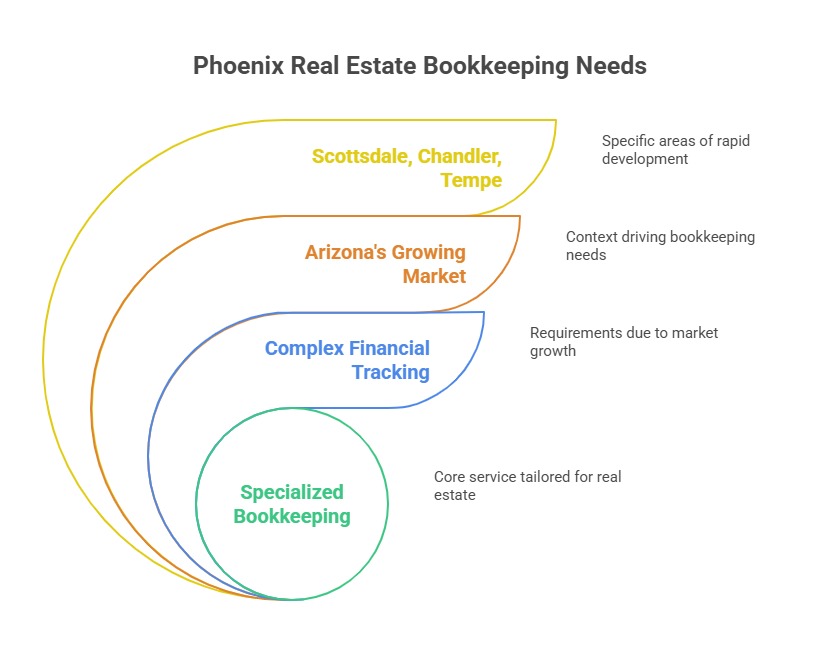
Real estate bookkeeping in Phoenix differs significantly from standard small business accounting. Arizona's growing market, with Scottsdale, Chandler, and Tempe experiencing rapid development, creates complex financial tracking requirements that generic bookkeeping can't handle effectively.
Property managers juggling multiple rental units need accurate tracking of tenant payments, security deposits, maintenance expenses, and vendor invoices across different properties. Developers working on projects in Phoenix's expanding urban core face construction cost allocation, draw schedules, and capitalization requirements. Real estate investors navigating 1031 exchanges must maintain meticulous documentation to satisfy IRS requirements for tax-deferred property swaps.
The stakes run high. A single bookkeeping error on a 1031 exchange can trigger unexpected capital gains taxes. Missed depreciation deductions leave thousands of dollars on the table annually. Inaccurate cash flow tracking leads to poor investment decisions and financing problems.
Professional real estate bookkeeping provides the accuracy and industry-specific knowledge Phoenix professionals need to avoid costly mistakes while staying competitive in Arizona's fast-moving market.
Professional bookkeeping for Phoenix real estate businesses covers specialized tasks that general bookkeepers often miss. Monthly services typically include tracking rental income by property and unit, recording and categorizing operating expenses, reconciling property management software with accounting records, and preparing property-specific profit and loss statements.
For property managers handling multiple buildings, bookkeepers maintain separate ledgers for each property while providing consolidated reporting. This allows you to identify which Phoenix properties generate the strongest returns and which need attention.
Developers benefit from construction-in-progress tracking, hard cost versus soft cost allocation, and draw schedule management. As projects move from land acquisition through construction to stabilization, proper accounting ensures accurate project costing and profitability analysis.
Tax-focused services include depreciation schedule maintenance (crucial for maximizing deductions on Phoenix properties), 1031 exchange documentation and tracking, passive activity loss calculations, and real estate professional status qualification support. These services directly reduce your tax bill, often by tens of thousands annually for active investors.
Many Phoenix real estate professionals also need accounts payable management for vendor payments, tenant deposit tracking with proper liability accounting, and QuickBooks setup optimized for real estate operations. For firms managing these processes internally, outsourced bookkeeping services can reduce errors and free up time for revenue-generating activities.
1031 exchanges allow Phoenix real estate investors to defer capital gains taxes when selling one property and purchasing another. The bookkeeping requirements are strict, missing deadlines or documentation requirements triggers immediate tax liability on your entire gain.
Professional bookkeepers maintain detailed records of the relinquished property's adjusted basis, track the 45-day identification period and 180-day exchange completion deadline, document all exchange-related expenses, and ensure proper basis calculations for the replacement property. They also coordinate with qualified intermediaries and handle the complex accounting entries required when closing both transactions.
For example, if you sell a Phoenix rental property with $200,000 in accumulated depreciation, your bookkeeper needs to track that basis adjustment forward to your replacement property. This affects future depreciation calculations and eventual tax liability when you finally sell without exchanging.
Getting 1031 exchange accounting wrong costs real money. A Phoenix investor selling a $1 million property with a $400,000 gain could face $100,000+ in unexpected taxes if exchange documentation fails IRS scrutiny.
Phoenix investors often own properties across different submarkets, apartments in Tempe, single-family rentals in Chandler, commercial buildings in Scottsdale. Each property needs separate financial tracking while rolling up into consolidated reporting for overall portfolio analysis.
Effective bookkeeping for multi-property portfolios includes property-level income and expense tracking, consolidated cash flow reporting, comparative analysis showing which properties outperform, and separate bank account reconciliation for each entity or property. This structure helps Phoenix investors identify underperforming assets quickly and make data-driven decisions about refinancing, selling, or improving properties.
Many investors structure ownership through multiple LLCs for liability protection. Bookkeepers maintain separate books for each entity while providing consolidated reporting that shows total portfolio performance. This organizational structure matters especially in Phoenix's competitive market where timing and accurate financial information drive investment decisions.
For real estate firms scaling operations, understanding how to read financial statements properly becomes critical for making strategic portfolio decisions and communicating performance to lenders or partners.
Strategic bookkeeping supports proactive tax planning throughout the year, not just at filing time. Phoenix real estate investors face unique opportunities and challenges in Arizona's tax environment.
Depreciation optimization represents the single biggest tax benefit for rental property owners. Bookkeepers track depreciation schedules for buildings (27.5 years residential, 39 years commercial), appliances, flooring, and other components with shorter recovery periods. Cost segregation studies can identify assets to depreciate faster, accelerating deductions into earlier years.
Phoenix investors should also track real estate professional status qualification, spending 750+ hours annually in real estate activities and more than half your working time. This status allows you to deduct rental losses against ordinary income rather than limiting them as passive losses. Detailed time logs and activity documentation substantiate this valuable election.
Arizona-specific considerations include property tax payments (deductible as business expenses), transaction privilege tax on commercial rentals, and local improvement district assessments that must be properly categorized. Professional bookkeepers familiar with Phoenix real estate understand these nuances.
Quarterly estimated tax payments require accurate profit projections. Without proper bookkeeping, Phoenix investors often underpay estimates, triggering penalties and interest. Real-time financial reporting helps you adjust payments throughout the year based on actual performance.
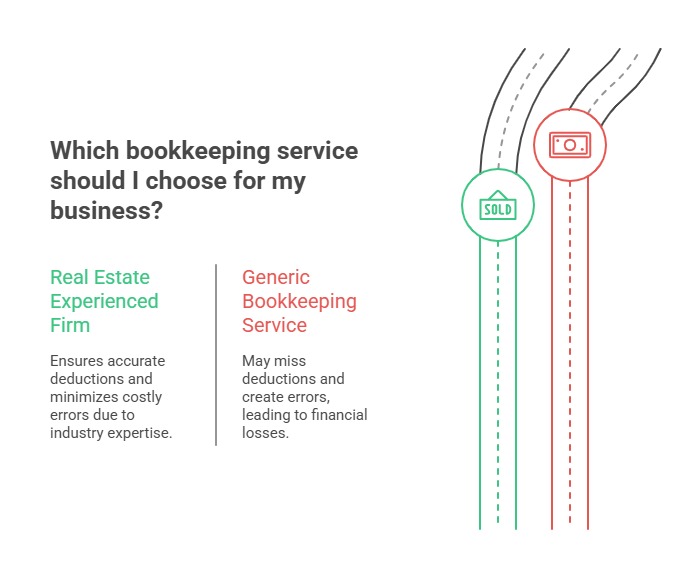
When evaluating bookkeeping services for your Phoenix real estate business, prioritize firms with demonstrated real estate industry experience. Generic bookkeepers miss deductions and create errors that cost you money.
Look for services that offer property management software integration (AppFolio, Buildium, Rent Manager), QuickBooks expertise with real estate chart of accounts, monthly financial statements with property-level detail, and tax planning support beyond basic bookkeeping. You also want responsive communication, real estate moves fast in Phoenix, and you need answers quickly when evaluating acquisitions or addressing tenant issues.
Consider the pricing model. Some firms charge per property, others by transaction volume, and some offer flat monthly rates. For Phoenix investors with growing portfolios, scalable pricing matters significantly as you add properties.
Many successful real estate firms in Phoenix combine solid bookkeeping with strategic financial guidance from fractional CFO services to optimize capital allocation and expansion strategies across their portfolio.
Even experienced Phoenix real estate professionals make costly bookkeeping errors. The most common include mixing personal and business expenses (which jeopardizes deductions and complicates audits), failing to track property-specific expenses separately, missing depreciation deductions or miscalculating useful lives, and poor documentation for repairs versus improvements.
Repair expenses are fully deductible in the year incurred, while improvements must be capitalized and depreciated over multiple years. The distinction matters significantly for your tax bill, but many Phoenix investors categorize incorrectly.
Another frequent mistake involves security deposit handling. Deposits aren't income when received, they're liabilities. Recording them as revenue inflates your taxable income unnecessarily and creates reconciliation problems when returning deposits to tenants.
Cash basis versus accrual accounting also trips up investors. Most Phoenix real estate businesses benefit from accrual-basis accounting (especially when seeking financing), but many default to cash basis because it seems simpler. The wrong accounting method can distort your financial picture and complicate lender relationships.
For real estate professionals managing tax compliance across multiple properties and entities, working with specialized tax planning services ensures you're capturing all available deductions while maintaining audit-ready documentation.
Phoenix real estate bookkeeping typically runs $200-$800 monthly depending on portfolio size and complexity. Single-property investors often pay $200-$350 monthly, while investors with 5-10 properties might pay $500-$800. Developers and property managers with high transaction volumes can expect $1,000+ monthly. Many firms offer free consultations to quote your specific needs.
No, but you need a bookkeeper experienced with both rental accounting and real estate development. The accounting differs significantly, rentals focus on monthly cash flow and depreciation, while flips require construction cost tracking and inventory accounting. A qualified real estate bookkeeper handles both within separate entity structures.
Yes. Bookkeepers can set up time-tracking systems and maintain documentation proving you meet IRS requirements (750+ hours annually in real estate, more than half your working time). This documentation becomes critical if the IRS questions your status during an audit, potentially saving six figures in taxes for active Phoenix investors.
Property management software (like AppFolio or Buildium) handles operational tasks, lease tracking, rent collection, maintenance requests, tenant communication. Real estate bookkeeping takes that data and creates proper financial statements, handles tax preparation, manages depreciation schedules, and provides strategic financial analysis. Most Phoenix investors need both, with integration between systems.
Accrual accounting provides a more accurate financial picture for real estate businesses and is typically required by lenders. It recognizes income when earned (not when cash received) and expenses when incurred (not when paid). This matters significantly for properties with rent receivables or construction projects. Cash-basis accounting works for very small operations but limits growth options.
Professional bookkeepers use class tracking or location tracking in QuickBooks (or similar software) to separate expenses by property while maintaining consolidated books. This allows property-specific profit and loss statements showing which Phoenix properties perform best, while also providing portfolio-wide reporting for tax preparation and lender requirements.
Expect to provide bank and credit card statements, rent rolls showing tenant payments, vendor invoices and receipts, loan statements showing interest and principal payments, property tax bills, insurance premium notices, and any purchase or sale documents. Most Phoenix bookkeepers can pull transaction data directly from your property management software and bank accounts with proper access.
Yes. Commercial real estate bookkeeping involves additional complexity including common area maintenance (CAM) reconciliations, percentage rent calculations, tenant improvement allowances, and more sophisticated lease accounting under ASC 842 standards. Phoenix bookkeepers experienced with commercial properties handle these requirements while ensuring compliance with generally accepted accounting principles.

Section 4960's 21% excise tax now reaches far more nonprofit employees. See who is a covered employee in 2026 and what changed.

The Section 45S paid family leave credit is permanent for 2026 with new options. See who qualifies, the amounts, and how to claim it.

Opportunity zones become permanent in 2027 under the One Big Beautiful Bill. See the new deferral, rural bonus, and the 2026 handoff.