


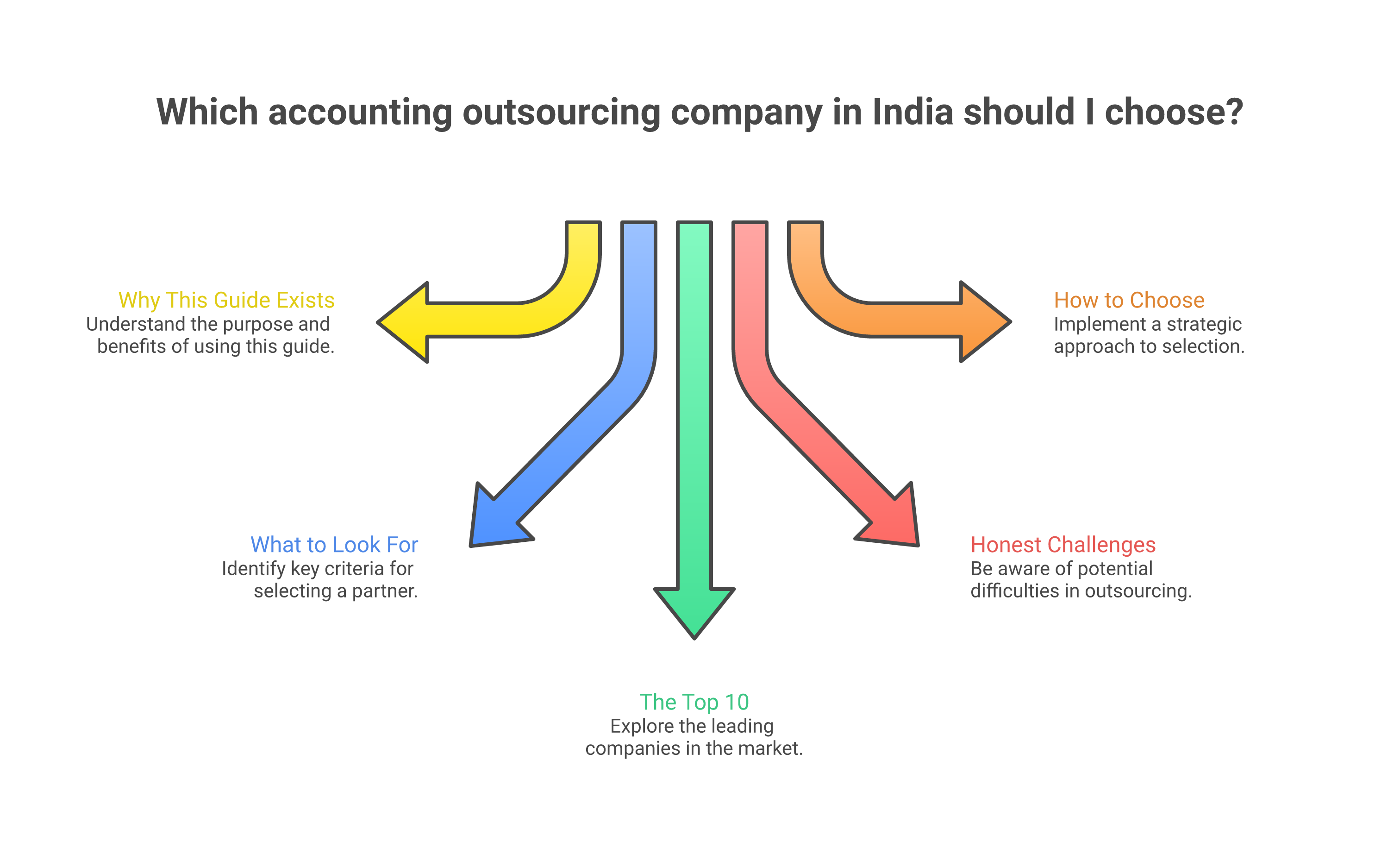
We are going to do something unusual here: review our own competitors. Yes, Madras Accountancy is on this list. We are also going to talk honestly about the other companies CPA firms consider when outsourcing to India.
Why? Because CPA firm owners doing research deserve straight answers. Most "top outsourcing companies" articles are either written by the companies themselves (pure marketing) or by content farms that have never actually used any of the services (pure filler). We compete against these firms regularly. We know what they do well and where they come up short, because our clients tell us, sometimes after switching from one of these providers.
A few ground rules for this guide. We will share what we genuinely know about each company, including strengths and weaknesses. Where we do not have direct knowledge, we will say so. And yes, we will list ourselves first, because this is our article and we think we are the best option, but we will try to be fair about what makes each provider worth considering.
If you are still in the early stages of deciding whether India outsourcing is right for your firm, start with our due diligence checklist for offshore accounting before diving into provider comparisons.
Before the list, here is what actually matters when choosing a provider. Not marketing claims. Outcomes.
US accounting expertise. India has thousands of accounting firms. Most serve Indian businesses using Indian accounting standards. You need a team that understands US GAAP, the US tax code, and how US CPA firms operate. This is non-negotiable.
Data security. Your clients' financial data is crossing international borders. The provider needs SOC 2 compliance (or equivalent), strong access controls, encryption, and clear data handling policies. Our data security checklist covers the specifics.
Team stability. High turnover at the outsourcing provider means you are constantly retraining. Ask about retention rates and average tenure. If they will not share these numbers, that tells you something.
Communication systems. How will you communicate with your team? What time zones do they work? How quickly do they respond? How are issues escalated? Process matters more than personality here.
Scalability. Can they add staff during busy season and scale back after? How quickly can they onboard new team members? Your needs will fluctuate, and your provider needs to flex with you.
Pricing transparency. Beware of providers who quote low per-hour rates but add fees for management, technology, training, or "quality assurance." Get a fully loaded cost before you compare.
Headquarters: Chennai, India
Founded: 2018
Team size: 50-100+
Services: Bookkeeping, tax preparation, payroll, accounts payable/receivable, financial statement preparation, audit support, CFO support services
Pricing model: Dedicated FTE model, monthly flat fees per team member
Strengths: We built Madras Accountancy specifically to serve US CPA firms. Not Indian businesses, not UK firms, not Australian firms. US CPA firms. That focus shapes everything from our hiring (we recruit accountants and train them on US standards) to our technology stack (we work on QuickBooks, Xero, Drake, Lacerte, UltraTax, and other platforms US firms use) to our communication patterns (our teams overlap with US business hours).
Our model is dedicated team members, not a pool of interchangeable staff. Your offshore accountant knows your clients, your processes, and your preferences. They are part of your team, not a call center.
We invest heavily in quality control. Multi-level review processes, standardized checklists, and regular quality audits. Our error rates are below 2% across our client base.
We are also transparent about pricing. No hidden fees, no charges for management overhead, no surprise invoices. You know what you are paying before you start.
Weaknesses: We are not the largest provider on this list. Firms looking for 50+ FTEs might find that some larger providers can ramp faster. Our geographic presence is concentrated in Chennai, which means we do not have the multi-city redundancy that some larger firms offer. And we are selective about the clients we take on, which means we sometimes say no to work that does not fit our model.
Best for: CPA firms that want a dedicated, integrated offshore team rather than a transactional outsourcing relationship. Firms between $500K and $20M in revenue that need 1-15 dedicated team members.
Learn more at madrasaccountancy.com
Headquarters: Ahmedabad, India
Founded: 2003
Team size: 500+
Services: Bookkeeping, tax preparation, payroll, audit support, practice management
Strengths: QX is one of the most established players in India outsourcing for accounting. They have been doing this for over two decades, and that experience shows in their process maturity. Their training programs are well-structured, and they handle a wide range of US accounting work. They have strong brand recognition in the CPA firm market, particularly in the mid-size segment.
Weaknesses: Size can be a double-edged sword. Multiple CPA firms have told us that as QX has scaled, the personal attention declined. Account management can feel corporate rather than relationship-driven. Staff turnover has been an issue for some clients, though QX has invested in retention. Pricing has increased significantly over the past few years as they have moved upmarket.
Best for: Mid-size to large CPA firms that want an established provider with broad capabilities and are comfortable with a more structured corporate relationship.
Headquarters: Ahmedabad, India (with US presence in Sugar Land, TX)
Founded: 2015
Team size: 3,000+
Services: Dedicated offshore staffing for accounting, tax, audit, payroll, and advisory
Strengths: Entigrity has grown aggressively and is now one of the largest India-based accounting outsourcing providers. Their US presence (with account managers based in the US) is a genuine differentiator for firms that want a domestic point of contact. They offer a wide range of service levels and can scale quickly. Their dedicated staffing model aligns well with how most CPA firms want to work.
Weaknesses: Rapid growth sometimes outpaces quality control. We have heard from firms that switched from Entigrity citing inconsistent quality, particularly with newer staff members who were deployed before being fully trained. At their size, the experience can vary significantly depending on which team and manager you are assigned. Some firms report that the US sales team overpromises relative to what the India delivery team can execute.
Best for: CPA firms that want a large provider with US-based account management and need to scale to 5+ FTEs quickly.
Headquarters: Multiple locations in India
Founded: 2007
Team size: 200+
Services: Bookkeeping, tax preparation, payroll, audit support
Strengths: PABS has built a solid reputation for tax preparation work specifically. Their tax teams are well-trained on US individual and business returns. They offer flexible engagement models (dedicated staff, project-based, and seasonal). Pricing tends to be competitive relative to the larger providers.
Weaknesses: Their bookkeeping and advisory support capabilities are not as strong as their tax preparation. Some clients report that quality varies between their different India offices. Their technology infrastructure has lagged behind some competitors. Less brand recognition than QX or Entigrity, which means less investment in marketing but also less visibility in the market.
Best for: CPA firms primarily looking for tax preparation support, particularly during busy season.
Headquarters: Mumbai, India
Founded: 1975
Team size: 10,000+ (across all divisions, accounting is a smaller segment)
Services: Finance and accounting outsourcing, data management, technology services
Strengths: Datamatics is a large, publicly traded technology and BPO company. Their scale means robust infrastructure, strong data security (SOC 2, ISO 27001 certified), and the ability to handle very large engagements. Their technology capabilities are genuine, not just marketing. They bring automation and AI tools into their accounting workflows.
Weaknesses: Accounting is not their primary business. CPA firm outsourcing is a small piece of their overall operations, which means you may not get the same focus and attention as you would from a specialist provider. Their engagement models tend to be more corporate and enterprise-oriented, making them a less natural fit for smaller CPA firms. Communication can feel bureaucratic.
Best for: Large CPA firms or accounting departments that need enterprise-grade infrastructure and are comfortable with a corporate BPO relationship.
Headquarters: Delhi NCR, India
Founded: 2018
Team size: 100+
Services: Bookkeeping, tax preparation, payroll, CFO services, audit support
Strengths: Fino Partners is a newer entrant that has built a focused practice around US CPA firm support. Their team is trained specifically on US accounting standards and popular US accounting platforms. They offer competitive pricing and are generally responsive to client needs. Their smaller size means more personalized service.
Weaknesses: Being newer means less track record. Their processes and quality systems are still maturing compared to more established providers. Scalability may be limited for firms needing large teams. Less depth in specialized areas like complex tax situations or industry-specific accounting.
Best for: Smaller CPA firms looking for an affordable entry point into India outsourcing with a more personal relationship.
Headquarters: Pune, India
Founded: 2014
Team size: 200+
Services: Bookkeeping, accounts payable/receivable, financial reporting, payroll
Strengths: Finsmart has built strong capabilities in bookkeeping and financial reporting specifically. Their Pune location gives them access to a strong talent pool (Pune is a major educational hub in India). They have a well-structured training program and their bookkeeping accuracy rates are generally good. They are transparent about their processes and willing to adapt to client workflows.
Weaknesses: Tax preparation capabilities are less developed compared to bookkeeping. Their marketing and sales process can feel aggressive. Some firms have reported communication challenges during onboarding. Limited advisory and CFO support capabilities.
Best for: CPA firms primarily looking for bookkeeping outsourcing support with a provider that has genuine depth in that specific area.
Headquarters: Ahmedabad, India
Founded: 2011
Team size: 200+
Services: Bookkeeping, tax preparation, payroll, audit support, advisory
Strengths: Meru has been in the market long enough to have established processes and a track record. They serve CPA firms across the US, UK, and Australia, which gives them broad exposure to different accounting standards. Their pricing is competitive, and they offer flexible engagement models.
Weaknesses: Serving multiple geographies (US, UK, Australia) means their attention is divided. Some US-focused firms prefer a provider that focuses exclusively on US accounting. Quality consistency has been mixed based on feedback we have received. Their technology infrastructure is adequate but not leading-edge.
Best for: CPA firms that want a mid-size provider with proven longevity and competitive pricing, and do not mind sharing the provider's attention with non-US clients.
Headquarters: India (with US presence)
Founded: 2019
Team size: 50-100
Services: Tax preparation, bookkeeping, audit support, payroll
Strengths: Acobloom is a smaller, newer provider that has focused on building deep relationships with a smaller number of CPA firms. Their approach emphasizes quality over volume. They have a US-based management team that provides a cultural bridge between US firms and Indian staff. Responsive and willing to customize their service delivery.
Weaknesses: Small size means limited scalability and less infrastructure redundancy. Being newer means less track record and less battle-tested processes. May not have the depth of specialized expertise for complex work.
Best for: CPA firms that value a close, personal outsourcing relationship and do not need large teams.
Headquarters: Ahmedabad, India
Founded: 2017
Team size: 100+
Services: Bookkeeping, tax preparation, payroll, audit support, virtual CFO services
Strengths: CapActix has built a decent range of service offerings and serves CPA firms across multiple size ranges. Their Ahmedabad location provides access to a growing talent pool. They offer both dedicated staffing and project-based models. Pricing is generally competitive.
Weaknesses: In a crowded Ahmedabad market (QX, Entigrity, and Meru are also based there), CapActix sometimes struggles to attract top talent. Quality reviews are mixed. Their virtual CFO offering is relatively new and less proven than their core bookkeeping and tax services.
Best for: CPA firms looking for a mid-range provider with flexible engagement options and competitive pricing.
No matter which provider you choose, India outsourcing comes with challenges that you should plan for. Any provider that tells you otherwise is not being straight with you.
Communication gaps. English proficiency varies. Accounting terminology is usually fine, but nuanced client communication (explaining a complex adjustment to a business owner, for instance) can be challenging for offshore staff. Plan to keep client communication onshore.
Quality variance. Even the best providers have quality variance between team members. Some offshore accountants are exceptional. Others are adequate. Your review processes need to account for this. Build quality control systems that catch errors before they reach clients.
Time zone management. India is 9.5-12.5 hours ahead of the US depending on the time zone. This creates a built-in work cycle advantage (work gets done "overnight"), but it also means real-time collaboration is limited to a few overlapping hours. Effective time zone management is essential.
Cultural differences. Indian work culture tends toward deference to authority, which means offshore staff may not push back when they disagree or flag problems early enough. You need to explicitly create psychological safety for your offshore team to raise concerns and ask questions.
Staff turnover. The India accounting outsourcing market is competitive. Good accountants get recruited by other providers. Average turnover in the industry runs 15-25% annually. Ask about retention specifically and look for providers with below-average turnover rates.
Data security. Sending client financial data offshore requires robust security controls. SOC 2 certification, data encryption, access management, DLP (data loss prevention), and clear data handling policies are minimum requirements. Review our data security controls guide for specifics.
Here is our straightforward recommendation process:
Step 1: Define your needs. What work are you outsourcing? How many people do you need? What is your budget? What quality standards do you require? Write these down before you talk to any provider.
Step 2: Shortlist 3-4 providers. Based on the profiles above, pick the ones that match your size, needs, and preferences. Do not try to evaluate all 10.
Step 3: Talk to references. Not the references the provider gives you (those are curated). Ask in CPA firm communities, LinkedIn groups, or your professional network. Find firms that have used the providers you are considering and get candid feedback.
Step 4: Run a pilot. Start with a small engagement, maybe 1-2 people for 3 months on a defined scope of work. Evaluate quality, communication, responsiveness, and fit. Then decide whether to scale.
Step 5: Negotiate clearly. Get fully loaded pricing in writing. Understand what is included and what costs extra. Define service levels, escalation procedures, and exit terms. Our article on choosing the right outsourcing partner covers the evaluation criteria in detail.
We are going to make our case directly. If you are a US CPA firm looking for an India outsourcing partner, here is why we think you should talk to us:
We are built for CPA firms. Not banks, not corporations, not Indian businesses. US CPA firms. Every process, every training program, every quality system is designed for the work you do.
We provide dedicated team members. Your offshore accountants work for you, know your clients, and integrate into your workflow. They are not shared across multiple firms.
We are the right size. Big enough to deliver consistent quality and handle reasonable scale. Small enough that you get the founder's attention when you need it.
We invest in quality. Multi-level reviews, standardized processes, regular quality audits, and below-industry-average error rates.
And we are transparent. About pricing, about capabilities, about limitations. If something is not a good fit for us, we will tell you.
Start a conversation with us at madrasaccountancy.com. No pressure, no hard sell. Just an honest conversation about whether we are the right fit for your firm.
How much does accounting outsourcing to India typically cost? Fully loaded costs for a dedicated offshore accountant range from $1,500 to $3,500 per month depending on experience level, provider, and scope of work. This includes salary, benefits, infrastructure, management, and technology. For a detailed cost comparison, see our offshore vs onshore cost analysis.
How do I handle data security when outsourcing to India? Require SOC 2 Type II certification (or equivalent). Ensure data encryption in transit and at rest. Implement role-based access controls. Use DLP tools to prevent unauthorized data transfers. Require background checks on all staff. And include clear data handling and destruction clauses in your contract.
What is the typical ramp-up time for an offshore accounting team? Expect 2-4 weeks for an offshore team member to become productive on routine tasks and 2-3 months for full productivity on complex work. The ramp-up period depends heavily on how well you document your processes and how much time you invest in training during the initial weeks.
Should I choose a large or small outsourcing provider? It depends on your needs. Large providers (500+ staff) offer scale, infrastructure, and redundancy but may provide less personalized attention. Smaller providers (50-200 staff) offer more flexibility and closer relationships but may have scalability limits. Match the provider size to your needs and growth trajectory.
How do I manage quality with an offshore team? Build a structured review process. All offshore work should be reviewed by a senior onshore staff member before going to the client. Use standardized checklists for each deliverable type. Track error rates by team member and engagement type. Provide regular feedback and invest in training. Quality is a system, not a hope.
Section 4960's 21% excise tax now reaches far more nonprofit employees. See who is a covered employee in 2026 and what changed.

The Section 45S paid family leave credit is permanent for 2026 with new options. See who qualifies, the amounts, and how to claim it.
Opportunity zones become permanent in 2027 under the One Big Beautiful Bill. See the new deferral, rural bonus, and the 2026 handoff.



