


Direct Answer: An Arizona real estate CPA firm specializes in accounting, tax planning, and financial services for property investors, developers, realtors, and property managers. These firms handle 1031 exchanges, cost segregation studies, and industry-specific tax strategies that reduce your tax burden while maximizing profitability.
Arizona's real estate industry generated over $89 billion in 2024. Property professionals face unique challenges: fluctuating market conditions and tax implications that impact profit margins. Most real estate businesses lose 18-25 hours monthly on bookkeeping tasks, time better spent on deals and client relationships.
Generic accounting firms miss the nuances of real estate taxation. A specialized Arizona real estate CPA understands passive activity rules, depreciation strategies, and state-specific regulations that impact your bottom line.
Real estate transactions involve tax considerations that general accountants overlook. When managing rental properties, flipping houses, or developing commercial projects, you need expertise in tracking deductions, from property management fees to travel expenses, ensuring you're not leaving money on the table.
Arizona's tax landscape presents specific opportunities. State depreciation rules differ from federal standards, creating planning opportunities most CPAs miss. The market's volatility demands proactive cash flow forecasting and deal structuring that minimizes tax exposure while keeping you audit-ready.
Arizona real estate CPA firms offer comprehensive services: bookkeeping, tax preparation, strategic planning, and specialized services like 1031 exchanges and cost segregation.
Real estate bookkeeping differs significantly from standard accounting. You're tracking multiple properties, security deposits, capital improvements, and tenant transactions. Firms experienced in outsourced bookkeeping services for real estate businesses maintain accurate records that withstand IRS scrutiny while giving you real-time visibility into property performance.
Tax preparation analyzes every transaction, property sales, vacation rentals, or development projects, identifying deductions specific to real estate: mortgage interest, property taxes, insurance, repairs, depreciation, and travel expenses.
Strategic tax planning happens year-round. Your firm should suggest entity restructuring (LLC versus S-corp), timing strategies for sales, and investment approaches aligned with your goals. Growing businesses must understand when to outsource versus hire in-house to maintain profitability.
Cost segregation studies accelerate depreciation deductions, potentially saving investors $50,000-$200,000+ on a single property. 1031 exchanges defer capital gains taxes indefinitely, but strict timing rules mean mistakes cost thousands.
Select an Arizona real estate CPA by evaluating their industry experience, service range, technology capabilities, and understanding of your specific property sector.
Ask potential firms: How many real estate clients do you serve? What percentage focuses on property professionals? Can you provide case studies showing tax savings? Firms claiming to "serve everyone" often lack the depth you need.
Technology integration matters. Your CPA should work seamlessly with property management software (AppFolio, Buildium), QuickBooks Online, and cloud systems. Real-time financial data helps you make faster investment decisions.
Match the firm's specialization to your needs. Residential flippers face different challenges than commercial developers. Property managers need different structures than individual investors. Realtors have unique commission tracking requirements.
1031 exchanges defer capital gains taxes when reinvesting in like-kind real estate. Cost segregation accelerates depreciation deductions by reclassifying building components, creating immediate tax savings.
Section 1031 exchanges require strict timing: 45 days to identify replacement properties and 180 days to complete purchase after selling. Missing these deadlines, even by one day, triggers immediate tax liability.
Arizona's strong market makes 1031 exchanges particularly valuable. Selling a Phoenix rental that's appreciated $300,000 could save you $75,000-$100,000 in capital gains taxes through proper exchange structuring.
Cost segregation analyzes property components to maximize depreciation. Instead of depreciating buildings over 39 years (commercial) or 27.5 years (residential), you identify components qualifying for 5, 7, or 15-year schedules, carpet, fixtures, landscaping, specialized systems.
Real impact: A Scottsdale investor purchasing a $2 million commercial property might accelerate $400,000-$600,000 in depreciation, creating $100,000-$150,000 in first-year tax savings. For multiple properties, comprehensive tax planning and preparation services ensure you're capturing every deduction.
Arizona real estate CPA firms typically charge $2,000-$5,000 annually for basic tax preparation, $5,000-$15,000 for comprehensive planning, and $10,000-$30,000+ for complex portfolios. Cost segregation studies run $5,000-$15,000 per property.
Pricing varies by complexity. A realtor might pay $2,000-$3,500 annually. A property manager with 50+ units typically invests $5,000-$8,000 for bookkeeping and reporting. Developers often spend $15,000-$30,000+ for CFO-level services.
The ROI often exceeds 5-10x your investment. A $5,000 annual fee identifying $50,000 in overlooked deductions delivers tremendous value. One proper 1031 exchange saving $80,000 justifies years of fees. Review typical costs to outsource accounting services versus hiring in-house.
Many firms offer flat-fee monthly packages ($500-$2,500) covering bookkeeping, payroll, tax planning, and reporting. This predictable pricing helps you budget while ensuring consistent oversight.
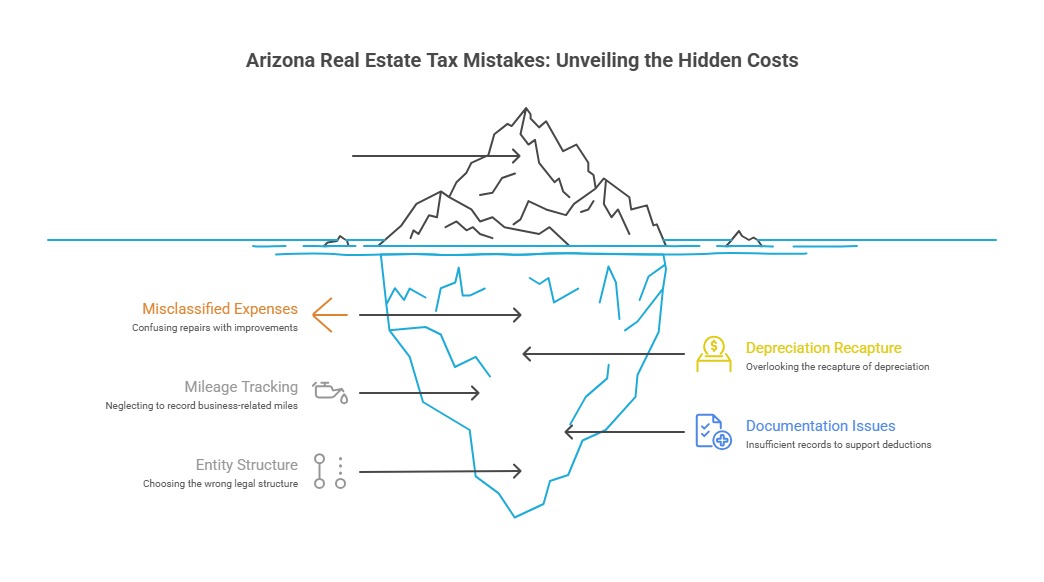
Misclassifying repairs versus improvements, missing depreciation recapture, failing to track miles, inadequate documentation, and improper entity structures cost Arizona real estate professionals thousands annually.
The repair versus improvement distinction triggers IRS audits. Fixing a broken water heater is deductible. Upgrading to high-efficiency systems must be depreciated over years. Misclassification means disallowed deductions.
Depreciation recapture catches investors by surprise. When selling property, the IRS recaptures all depreciation at 25%. Many face unexpected tax bills of $30,000-$100,000+ without proper planning.
Mileage tracking rarely happens correctly. Active professionals drive 5,000-15,000 deductible miles annually between properties and meetings. At 67¢ per mile, that's $3,350-$10,050 in missed deductions without systematic tracking.
Entity structure mistakes limit efficiency. Operating as a sole proprietor exposes all profits to 15.3% self-employment tax. Proper LLC or S-corp structuring saves active investors $8,000-$25,000 annually.
Many Arizona CPA firms leverage offshore accounting partnerships to deliver cost-effective services. These partnerships reduce overhead 40-60% while maintaining quality through experienced professionals handling bookkeeping, tax preparation, and compliance.
Offshore accounting works through cloud platforms where U.S. CPAs oversee international teams handling data entry and preliminary work. The Arizona CPA reviews everything and provides strategic guidance, focusing on high-value advisory rather than repetitive tasks.
Clients benefit through lower fees and faster service. Quality partnerships maintain rigorous standards: same-day error resolution, U.S. GAAP expertise, and multiple review layers. Top firms process 50,000+ tax returns annually with 98%+ accuracy rates.
Security matters tremendously. Modern partnerships use bank-level encryption, strict access controls, and compliance certifications (SOC 2, ISO 27001) meeting or exceeding U.S. standards.
Yes. With 2-3 properties generating $50,000-$150,000 in annual rent, you're dealing with depreciation schedules, passive loss limitations, and state tax requirements that cost money when handled incorrectly. A CPA typically saves more than their fees.
Quarterly meetings work best. These sessions review performance, adjust withholdings, discuss upcoming transactions, and plan strategically. During major events (property sales, large acquisitions), schedule additional consultations.
While no CPA guarantees audit prevention, proper documentation, accurate reporting, and conservative positions significantly reduce risk. Your CPA should balance tax savings with audit risk, keeping you compliant while maximizing legitimate deductions.
Real estate CPAs specialize in property-specific tax strategies, understand 1031 exchanges, cost segregation, and passive activity rules, and typically serve 50%+ real estate clients. General accountants lack depth in real estate taxation.
Not necessarily. Agents face different issues, commission income, business expenses, and self-employment taxes. Investors deal with passive income, depreciation, and capital gains. Ensure your CPA understands your specific revenue model.
Keep purchase documents, capital improvement records, and depreciation schedules until three years after selling property. The IRS can audit three years after filing (six years for substantial underreporting).
Modern firms use cloud accounting (QuickBooks Online, Xero), property management integrations, secure portals, and digital signatures. Technology enables faster service and real-time financial visibility.
Yes. Madras Accountancy partners with U.S. CPA firms serving real estate clients nationwide. Through secure cloud platforms, we provide bookkeeping, tax preparation, and compliance support, enabling competitive pricing while maintaining quality. We've processed 50,000+ tax returns since 2015 with 200+ partnerships.
Arizona's thriving real estate market demands specialized financial expertise. The right CPA firm becomes a strategic partner who identifies tax-saving opportunities and keeps you focused on growing your portfolio rather than wrestling with spreadsheets.
Whether managing rental properties, developing projects, or running a brokerage, specialized accounting delivers ROI through lower taxes and smarter decisions. Evaluate firms based on real estate experience, technology capabilities, and clear communication.

Section 4960's 21% excise tax now reaches far more nonprofit employees. See who is a covered employee in 2026 and what changed.

The Section 45S paid family leave credit is permanent for 2026 with new options. See who qualifies, the amounts, and how to claim it.

Opportunity zones become permanent in 2027 under the One Big Beautiful Bill. See the new deferral, rural bonus, and the 2026 handoff.



