

.png)

Your construction business landed three new projects this quarter. The contracts look solid, the crews are ready, and materials are ordered. But six months in, you're not sure which jobs are actually making money. The general ledger shows revenue, but when you factor in equipment costs, change orders, and that delayed payment from the commercial project, suddenly your "profitable" quarter looks questionable.
Construction accounting isn't about tracking what you spent last month. It's about knowing right now whether Project A can afford that change order, if Project B's labor costs are eating your margin, and when Project C's retainage will finally hit your account.
According to the Construction Financial Management Association, 76% of construction companies that implemented industry-specific accounting systems reported improved project profitability compared to only 34% using general accounting software.
Construction accounting services provide specialized financial management for contractors, handling job costing, retainage tracking, progress billing, and compliance requirements unique to the industry. Unlike traditional accounting that treats your entire business as one profit center, construction accounting treats each project as its own financial entity, tracking every material cost, labor hour, and equipment charge back to specific jobs.
This guide explains what construction accounting services actually do, why contractors who skip them often struggle with cash flow despite being busy, and how to determine if outsourcing makes more financial sense than hiring in-house.
Construction accounting operates on a project-by-project basis rather than viewing your company as a single financial entity. Each job becomes its own profit center with distinct revenue, costs, and timelines that must be tracked separately to understand true profitability.
Regular accounting works fine for businesses selling products or services with predictable costs and quick turnaround. A software company can track monthly expenses, calculate gross margin, and call it done. Construction doesn't work that way. Your costs vary dramatically between projects, one job might need expensive materials while another opts for budget alternatives, labor rates change based on union requirements and prevailing wages, and projects stretch across multiple accounting periods with partial payments along the way.
Here's what makes construction accounting distinct:
Projects function as individual profit centers. Most businesses track income and expenses at the company level. Construction companies need separate financial tracking for every job because costs, timelines, and profit margins differ significantly. A residential remodel and a commercial build require completely different materials, labor, and overhead allocations.
Production is decentralized.
You're not manufacturing widgets in one factory, you're building at multiple job sites simultaneously. Materials get delivered to different locations, crews move between projects, and equipment travels from site to site. This mobility creates additional costs and complexity that general accounting systems weren't designed to handle.
Payment cycles are extended and complex. Unlike retail transactions settled in days, construction contracts often allow 60-90 day payment terms. Add retainage (typically 5-10% held until project completion), and you're managing significant accounts receivable while funding ongoing work. This creates cash flow pressure that requires careful forecasting.
Revenue recognition follows specialized rules. You can't just record revenue when you get paid, GAAP requires most contractors to use percentage-of-completion or completed contract methods. These approaches match revenue with actual work performed, not cash received, which means your income statement may look very different from your bank account.
Contracts are long-term with variable terms. A single project might span multiple years with changing scope, materials price fluctuations, and weather delays. Your accounting system needs to track original budget versus actual costs, manage change orders, and adjust forecasts as conditions change.
The financial impact of getting this wrong is substantial. Construction companies face failure rates higher than most industries, many don't make it past their first decade. Poor accounting practices contribute significantly to these failures because contractors can't identify unprofitable jobs until it's too late.
Construction accounting services encompass job costing, payroll processing with prevailing wage compliance, progress billing and retainage tracking, work-in-progress reporting, and financial statement preparation tailored to industry requirements. These services work together to give contractors real-time visibility into project profitability and company financial health.
Job costing forms the foundation. This practice assigns every expense, materials, labor, subcontractors, equipment, and overhead, to specific projects using detailed cost codes. You'll know exactly what you spent on concrete for the foundation versus electrical rough-in versus finish work. Companies using comprehensive job costing systems identify 12-18% more cost-saving opportunities compared to those using general accounting.
Each job gets a unique number (often the year plus a sequence, like 2501 for the first job of 2025) and costs are coded using a standardized structure. Division 01 might be general requirements, Division 02 existing conditions, and so on. This systematic approach lets you compare actual costs against estimates, identify patterns across projects, and improve future bids.
Proper job costing requires tracking both direct costs (materials, labor, equipment used exclusively for that project) and indirect costs (site security, transportation, administrative support). The tricky part is overhead allocation, determining how much of your office rent, insurance, and management salaries should be attributed to each job. Many contractors use a percentage of direct costs, but this needs regular review as your company grows.
Payroll processing gets complicated fast in construction. You're dealing with multi-state operations, union requirements, prevailing wage compliance on government projects, and certified payroll reporting. Miss a filing or miscalculate prevailing wages, and you're facing penalties and project delays. Construction accounting services handle all of this, ensuring workers are paid correctly and you stay compliant with Davis-Bacon Act requirements on federal contracts.
Progress billing and invoicing align with how construction contracts actually work. Instead of waiting until job completion, you invoice as milestones are met, foundation poured, framing complete, mechanical systems installed. This improves cash flow significantly. Your accountant prepares applications for payment (often using AIA forms), tracks retainage held by the client, and ensures you're billing for all approved change orders.
Retainage tracking deserves special attention because it's unique to construction. Clients typically withhold 5-10% of each payment as security until project completion. That's your money, but you won't see it for months or even years. Understanding your financial statements including retainage receivables is essential for accurate cash flow forecasting. Proper accounting tracks this separately, so you know exactly how much is held on each project and when it should be released.
Work-in-progress (WIP) reporting provides a snapshot of every active project's financial status. For each job, you'll see costs incurred to date, revenue earned using percentage-of-completion, billings sent, and whether you're over or under billed. This report is invaluable, it shows which projects are tracking to budget, which are running over, and where you need to take corrective action.
Financial statement preparation for construction companies requires specialized knowledge. Your balance sheet needs to properly account for costs in excess of billings (underbillings) and billings in excess of costs (overbillings). The income statement should reflect work performed, not just cash collected. Banks and bonding companies scrutinize these statements, so they need to be accurate and follow construction industry standards.
Tax compliance and planning gets complex with construction. You're dealing with 1099 contractors, sales tax on materials (but not labor), potential multi-state tax obligations if you work across state lines, and industry-specific deductions. Section 179 allows accelerated depreciation on equipment purchases, saving substantial tax dollars if used correctly. Your construction accountant ensures you're taking every legitimate deduction while staying compliant with IRS rules.
The decision between in-house and outsourced construction accounting hinges on three factors: your annual revenue, the complexity of your projects, and whether you're spending more than 15 hours weekly on bookkeeping tasks. Companies under $5 million in revenue typically find outsourcing more cost-effective, while those over $20 million often benefit from dedicated in-house teams.
Start by calculating your true accounting costs. An experienced construction bookkeeper costs $50,000-65,000 annually plus benefits (add 25-30% for taxes, insurance, paid time off). A construction accountant with CPA credentials runs $75,000-95,000. You'll also need accounting software licenses ($2,000-10,000 annually depending on features), ongoing training to keep staff current on construction accounting standards, and backup coverage when someone is out.
Compare that to outsourcing costs, which typically run 40-60% less than in-house while providing access to specialized expertise. Many construction firms partner with offshore accounting providers who understand job costing, WIP reporting, and construction-specific compliance requirements. You get an entire accounting team instead of relying on one or two people.
Time commitment is another factor. If your project managers or office staff are spending 15+ hours weekly on bookkeeping, that's time not spent on estimating, managing jobs, or developing new business. The opportunity cost adds up quickly. One contractor calculated his team was spending 20 hours weekly entering invoices, coding costs, and reconciling accounts, that's half of a full-time position doing data entry instead of revenue-generating work.
Project complexity matters too. If you're handling mostly straightforward time-and-materials work or fixed-price contracts under $500,000, your accounting needs are simpler. But once you're managing multiple concurrent projects over $1 million, dealing with complex contracts, handling union payroll, or working on government jobs requiring certified payroll, the specialized knowledge becomes essential.
Many contractors use a hybrid approach called co-sourcing. They keep basic bookkeeping in-house, entering invoices, processing payroll, but outsource specialized functions like WIP reporting, tax preparation, and fractional CFO services. This gives you control over day-to-day operations while accessing expertise for complex requirements.
Growth trajectory influences the decision. If you're scaling from $3 million to $10 million over the next three years, hiring in-house staff seems logical. But you'll need to hire before you need them (they require 2-3 months to get up to speed) and risk overhead if growth slows. Outsourcing scales with your business, you pay for services as needed without long-term commitments.
The quality of your current financial reporting is telling. If you can't quickly answer questions like "What's our profit margin on the Main Street project?" or "How much retainage are we holding across all active jobs?", your accounting system isn't serving you well. That's a sign you need specialized help, whether in-house or outsourced.
The most expensive accounting mistake construction contractors make is failing to track job costs accurately in real-time, leading to 18-25% profit margin erosion across projects. By the time you realize a job is losing money, you're too far in to recover, and the damage spreads to future bids based on faulty data.
Inaccurate overhead allocation consistently undercuts profitability.
Many contractors apply overhead as a simple percentage of direct costs without regularly updating that percentage as their business changes. Your overhead might have been 15% when you had one office and three crews, but it's probably 22% now that you've added equipment, expanded your office, and hired estimators. Using outdated overhead rates means you're underbidding jobs by thousands of dollars.
The fix requires reviewing overhead annually (at minimum) and calculating it properly. Add up all indirect costs, rent, utilities, insurance, office salaries, depreciation, professional fees. Divide by your total direct costs for the year. That's your overhead percentage. Apply it to each new job estimate. Some contractors go further and calculate overhead rates by division (residential versus commercial, new construction versus remodeling) for even more accurate bidding.
Poor cash flow forecasting creates unnecessary financial stress. Construction has inherent cash flow challenges, you pay for materials and labor weekly but collect from clients in 30-90 days. Add retainage that's held for months, and you need significant working capital. Contractors who don't forecast cash flow end up scrambling to make payroll, taking expensive short-term loans, or passing up profitable work because they can't fund it.
Detailed cash flow projections should look 90 days ahead at minimum. List expected receipts (progress payments, retainage releases) and required payments (payroll, suppliers, subcontractors, equipment).
Planning for seasonal variations is critical if your work slows during winter or rainy season. Construction firms that forecast cash flow monthly reduce payment delays by an average of 23 days.
Mixing personal and business expenses causes headaches at tax time and obscures your true financial position. Using your business account for personal expenses makes it harder to understand profitability, complicates tax preparation, and creates problems if you're ever audited. Set up separate accounts, pay yourself a regular salary or draw, and maintain clear boundaries. The few minutes saved by using one account costs hours of cleanup work later.
Ignoring change orders financially is remarkably common. The client approves additional work, your crew handles it, but no one properly documents the change order or updates job costs and billing. You've spent labor and materials on work you're not getting paid for.
Every change order should trigger three actions: written documentation with client signature, update to job budget and cost codes, and adjustment to next progress billing.
Failing to track equipment costs accurately makes jobs appear more profitable than they are. If you own a backhoe that cost $65,000, you need to charge jobs for its use to recover that investment and fund future equipment purchases. Many contractors overlook this, thinking "we already own it, so it's free." It's not free, it depreciates, requires maintenance, and consumes fuel. Proper controls and tracking ensure every dollar spent is accounted for in job costs.
Not reconciling accounts monthly lets errors compound. An unrecorded payment here, a miscoded expense there, over months, these discrepancies grow into significant problems that are hard to untangle. Monthly reconciliation of bank accounts, credit cards, and subcontractor accounts catches issues while they're still manageable and ensures your financial statements reflect reality.
Clean, accurate financial statements prepared using construction industry standards significantly strengthen your bonding capacity and bank relationships. Surety companies and lenders look specifically at WIP schedules, underbilling/overbilling ratios, and working capital when evaluating construction firms, getting these right can increase your bonding capacity by 30-50%.
Bonding companies are essentially guaranteeing you'll complete projects as contracted. They're putting their capital at risk, so they scrutinize your financials carefully.
They want to see revenue recognition using percentage-of-completion method, detailed WIP schedules showing all active projects, proper separation of costs in excess of billings and billings in excess of costs, and realistic reserves for warranty work and potential claims.
Your WIP schedule is particularly important. It should show every active project with original contract amount, costs incurred to date, percentage complete (usually based on costs incurred versus total estimated costs), earned revenue, billings to date, and over/under billing status. Projects showing significant underbilling suggest you're working ahead of billing, which requires working capital. Significant overbilling raises questions about whether work is actually complete and revenue recognition is appropriate.
Working capital matters intensely to both bonding companies and banks. As a rule of thumb, bonding companies want working capital of 10-15% of your bonded work program. If you want $10 million in bonding capacity, you need $1-1.5 million in working capital. Working capital is current assets minus current liabilities, essentially, resources available to fund ongoing operations. Construction accounting services help optimize working capital by improving collections, managing costs, and structuring your balance sheet properly.
Banks evaluate construction companies differently than other businesses. They understand your accounts receivable includes retainage that won't be collected for months, that your inventory is actually work-in-progress on active jobs, and that seasonal fluctuations are normal. But they need to see this presented correctly. Financial statements prepared by someone familiar with construction accounting give banks confidence in your numbers.
The debt-to-equity ratio gets heavy scrutiny. Banks generally want to see this below 3:1 for construction companies, though ratios vary by company size and contract type.
Lease accounting for equipment can affect this ratio significantly, make sure lease obligations are properly recorded according to current GAAP standards. Financial statements that don't properly account for leases raise red flags.
Consistent, timely reporting builds trust with bonding companies and banks. Submit financial statements quarterly (monthly is even better), respond quickly to information requests, and proactively communicate about significant changes, landing a major project, losing a key contract, or investing in new equipment. Surprises erode confidence, while transparency strengthens relationships.
Many contractors don't realize poor accounting is costing them opportunities.
You might be financially strong enough to handle larger projects, but if your financial statements don't properly reflect construction industry methods, bonding companies can't tell. That limits your bonding capacity and keeps you stuck bidding smaller jobs.
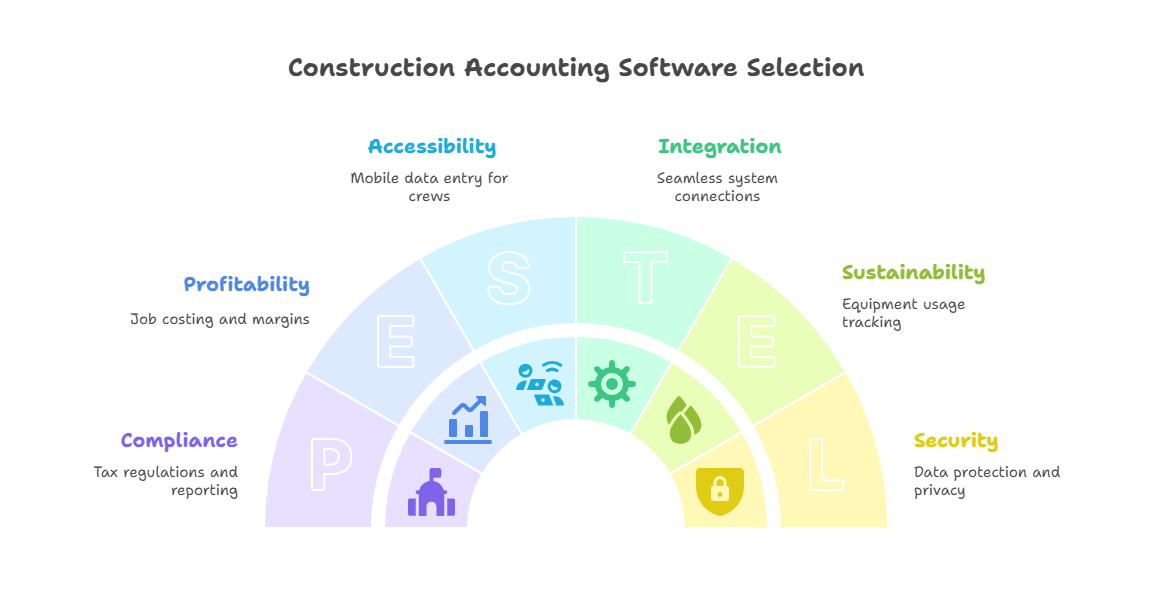
Modern construction accounting services use industry-specific software platforms that integrate job costing, project management, and financial reporting in one system. QuickBooks Online with construction-specific setup works for smaller contractors under $5 million in revenue, while companies exceeding that typically need dedicated construction accounting software like Sage 100 Contractor, Foundation, or Viewpoint.
The software choice matters because general accounting platforms weren't designed for construction. You can force QuickBooks to track jobs, but it requires extensive customization and workarounds. Purpose-built construction software handles job costing naturally, manages retainage automatically, generates AIA billing forms with one click, and produces WIP schedules without manual calculations.
Integration capabilities are essential. Your accounting system should connect seamlessly with project management software (like Procore, Buildertrend, or CoConstruct), time tracking apps used by field crews, and equipment tracking systems. When these systems talk to each other, labor hours automatically flow from timesheets to job costs, material orders update project budgets in real-time, and you're not entering data twice.
Cloud-based platforms have become standard because they allow project managers, superintendents, and office staff to access financial information from anywhere. A project manager on site can check remaining budget for electrical work before approving a change order. The estimator can pull actual costs from completed projects while preparing new bids. Your CPA can access financials to prepare tax returns without waiting for you to email reports.
Mobile accessibility matters for construction specifically because decision-makers are rarely at desks. Field personnel need to enter timecards, capture progress photos for billing, and approve invoices from their phones or tablets. The easier you make data entry for crews, the more accurate and timely your information becomes.
Cost coding structures require careful setup. Most construction software allows you to define how job costs are organized, by CSI division, by project phase, by cost type, or custom categories that match how you bid and manage work. The right professional will configure cost codes that make sense for your business and train your team to use them consistently. Inconsistent cost coding makes reports useless.
Reporting capabilities separate basic software from robust solutions.
You need reports that show job profitability by phase, compare estimated versus actual costs by cost code, track equipment usage and costs, analyze margins by project type, and calculate true overhead rates. Canned reports rarely meet construction needs, look for software allowing custom report building.
Automated workflows reduce manual work and errors.
Progress billing should pull from job costs automatically, applying retainage percentages and generating AIA G702/G703 forms. Invoice approval workflows should route vendor bills to project managers for approval, then to accounting for payment. Automated bank feeds should import and categorize transactions, with just a quick review needed rather than manual entry.
Security and backup are non-negotiable for cloud-based construction accounting. Your financial data includes sensitive information about projects, clients, and profitability. Ensure the software provides bank-level encryption, regular automated backups, user permission controls (so field staff can't access financial reports), and audit trails showing who made what changes.
Construction companies generating $3-15 million in annual revenue benefit most from fractional CFO services when they're scaling rapidly, struggling with cash flow despite profitability, or preparing for significant changes like ownership transition. Unlike bookkeeping that handles daily transactions, CFO services provide strategic financial guidance, optimizing bonding capacity, structuring growth financing, and building systems that support your next growth phase.
The typical trigger points include expanding into new markets or service lines, persistent cash flow problems despite showing profit on paper, difficulty getting bonding capacity to bid larger projects, preparing to sell the business or transition to next generation, adding significant equipment requiring financing decisions, or managing the financial side of 8+ concurrent projects.
A fractional CFO brings expertise you likely don't have in-house. They've helped multiple construction companies navigate growth challenges, optimize capital structure, and build financial systems. Where your bookkeeper records what happened and your CPA prepares tax returns, a CFO focuses on what should happen, should you lease or buy equipment, can you afford to hire two more crews, how should retainage be structured in new contracts.
Cash flow optimization is often the first focus. They'll analyze your payment terms, billing timing, retainage structures, and working capital needs to create a 13-week cash flow forecast. This rolling forecast predicts cash shortfalls before they happen, identifies opportunities to negotiate better terms with suppliers, and shows when you have excess cash to invest in growth or equipment.
Bonding and banking relationship management improves with CFO-level attention. They prepare detailed financial packages for bonding companies, proactively communicate about large projects or changes, and ensure financial statements present your company in the best possible light. Many contractors see bonding capacity increase 30-50% within 12 months of engaging CFO services, not because their financial position changed, but because it's being presented properly.
Profitability analysis gets more sophisticated. Instead of just knowing overall company profit, you'll understand profitability by project type (residential versus commercial, new construction versus remodeling), by client (which clients are most profitable to work with), and by project manager (are some PMs consistently delivering better margins). These insights guide strategic decisions about where to focus business development efforts.
Pricing and estimating improve dramatically with CFO involvement. They help ensure overhead calculations are current, profit margins are appropriate for risk level, and estimates include all true costs. Many contractors discover they've been underbidding by 8-12% once a CFO analyzes their actual costs against estimates.
Exit planning becomes manageable. If you're thinking about retirement or selling the business in 3-5 years, a fractional CFO helps maximize enterprise value. They focus on EBITDA improvement, reducing owner dependence, documenting systems and processes, and cleaning up financial statements. Companies that plan exit strategy 3-5 years ahead typically achieve 20-30% higher valuations than those trying to sell quickly.
The investment typically runs $2,500-7,500 monthly depending on company size and services needed, which is 50-70% less than hiring a full-time CFO. You get experienced strategic guidance without the overhead of another salary, benefits, and office space. Many construction firms find the improved cash flow management and bonding capacity gains pay for the service within 3-6 months.
Construction accounting tracks costs on a project-by-project basis rather than at the company level, uses specialized revenue recognition methods like percentage-of-completion, and handles unique challenges such as retainage, progress billing, and decentralized production. Each construction project functions as its own profit center with distinct materials, labor costs, and timelines that must be tracked separately.
Job costing tracks every expense, labor, materials, equipment, and overhead, for each project, allowing contractors to identify cost overruns early, improve bidding accuracy, and make data-driven decisions. Companies using detailed job costing systems report identifying 12-18% more cost-saving opportunities compared to those using general accounting methods.
The top challenges include managing cash flow with extended payment cycles (often 60-90 days), accurate job costing across multiple projects, handling retainage (typically 5-10% held until project completion), complex multi-state payroll with prevailing wage requirements, and proper overhead allocation. These challenges require specialized accounting expertise to navigate effectively.
Retainage should be tracked separately as accounts receivable on your balance sheet and recorded when you invoice the client, not when you receive payment. Most construction accounting software allows you to set retainage percentages automatically. Proper tracking ensures you can forecast cash flow accurately and identify projects where retainage release is delayed beyond contract terms.
Most contractors use the percentage-of-completion method, which recognizes revenue as work progresses and provides a more accurate financial picture for projects spanning multiple accounting periods. The completed contract method is allowed for smaller projects under $10 million or when reliable estimates can't be determined, though it can cause significant income fluctuations between years.
Implement progress billing to invoice as milestones are met rather than waiting until project completion, negotiate shorter payment terms in contracts (30 days instead of 60-90), track retainage release dates carefully, and maintain accurate cash flow forecasts that account for seasonal variations. Construction firms that forecast cash flow monthly reduce payment delays by an average of 23 days.
Outsourcing makes sense for firms spending 15+ hours weekly on bookkeeping, struggling with job costing accuracy, or lacking in-house expertise in construction-specific accounting. Many contractors partner with specialized offshore accounting firms to reduce overhead by 40-60% while accessing CPAs with construction industry experience. The key is choosing a provider familiar with job costing, retainage, and WIP reporting.
Madras Accountancy provides full-service construction accounting including job costing, WIP reporting, progress billing, retainage tracking, payroll processing (including certified payroll), tax preparation, and fractional CFO services. As an offshore partner to U.S. CPA firms since 2015, we combine construction industry expertise with cost-effective delivery, allowing contractors to focus on building while we handle the financial complexity.
Construction accounting isn't just paperwork, it's the financial operating system that either limits your growth or enables it. Companies that treat accounting as an afterthought end up missing profit leaks, underbidding jobs, and scrambling for working capital. Those that invest in proper construction accounting services gain the financial clarity to bid confidently, manage cash flow proactively, and scale sustainably.
The construction firms thriving over the long term share one trait: they know their numbers. They can tell you instantly which projects are profitable, where costs are tracking against budget, and whether they have the working capital to take on new work. That knowledge comes from specialized accounting designed for construction's unique challenges.
Madras Accountancy has served as an offshore accounting partner to U.S. CPA firms since 2015, providing construction companies with expert job costing, WIP reporting, payroll compliance, and fractional CFO services. Our team combines deep construction industry knowledge with cost-effective offshore delivery, helping contractors achieve the financial clarity they need without the overhead of building in-house accounting departments. Ready to get your construction accounting dialed in? Let's talk about how we can support your financial needs.
Related read: accounting software.
Related read: construction industry audit challenges solutions.
Section 4960's 21% excise tax now reaches far more nonprofit employees. See who is a covered employee in 2026 and what changed.

The Section 45S paid family leave credit is permanent for 2026 with new options. See who qualifies, the amounts, and how to claim it.
Opportunity zones become permanent in 2027 under the One Big Beautiful Bill. See the new deferral, rural bonus, and the 2026 handoff.