

Direct Answer: Setting up a C corporation for real estate generally creates unfavorable tax consequences due to double taxation, income is taxed at the corporate level (21% federal rate), then again when distributed to shareholders as dividends. Most real estate investors avoid this structure, opting instead for LLCs or S corporations that offer pass-through taxation and similar liability protection.
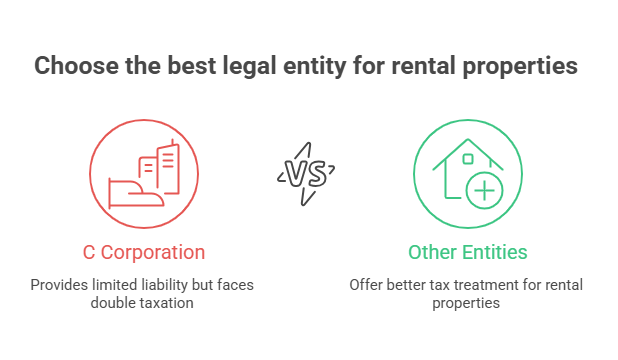
A C corporation is a separate legal entity that provides limited liability protection, shielding your personal assets from business debts. The problem? Tax treatment makes it expensive for rental properties.
Here's how double taxation works: When your corporation earns rental income of $100,000, it first pays corporate tax (roughly $21,000 at the 21% federal rate). When you distribute the remaining $79,000 to yourself as a dividend, you'll pay personal income tax on that amount—potentially another $15,800 at a 20% dividend rate. Your effective tax burden reaches 36.8% on the same dollar.
For comparison, an LLC with pass-through taxation lets you pay tax only once at your personal rate. This is why real estate professionals typically recommend limited liability companies or S corporations for holding real property.
Despite the tax disadvantages, a few scenarios warrant considering a C corporation for real estate investing:
Active real estate development: If you're flipping properties or running a property management business (not just holding rental properties), the corporation structure can work. You're generating ordinary income through business operations rather than passive rental income, and you can reinvest profits without distributing them as taxable dividends.
Significant retained earnings: When you plan to keep profits inside the business for growth—buying more properties, renovations, or expansion—you only pay the 21% corporate tax rate without triggering dividend taxation. This defers the second layer of tax indefinitely.
Employee benefit plans: C corporations can offer better tax-advantaged benefits to owner-employees, including health insurance and retirement plans that aren't available to LLC members.
Understanding the differences between C corps and S corps helps you evaluate which entity structure aligns with your real estate investment strategy.
Beyond double taxation, C corporations face another problem with real estate: depreciation recapture and capital gains.
When a corporation sells appreciated real estate, it pays corporate tax on the gain—including recapture of depreciation at ordinary income rates. Then when you liquidate the corporation or distribute proceeds, you're taxed again at personal rates. This makes exit strategies expensive.
Most rental property owners benefit from holding real estate outside the corporation. If you need the liability protection, an LLC structured as a pass-through entity gives you limited liability without the corporate tax burden. Your rental income flows to your personal tax return, and you're taxed once at your individual rate.
For real estate held long-term, this matters significantly. Capital gains tax rates (0-20% federal) are typically lower than ordinary income rates. But a C corporation converts your real estate gains into corporate income first, then dividend income—losing the preferential capital gains treatment.
If your situation justifies using a C corporation, here's the setup process:
File articles of incorporation with your state. This creates the legal entity and establishes the corporate structure. You'll need a registered agent, corporate bylaws, and initial director appointments.
Obtain an EIN from the IRS for your corporation. This tax identification number is required for opening bank accounts and filing tax returns.
Establish corporate formalities. Hold regular board meetings, maintain corporate minutes, and keep business finances completely separate from personal funds. Failing to maintain the corporate veil can expose you to personal liability—defeating the purpose of incorporation.
Set up proper accounting systems. C corporations require more complex bookkeeping than LLCs. You'll need to track depreciation schedules, shareholder distributions, and corporate-level transactions separately. Many firms work with outsourced bookkeeping services to maintain accurate records and avoid costly errors.
File Form 1120 annually to report corporate income. Unlike pass-through entities, your corporation files its own tax return and pays corporate income tax directly.
Before committing to a C corporation, consider these structures that most real estate investors prefer:
Single-member LLC: Provides liability protection while being treated as a disregarded entity for tax purposes. Your rental income and expenses flow directly to Schedule E of your personal return. You maintain the legal separation between personal and business assets without double taxation.
Multi-member LLC: Works like a partnership for tax purposes. Income passes through to members based on ownership percentages, and you still get limited liability protection.
S corporation: Offers pass-through taxation like an LLC but with potential self-employment tax savings. However, S corps have restrictions on ownership and profit distribution that may not suit all real estate ventures.
The right choice depends on your specific situation—property types, investment strategy, income levels, and long-term goals. Working with experienced tax advisors helps you structure your real estate holdings to minimize your tax bill while protecting your assets.
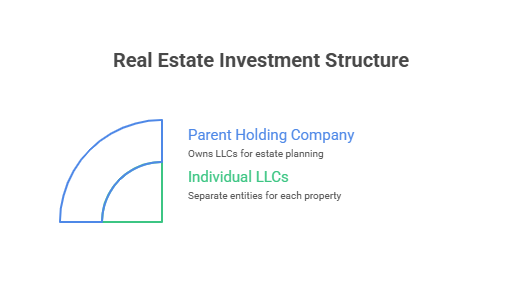
Most successful real estate investors use a tiered structure: They form separate LLCs for individual properties (or small groups of properties) to isolate liability. These LLCs are then owned by a parent holding company—sometimes another LLC, sometimes a trust—for estate planning purposes.
This approach gives you lawsuit protection (if one property gets sued, others remain protected), tax efficiency (pass-through taxation), and flexibility in how you distribute ownership or sell individual properties. It's more complex than a single corporation, but it solves the problems that make C corporations problematic for real estate.
For investors managing multiple rental properties, maintaining proper financial records becomes increasingly important. Many turn to virtual CFO services to develop strategic entity structures and optimize their tax position as their portfolio grows.
Yes, but it triggers immediate taxation on any appreciated assets, including real estate. The IRS treats the conversion as if you sold all assets at fair market value, then transferred them to the LLC. This makes changing structures expensive once you've started.
Yes, assuming you maintain proper corporate formalities. The corporation owns the property, not you personally. If someone sues over a rental property issue, they're suing the corporation. Your personal assets remain protected as long as you don't pierce the corporate veil.
Yes, mortgage interest on real property owned by your corporation is deductible as a business expense. The corporation pays the mortgage and deducts the interest on Form 1120, reducing taxable corporate income.
The corporation claims depreciation on rental properties using the same schedules as individual owners (27.5 years for residential rental property). This reduces corporate taxable income. However, when you eventually sell the property, the corporation must recapture depreciation at ordinary income rates, then you're taxed again when distributing the proceeds.
No. Real estate professional status helps individual taxpayers deduct rental losses against ordinary income. Since a C corporation files its own tax return, this designation doesn't apply. Corporate losses offset corporate income only.
Some investors own rental property personally and lease it to their C corporation (which then subleases to tenants). This keeps the real estate outside the corporate structure. However, the IRS scrutinizes these arrangements. Lease payments must be at fair market value, and this setup creates administrative complexity without significant tax benefits.
Dissolving triggers immediate taxation. The corporation is treated as selling all assets at fair market value (paying corporate tax on any gain), then distributing the proceeds to shareholders (triggering dividend tax). This double tax hit makes exiting a C corporation expensive.
Only in specific situations: when you're running an active real estate business (not passive rentals), when you'll retain all earnings indefinitely, or when you need specific corporate benefits that outweigh the tax disadvantages. For most rental property investors, pass-through entities like LLCs offer better tax treatment and similar liability protection.

Section 4960's 21% excise tax now reaches far more nonprofit employees. See who is a covered employee in 2026 and what changed.

The Section 45S paid family leave credit is permanent for 2026 with new options. See who qualifies, the amounts, and how to claim it.

Opportunity zones become permanent in 2027 under the One Big Beautiful Bill. See the new deferral, rural bonus, and the 2026 handoff.