

.png)

You're staring at a commercial real estate deal that looks promising on paper. The seller's pro forma shows strong returns, but you need to verify the numbers yourself. Without a proper real estate financial model, you're essentially making a million-dollar decision based on someone else's spreadsheet. That's where financial modeling comes in-it transforms assumptions into testable projections that reveal whether a deal actually works.
Real estate financial modeling is the process of building Excel-based frameworks that forecast property cash flows, calculate investment returns, and stress-test scenarios before you commit capital. This guide walks you through the foundations of real estate financial modeling, from basic acquisition models to complex development waterfalls, with practical examples and templates you can use immediately.
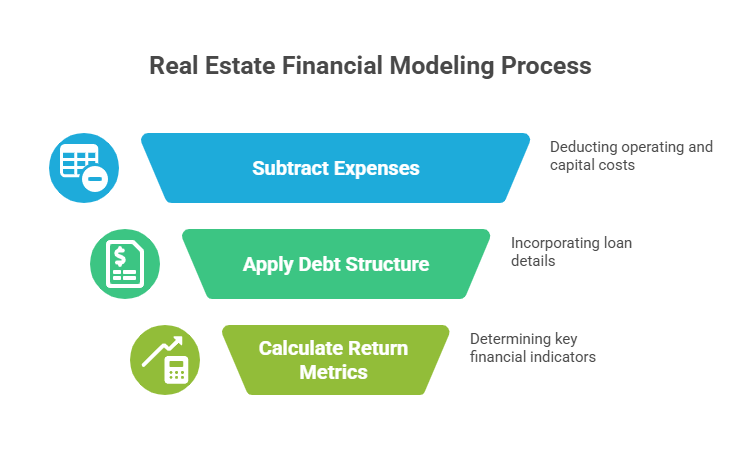
A real estate financial model is an Excel-based tool that projects property-level cash flows and calculates key metrics like IRR, equity multiple, and cash-on-cash returns. The model starts with revenue assumptions (rents, lease terms, occupancy), subtracts operating expenses and debt service, then applies various return calculations to determine whether the investment meets your hurdle rate.
The core components of any real estate model include:
Most real estate financial models follow a monthly or annual projection period, typically spanning 5-10 years depending on the investment strategy. Acquisition models might use a 7-year hold period, while development models extend to 10+ years to capture the full construction and stabilization timeline.
The difference between a basic pro forma and a proper financial model lies in flexibility. A static pro forma gives you one scenario. A well-built model lets you adjust key assumptions-rent growth, exit cap rate, renovation costs-and instantly see how those changes impact returns. That's why real estate private equity firms build detailed models: they need to test 20 different scenarios before presenting a deal to their investment committee.
Real estate deals involve too many variables to rely on back-of-envelope calculations. A multifamily acquisition might look attractive at a 7% cap rate, but what happens if vacancy increases 5% or property taxes get reassessed? Financial models answer these questions before you're locked into a purchase agreement.
Here's what changes when you run the numbers properly:
Risk quantification: Your model shows you the breakeven vacancy rate, the minimum rent growth needed to hit your return target, and how much cushion exists if expenses run higher than expected. Most investors discover their deal assumptions were too aggressive once they build a proper model with conservative inputs.
Lender requirements: Banks won't finance commercial real estate without seeing your detailed cash flow projections. Your model needs to prove debt service coverage ratios (DSCR) stay above 1.25x throughout the hold period. If your model shows DSCR dropping to 1.1x in year three, expect the lender to reduce your loan-to-value (LTV) or require additional equity.
Investor reporting: If you're syndicating deals or managing capital for partners, your model becomes the baseline for all future reporting. The projections you show investors during fundraising set expectations for quarterly updates. When actual performance deviates from your model, you'll need to explain why-which is much easier when your original assumptions were documented and reasonable.
The firms that consistently close deals have refined their modeling approach over hundreds of transactions. They know which assumptions actually drive returns (hint: it's usually exit cap rate and rent growth) and which variables barely move the needle. Building your own models develops that same intuition.
Start with a simple acquisition model before attempting development or value-add scenarios. Here's the framework that works for most commercial real estate deals:
Set up your Excel workbook structure. Create separate tabs for: (1) Assumptions, (2) Revenue, (3) Expenses, (4) Debt Schedule, (5) Cash Flow, (6) Returns. This organization keeps your model clean and makes it easier to audit later.
Input your revenue assumptions. In the Revenue tab, build out your rent roll with current in-place rents and lease expiration dates. For vacant units, estimate market rents based on comparable properties. Include annual rent escalations (typically 2-3% for multifamily, specific lease terms for commercial). Add other income sources like parking, laundry, or storage.
Build your operating expense forecast. Start with the seller's trailing 12-month expense statement, but verify each line item. Property management fees typically run 3-5% of gross revenue. Insurance, utilities, and maintenance costs should grow with inflation. Property taxes might increase significantly if the property gets reassessed post-sale.
Structure your debt schedule. Use Excel's IPMT and PPMT functions to calculate monthly interest and principal payments. Your amortization schedule should show the declining loan balance and increasing principal repayments over time. Don't forget to include loan fees and closing costs in your upfront capital requirements.
Calculate cash flow to equity. Subtract operating expenses and debt service from your gross revenue to get annual cash flow. This is the actual cash distributed to equity investors after the lender gets paid. Many models then discount these cash flows using a target IRR to determine the maximum price you can pay for the property.
Model your exit scenario. Apply an exit cap rate to your projected NOI in year 5 or 7 to calculate your sale price. Subtract selling costs (typically 2-3% of sale price), pay off your remaining loan balance, and distribute the remaining proceeds to equity. This exit value often represents 70-80% of your total returns on a standard acquisition.
Once your basic model works, add sensitivity tables that show how returns change if your cap rate assumption moves up or down 50 basis points, or if rent growth comes in 1% below expectations. These scenarios help you understand where your risk actually lives.
The modeling approach varies significantly based on your investment strategy. A core acquisition needs simpler projections than a ground-up development or complex joint venture structure.
Acquisition models focus on in-place cash flows and stable operations. You're buying a stabilized asset with existing tenants, so your revenue is relatively predictable. The modeling challenge involves accurately underwriting renewal probabilities, tenant improvement costs, and market rent assumptions. For firms managing outsourced accounting services, these acquisition models become the baseline for all client reporting and variance analysis.
Development models require construction budgets, phased capital calls, and absorption schedules. You start with negative cash flow during construction, then model lease-up curves as tenants move in. The complexity increases because you're projecting costs (hard costs, soft costs, interest carry) and revenue timing simultaneously. Most development models use monthly periods instead of annual to capture the construction timeline accurately.
Value-add and renovation models sit between acquisition and development. You're buying an underperforming property, investing capital to improve it, then refinancing or selling at a higher valuation. These models need separate sections for renovation costs, temporary vacancy during construction, and higher post-renovation rents. The return calculation gets tricky because you have two distinct cash flow periods: during and after renovation.
Multifamily models typically have the most granular revenue assumptions because you're tracking individual unit rents, lease terms, and turnover. You need to model concessions, lease-up velocity for vacant units, and renewal versus turnover costs. Operating expenses are usually calculated per-unit or as a percentage of revenue.
Office and retail lease models require more complex lease structures with triple-net provisions, expense reimbursements, and tenant improvement allowances. You track each lease separately because terms vary significantly by tenant. The model needs to calculate landlord obligations (TI, commissions) and recover those costs through base rent and expense pass-throughs.
Master these Excel formulas to build flexible, error-free financial models:
IPMT and PPMT calculate your interest and principal payments for each loan period. The syntax is IPMT(rate, per, nper, pv) where rate is your monthly interest rate, per is the specific payment number, nper is total payments, and pv is your loan amount. Use PPMT with the same structure for principal.
XNPV and XIRR give you time-weighted returns when your cash flows occur at irregular intervals. Standard NPV and IRR functions assume annual or monthly periods, but real estate deals rarely time out perfectly. XNPV requires dates for each cash flow, making it more accurate for actual investment analysis.
IF statements with error handling prevent your model from breaking when inputs change. Wrap formulas in IFERROR() to display blanks or zeros instead of #DIV/0 or #VALUE errors. Use nested IF statements to model scenarios like: IF(vacancy > threshold, apply higher expense ratio, use standard expenses).
Data validation for assumptions creates dropdown lists that force users to select from predefined options. This prevents someone from accidentally entering a 50% interest rate when they meant 5.0%. For critical inputs like exit cap rate or rent growth, add comments explaining your reasoning.
Name ranges make your formulas readable and reduce errors. Instead of referencing cell C24, name that cell "Exit_Cap_Rate" and use the name in formulas. When you audit the model six months later, you'll understand what each formula does without needing to trace precedents.
Most modeling errors come from broken formulas, not wrong assumptions. Build your Excel file with consistent formatting, clear section headers, and explicit links between tabs. When something doesn't calculate correctly, you want to find the error in minutes, not hours.
Professional models share common characteristics that separate them from amateur spreadsheets. These practices reduce errors and make your model more valuable:
Separate assumptions from calculations. All key inputs (rent growth, cap rates, expense ratios) should live in a dedicated Assumptions tab. Every formula in your model pulls from these assumption cells. This separation makes it easy to adjust inputs and run scenarios without digging through complex formulas.
Color code your cells. Use blue font for inputs, black for formulas, and green for external links. This visual system shows users which cells they can edit (inputs) versus which cells contain formulas they shouldn't touch. Many firms add data validation to input cells to prevent illogical entries.
Document your sources. Every assumption needs a comment explaining where it came from. "Market rent: $2.50/SF per CoStar comp analysis" is better than just entering $2.50. Six months later, when someone questions your rent assumptions, you'll know exactly how you derived them.
Build in flexibility with scenario toggles. Add dropdown menus that let users switch between Base Case, Upside, and Downside scenarios. Instead of creating three separate models, your single file shows all three scenarios by toggling one input cell. This approach reduces version control issues and makes presentations cleaner.
Test your model with extreme inputs. Enter zero for all revenue to see if your loss calculation works correctly. Input 100% vacancy to verify your model doesn't generate negative expenses. If extreme values break your formulas, add error handling or constraints. For businesses seeking to improve their financial operations efficiency, these modeling best practices apply equally to internal financial planning systems.
Lock and protect completed sections. Once your debt schedule calculates correctly, protect that worksheet so users can't accidentally delete formulas. Leave assumption cells unlocked but protect everything else. This prevents the all-too-common issue where someone overwrites a formula and wonders why their model suddenly shows incorrect returns.
The highest-quality models balance sophistication with usability. You want enough detail to capture reality, but not so much complexity that only you can use the model. Aim for a template that another analyst can pick up, understand in 30 minutes, and run scenarios without training.

Even experienced investors make these modeling errors that undermine their analysis:
Aggressive rent growth assumptions. Using 4-5% annual rent growth when the local market averages 2-3% inflates your returns dramatically over a 7-year hold. Check recent rent data from CoStar or RealPage before assuming your property will outperform the market. Most models need market-rate growth, not best-case growth.
Understating capital expenditures. Ignoring roof replacements, HVAC upgrades, and parking lot resurfacing makes your property look more profitable than reality. Build a capital expenditure reserve of $200-400 per unit annually for multifamily, or 1-2% of property value for commercial. These costs will hit eventually-model them upfront.
Ignoring leasing costs and downtime. Every tenant turnover costs you lease commissions, tenant improvements, and lost rent during vacancy. For office properties, this can easily run $40-60 per square foot when you factor in TI allowances and free rent periods. Model these costs explicitly rather than just reducing revenue by a blanket percentage.
Static cap rate assumptions. Your model might show a 12% IRR using a 6% exit cap rate. But if cap rates expand to 6.5% due to interest rate changes, your returns drop to 8%. Run sensitivity tables showing returns across a range of exit cap rates. Include downside scenarios where cap rates expand 50-100 basis points.
Circular reference errors in refinance scenarios. When modeling cash-out refinances, your new loan amount depends on property value, which depends on NOI, which depends on whether you have enough cash to cover expenses. These circular references break Excel unless you enable iterative calculations or restructure your model.
For complex scenarios involving multi-channel financial reporting, proper accounting systems help avoid these interconnected calculation issues.
Forgetting about taxes. Real estate returns are only meaningful after taxes. Your model should include depreciation schedules, capital gains calculations, and at minimum an estimated tax rate applied to ordinary income. Many investors are surprised when their 15% IRR becomes 11% after-tax-model this from the start.
Over-engineering the model. Adding 50 sensitivity tables and complex macros might seem sophisticated, but it makes your model harder to use and more prone to errors. Focus on the 3-4 variables that actually drive returns (rent growth, exit cap, renovation cost, vacancy) and build scenarios around those. Everything else is probably noise.
The best defense against these errors is having another analyst review your model. They'll catch assumptions that seem optimistic, formulas that don't make sense, and logic gaps you missed because you've been staring at the spreadsheet for too long.
If you're serious about mastering this skill, formal training accelerates your learning curve. Here's what's available:
Online course platforms like Wall Street Prep and Breaking Into Wall Street offer comprehensive real estate financial modeling training programs. These courses include video tutorials, Excel templates, and case studies from actual transactions. The REFM (Real Estate Financial Modeling) certification from BIWS is particularly well-regarded among real estate private equity firms.
University programs from Cornell and MIT provide graduate-level real estate finance courses that include extensive modeling components. These programs go deeper into academic concepts like modern portfolio theory and real options analysis, though they may be less practical for day-to-day deal analysis.
Industry-specific training through organizations like the CCIM Institute or the National Association of Realtors focuses on commercial real estate valuation and investment analysis. These programs emphasize local market analysis and investment decision frameworks alongside Excel modeling skills.
The most valuable training combines theory with hands-on practice. Look for courses that provide actual deal case studies-acquisition, development, joint venture-and make you build complete models from scratch. You'll learn more building three full models than watching 50 tutorial videos.
Excel skills prerequisite: Before taking an advanced modeling course, make sure you're comfortable with lookup functions, pivot tables, and basic financial formulas. Most real estate courses assume you already know Excel fundamentals and jump straight into modeling techniques.
Real estate investors often overlook how proper accounting infrastructure improves their modeling accuracy and deal execution speed.
Most investors build models without access to clean, organized historical data. Your pro forma shows 5% expense growth, but your actual expense tracking is scattered across bank statements and receipts. This disconnect means your future models never improve based on actual performance-you're just repeating the same assumption errors. Firms that handle bookkeeping for small businesses can structure your property-level accounting to feed directly into your financial models, creating a feedback loop that improves projection accuracy.
Investor reporting packages generated from proper accounting systems match your model structure. Your quarterly reports show actual vs. projected cash flow, NOI variances, and budget performance. This standardized reporting makes it easier to raise future capital because investors see you track performance the way institutional players do.
Tax planning and structuring becomes easier when your accounting system captures property-level performance. Your CPA needs accurate NOI figures to calculate depreciation, optimize entity structure, and identify cost segregation opportunities. Models built without proper accounting support often miss these tax advantages because the underlying data isn't organized correctly.
Asset management and benchmarking improve when you track operating metrics consistently across properties. Your expense ratio per unit, turnover costs, and maintenance spending should inform your future acquisition models. Without clean accounting data, you're flying blind on these operational metrics.
For real estate businesses expanding operations or managing multiple properties, scaling your finance department becomes crucial as deal volume increases and investor reporting requirements grow more complex.
What's the difference between a pro forma and a financial model in real estate?
A pro forma is a simplified projection showing expected income and expenses, usually created by the seller or broker. A financial model is a comprehensive Excel tool that you build yourself to test different scenarios, calculate detailed returns, and stress-test assumptions. Models are more detailed and flexible than basic pro formas.
How long does it take to build a real estate financial model from scratch?
A basic acquisition model takes 4-6 hours for someone comfortable with Excel. Development models require 10-15 hours due to construction phasing and more complex cash flow timing. Your first model takes the longest-once you have a template, subsequent deals can be modeled in 2-3 hours by updating assumptions.
Do I need to be an Excel expert to create real estate financial models?
You need intermediate Excel skills including formulas, cell references, and basic functions like SUM and IF statements.
The modeling logic matters more than advanced Excel tricks. Start with simple acquisition models, then gradually add complexity as your skills improve. Most real estate professionals learn by modifying existing templates rather than building from a blank spreadsheet.
What's the typical IRR range for commercial real estate investments?
Core stabilized properties target 8-12% IRR with lower risk. Value-add investments aim for 15-20% IRR. Development deals seek 20%+ IRR to compensate for construction risk and longer time horizons. Your target return depends on risk tolerance, deal structure, and current market conditions. Always compare your projected returns to benchmark indices like the NCREIF Property Index.
Should I use monthly or annual periods in my financial model?
Annual periods work fine for stabilized acquisitions with predictable cash flows. Use monthly periods for development models, lease-up scenarios, or when precise timing matters for debt service coverage calculations. Monthly models take longer to build but provide more accurate return calculations for complex deals.
How do I know if my real estate model assumptions are realistic?
Compare your inputs against comparable transactions, broker opinions of value, and market research from CoStar or REIS. Your rent growth shouldn't exceed market averages unless you have specific value-add plans.
Exit cap rates should align with or be slightly higher than current market cap rates. If your assumptions make the deal look significantly better than market comps, they're probably too aggressive.
What's the most important metric in a real estate financial model?
IRR (internal rate of return) is the primary metric because it accounts for both cash flow timing and investment size. However, equity multiple, cash-on-cash return, and debt yield are also important depending on your strategy and lender requirements.
Don't rely on a single metric-analyze multiple return measures to understand the complete risk-return profile.
Can accounting firms help with real estate financial modeling?
Yes, experienced accounting firms can build custom models for specific deals, audit your existing models for errors, or set up standardized templates for your investment pipeline. Firms specializing in real estate accounting bring industry knowledge that improves assumption accuracy and helps you avoid common modeling mistakes that could cost you in negotiations or financing discussions.
Start with a simple acquisition model using a real property you're evaluating or a case study from a course. Follow the step-by-step structure outlined above: assumptions, revenue, expenses, debt, cash flow, returns. Don't worry about perfection-your first model will have errors, and that's part of the learning process.
Once you have a working template, test it with different scenarios. Adjust your rent growth assumption, change your exit cap rate, increase vacancy by 10%. Watch how these changes impact your returns. This scenario analysis develops the intuition that separates sophisticated investors from those who just plug numbers into someone else's spreadsheet.
The real value in modeling isn't the final IRR number-it's understanding how different variables interact to create or destroy value in a deal. Build enough models and you'll recognize patterns: which deals have sufficient cushion to weather downside scenarios, and which ones only work if everything goes perfectly. That judgment is what makes you a better investor.
About Madras Accountancy
Madras Accountancy provides outsourced accounting, tax preparation, and fractional CFO services to CPA firms and real estate investors across the United States and UK. Since 2015, we've helped over 200 firms scale their operations while maintaining quality control through same-day error resolution protocols. Our team specializes in real estate accounting, financial modeling support, and investor reporting packages that align with institutional standards. Learn more about our services at madrasaccountancy.com.

Section 4960's 21% excise tax now reaches far more nonprofit employees. See who is a covered employee in 2026 and what changed.

The Section 45S paid family leave credit is permanent for 2026 with new options. See who qualifies, the amounts, and how to claim it.

Opportunity zones become permanent in 2027 under the One Big Beautiful Bill. See the new deferral, rural bonus, and the 2026 handoff.