


A Seattle rental income accountant specializes in helping landlords and property investors maximize tax deductions on rental properties while ensuring compliance with Washington B&O tax and federal IRS requirements. They handle depreciation schedules, cost segregation studies, passive loss limitations, and Schedule E filing, services that typically save Seattle property owners $8,000 to $15,000 annually.
You bought your Seattle rental property thinking it would generate steady cash flow. Then tax season hit, and you realized managing rental income isn't as straightforward as collecting monthly checks. Between Washington's unique B&O tax requirements, federal depreciation rules, and Seattle-specific rental regulations, most landlords leave thousands on the table each year.
Seattle's rental market, with median property values exceeding $800,000 and strong tenant demand, creates significant tax implications that require specialized knowledge. The difference between a general accountant and a real estate CPA who understands Seattle's rental landscape can mean $8,000 to $15,000 in additional tax savings annually.
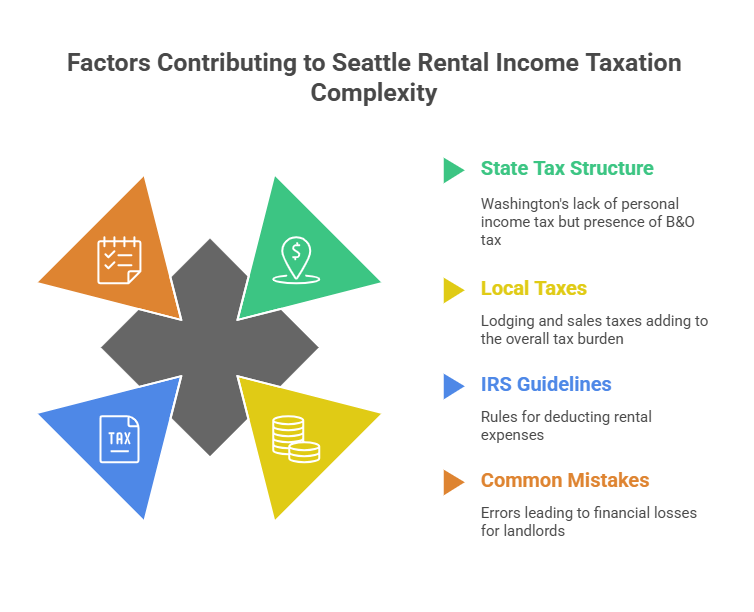
Rental income taxation in Seattle is uniquely complex. Washington State has no personal income tax, but short-term rental operators face B&O tax on gross income, plus lodging and sales tax requirements totaling 15-18%. According to IRS Publication 527, landlords can deduct "ordinary and necessary" rental expenses, but knowing which qualify requires expertise.
Common mistakes cost Seattle landlords $4,200+ annually per property: misclassifying repairs as improvements (losing immediate deductions), failing to claim depreciation, forgetting mileage tracking, and incorrectly calculating the $25,000 passive loss allowance. A specialized real estate CPA handles this complexity and identifies deductions generic preparers routinely miss.
A qualified rental property accountant develops year-round tax strategies for your portfolio. Key services include optimizing Schedule E filing, calculating quarterly estimated payments, advising on entity structure, and implementing strategies for maximizing depreciation and bonus deductions.
Depreciation and cost segregation expertise makes a massive difference. While residential rentals depreciate over 27.5 years, cost segregation studies reclassify components into 5, 7, or 15-year categories. In Seattle's market where properties average $800,000+, a cost segregation study on a $1 million property typically generates $40,000-60,000 in additional first-year deductions.
Seattle-specific compliance includes B&O tax filings for short-term rentals, lodging tax collection, RRIO compliance, and real estate excise tax calculations. Audit support provides peace of mind, your CPA prepares documentation, communicates with IRS agents, and develops comprehensive response strategies for tax examinations.
Seattle landlords claim obvious deductions like mortgage interest and property taxes but overlook write-offs worth thousands annually.
Mortgage interest is fully deductible regardless of loan amount, unlike primary residences with caps. Property taxes (typically 0.87% of assessed value in King County) are completely deductible. Repairs versus improvements creates costly confusion: repairs (fixing furnaces, patching roofs) are immediately deductible, while improvements (replacing entire systems, adding decks) must be depreciated over years.
Property management fees and outsourced bookkeeping services are fully deductible. Seattle management typically costs 8-10% of monthly rent, creating $3,000-6,000 in annual deductions. Insurance premiums, travel expenses (at $0.67/mile for 2025), home office deductions (worth $2,500-4,000 annually), legal and professional fees, and marketing costs all qualify as business expenses.
No state income tax means rental income isn't taxed at the state level, but short-term rentals (under 30 days) face B&O tax on gross receipts (not net income), creating an additional 1.2-1.8% burden.
The passive loss limitation restricts rental losses you can deduct against other income. The IRS allows up to $25,000 in losses if you "actively participate," but this phases out above $100,000 MAGI and disappears at $150,000. Real estate professionals spending 750+ hours annually in real estate activities bypass this limitation.
Cost segregation studies become particularly valuable in Seattle's market. Standard depreciation on a $900,000 rental allows roughly $29,000 annually. A cost segregation study might reclassify $200,000 into shorter periods, generating an additional $30,000-40,000 in first-year deductions. Seattle's RRET (Real Estate Excise Tax) of 1.1-3% applies when selling, strategic 1031 exchanges can defer this burden.
Look for CPA certification, proven rental property experience (ask for references), and knowledge of Washington B&O tax and Seattle regulations. Many excellent CPAs leverage offshore accounting teams to provide cost-effective services while maintaining quality.
Essential questions: How many rental clients do you serve? What's your cost segregation experience? How do you handle passive loss limitations? Can you represent me in audits? What's your depreciation maximization process?
Avoid CPAs offering one-size-fits-all advice, lacking Washington tax knowledge, or promising unrealistic savings. Service pricing ranges from $500-1,500 for basic Schedule E filing on 1-3 properties, to $2,000-5,000 for complex situations. The investment pays for itself when your CPA identifies $8,000-15,000 in additional deductions.
Seattle rental property owners working with specialized real estate CPAs consistently save 25-40% more in taxes compared to self-filing.
Typical scenario: A $950,000 rental generating $52,000 annual income with $38,000 in obvious expenses creates $14,000 taxable income ($3,500-5,000 tax liability) when self-filed. With a specialized accountant capturing missed deductions worth $12,000-18,000 (proper depreciation, home office, repairs, mileage, professional fees, utilities), taxable income drops to $2,000-8,000, reducing your tax bill by $4,200-7,000 annually.
Cost segregation delivers more dramatic results. On a $950,000 property, a $4,500 study typically generates $45,000-60,000 in accelerated depreciation, worth $12,000-18,000 in tax savings. The study pays for itself 3-4 times over immediately.
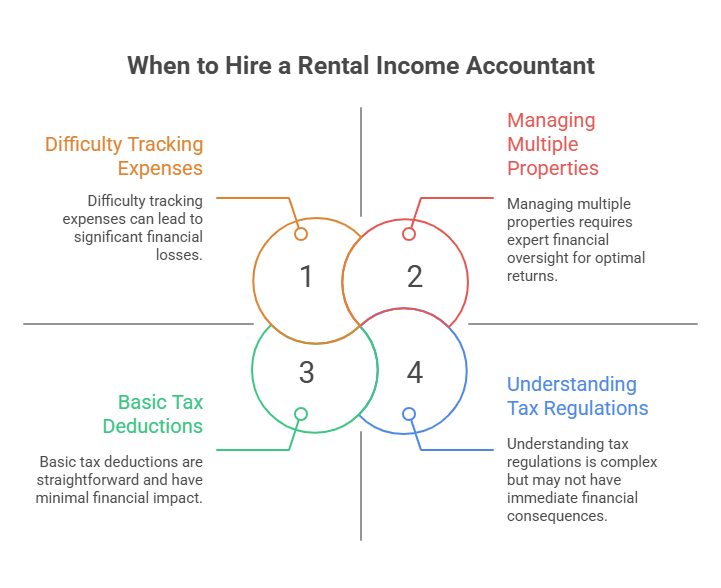
Hire a specialized CPA when you've just purchased your first rental, spend 10+ hours quarterly on tax prep, face an IRS audit, own multiple properties, or plan to sell and minimize capital gains through a 1031 exchange. Year-round tax planning, with quarterly check-ins to review income, expenses, and opportunities, generates far better results than last-minute April filing.
Basic Schedule E filing for 1-3 properties costs $500-1,500 annually. Complex situations with multiple properties and cost segregation run $2,000-5,000. Specialized accountants typically save Seattle landlords $8,000-15,000 in taxes, paying for themselves 3-5 times over.
Yes. Accounting and tax preparation fees related to rental activities are fully deductible as rental expenses on Schedule E, including annual tax filing, consultations, audit representation, and bookkeeping services.
Even one rental creates complex tax situations. If your property generates $30,000+ annual income, an accountant typically saves $3,000-6,000 in taxes, far exceeding the $500-800 cost. The depreciation calculation alone is worth professional expertise.
Short-term rentals (under 30 days) must collect Washington sales tax (10.25% in Seattle), lodging tax, and pay B&O tax on gross receipts. Long-term rentals (30+ days) avoid these taxes but face IRS passive loss limitations.
Bring mortgage statements, property tax bills, insurance documents, repair receipts, property management invoices, utility bills, advertising costs, mileage logs, and rental agreements. Your accountant will guide you on organizing these for maximum deductions.
LLCs provide liability protection without changing tax treatment (you still file Schedule E). For landlords with 3+ properties or significant net income, an S-corporation structure might reduce self-employment taxes. Discuss with your CPA before deciding.
Seattle's rental market offers tremendous wealth-building opportunities, but only if you keep more of what you earn. Most landlords overpay taxes by $5,000-12,000 annually simply because they lack specialized accounting expertise.
A Seattle rental income accountant pays for themselves many times over through proper depreciation scheduling, identification of overlooked deductions, strategic tax planning, IRS audit protection, and year-round guidance on growing your portfolio.
Since 2015, Madras Accountancy has helped U.S. CPA firms and their rental property clients reduce tax liabilities while maintaining full compliance with federal and Washington State requirements. Our offshore model delivers CPA-quality accounting, tax preparation, and bookkeeping services at 40% lower costs than traditional firms, without sacrificing expertise or responsiveness.
Ready to stop overpaying on rental property taxes? Contact Madras Accountancy today for a consultation on how our specialized rental income accounting services can save you thousands this tax year.

Section 4960's 21% excise tax now reaches far more nonprofit employees. See who is a covered employee in 2026 and what changed.

The Section 45S paid family leave credit is permanent for 2026 with new options. See who qualifies, the amounts, and how to claim it.

Opportunity zones become permanent in 2027 under the One Big Beautiful Bill. See the new deferral, rural bonus, and the 2026 handoff.