



Best Real Estate Accounting Services in the USA
The top real estate accounting services in the USA specialize in property-specific tax strategies, multi-entity structures, and investor reporting. Leading firms like Baker Tilly, Withum, and George Dimov CPA combine real estate expertise with technology platforms (QuickBooks, Yardi, AppFolio) to deliver cost segregation studies, 1031 exchange guidance, and portfolio-level financial reporting. Most specialized firms reduce clients' tax burden by 15-30% annually through strategic planning unavailable from general accountants.
You just closed on your third rental property. Your general business accountant handles the basics, income and expenses, quarterly taxes. But you're missing cost segregation opportunities worth $25,000+ in accelerated depreciation. Your entity structure creates unnecessary tax liability. And you're managing three LLCs with spreadsheets instead of consolidated financial statements.
Real estate accounting demands specialization. The tax code for property investments includes 1031 exchanges, passive activity loss rules, rental real estate exceptions, opportunity zones, and Section 179D deductions that general accountants rarely encounter. The right accounting partner transforms your books from compliance exercise into strategic asset.
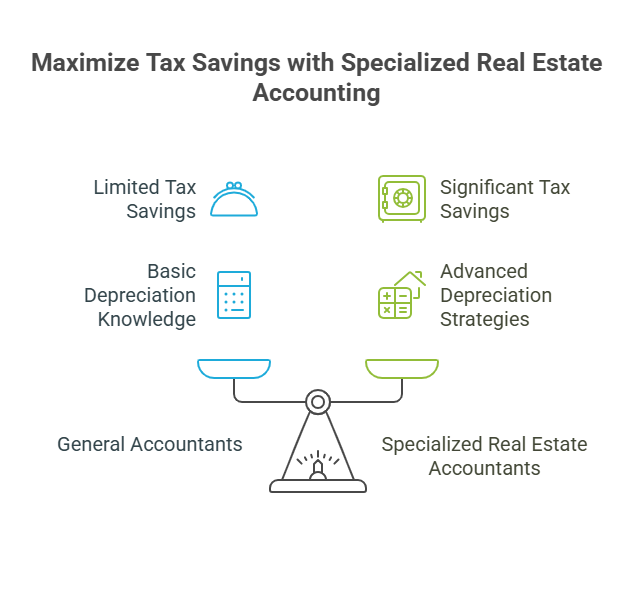
Real estate accounting requires specialized knowledge of property-specific tax rules, multi-entity structures, and investor reporting that standard business accountants don't regularly handle. The difference matters significantly, specialized firms save clients 15-30% more in taxes annually through strategies unavailable to generalists.
Property depreciation rules alone create complexity most accountants miss. Residential rentals depreciate over 27.5 years, commercial over 39 years. But cost segregation studies can accelerate 20-40% of a building's value into 5, 7, and 15-year property classes, creating massive first-year deductions. This specialized tax engineering requires engineers and tax professionals working together, not something your corner CPA offers.
Multi-entity accounting separates excellent real estate accountants from adequate ones. Serious investors operate each property in separate LLCs for liability protection. This creates consolidation challenges, inter-company transactions, and partnership tax returns that multiply compliance work. Top real estate accounting firms handle 50+ entity structures seamlessly with specialized software and systematic processes.
Investor reporting demands grow as portfolios scale. Limited partners want quarterly cash distribution calculations, capital account tracking, and K-1 preparation that accurately reflects their ownership percentages. Property management companies need property-level P&Ls showing net operating income, cap rates, and cash-on-cash returns. Real estate accounting services deliver these reports automatically rather than as one-off special projects.
The tax strategies available to real estate investors dwarf those for other businesses. Opportunity zone investments defer and potentially eliminate capital gains. Real estate professional status unlocks unlimited loss deductions. Like-kind exchanges under Section 1031 defer taxes indefinitely. Specialized accountants structure these strategies proactively rather than missing opportunities discovered only during audits.
Tax Planning and Preparation
Real estate tax preparation extends far beyond filling out Schedule E. Top firms analyze acquisition structures before you close deals, ensuring maximum depreciation deductions and optimal entity selection. They model tax scenarios for property sales, comparing installment sales versus 1031 exchanges versus opportunity zone rollovers. Annual tax planning sessions review your entire portfolio for harvest opportunities, entity restructuring, and strategic timing of improvements or dispositions.
Cost Segregation Studies
Cost segregation transforms building components into accelerated depreciation schedules. Instead of depreciating your $1 million property over 27.5 years ($36,364 annually), studies identify $300,000 of 5-year property (carpets, fixtures) and $200,000 of 15-year property (landscaping, parking lots). Year-one depreciation jumps to $100,000+, creating immediate tax savings. Leading real estate accounting firms either conduct studies in-house or partner with engineering firms, then handle the complex tax filings and documentation required.
1031 Exchange Coordination
Section 1031 exchanges defer capital gains taxes when selling investment property by rolling proceeds into replacement properties. The rules are unforgiving, 45-day identification deadlines, 180-day closing requirements, qualified intermediary requirements, and strict same-taxpayer rules. Real estate accountants coordinate with intermediaries, ensure proper entity structures, and handle the required tax reporting. One missed deadline costs clients six figures in unnecessary taxes.
Entity Structure Optimization
Should you hold properties in single-member LLCs, multi-member LLCs, S corporations, or qualified opportunity zone funds? The choice impacts asset protection, tax treatment, and estate planning. Real estate accounting services evaluate your current structure, identify inefficiencies, and implement changes. They handle the mechanics, forming entities, transferring properties, filing organizational documents, and setting up proper accounting systems for each entity.
Bookkeeping and Financial Reporting
Property-level bookkeeping tracks rental income, operating expenses, capital improvements, and reserve accounts for each property separately. This granularity lets you analyze which properties perform and which drain cash. Top firms use real estate-specific accounting software (Buildium, AppFolio, Yardi) that integrates property management data directly into financial statements. Monthly reports show metrics real estate investors actually care about: net operating income, debt service coverage ratios, and cash flow after debt service.
Audit and Assurance Services
Larger real estate portfolios, syndications, and funds require audited financial statements for lenders and limited partners. Real estate accounting firms with audit practices understand property valuation, revenue recognition for percentage rent, and lease accounting under ASC 842. They prepare financial statements meeting specific lender requirements for loan packages or SEC requirements for public offerings.
Understanding comprehensive financial statements becomes essential as your portfolio grows beyond basic rental properties into syndications requiring partner distributions.
Start with real estate specialization depth. Review the firm's website, do they publish content specifically about real estate taxation? Look for blog posts on 1031 exchanges, cost segregation, or real estate professional status. Generic accounting content suggests they handle real estate occasionally rather than specializing. Ask what percentage of their practice focuses on real estate clients. Top firms dedicate 50%+ of their work to property investors and operators.
Check technical expertise through specific questions. Ask about their experience with cost segregation studies, do they conduct them in-house or refer out? How do they handle passive activity loss limitations? What entity structures do they recommend for out-of-state rental properties? Strong answers with specific examples demonstrate depth. Vague responses or "it depends" without follow-up suggest limited experience.
Evaluate technology integration carefully. Do they use real estate-specific accounting software? Can they integrate with your property management system? What reports do they deliver and how frequently? Modern firms provide client portals with real-time access to financial statements, not quarterly PDF emails. They automate data imports from property management software rather than requesting monthly spreadsheets.
Review service breadth beyond basic tax preparation. Can they handle bookkeeping for multiple entities? Do they offer fractional CFO services for portfolio-level strategy? What about audit services for syndications? Comprehensive firms provide integrated solutions rather than forcing you to cobble together multiple providers. This integration prevents disconnects between your bookkeeper, tax preparer, and strategic advisor.
Ask about proactive communication rather than reactive response. Top real estate accountants reach out before deadlines with tax-saving strategies, not after year-end when opportunities expired. They schedule quarterly planning calls to review portfolio performance and upcoming transactions. When new tax law changes affect real estate, they email clients explaining impacts before you ask.
Consider pricing structure carefully. Hourly billing creates uncertainty and misaligned incentives, you hesitate to call with questions, and efficiency improvements don't benefit you. Fixed-fee arrangements for monthly bookkeeping and annual tax preparation let you budget accurately. Value-based pricing for strategic services (cost segregation, entity restructuring) ties fees to results rather than hours worked.
Comparing in-house versus outsourced accounting helps determine whether building an internal team or partnering with specialized firms delivers better value at your portfolio size.
Pricing varies dramatically based on portfolio complexity, entity count, and service scope. Here's what real estate businesses actually pay in 2025:
Small Investors (1-5 properties): $2,000-5,000 annually for tax preparation covering 1-2 entities and basic Schedule E reporting. Monthly bookkeeping adds $200-500 per property if outsourced. Total annual cost: $4,000-10,000.
Mid-Size Portfolios (6-20 properties): $8,000-20,000 annually for tax preparation handling multiple entities, partnership returns, and state filings. Monthly bookkeeping for the portfolio runs $1,500-3,000. Cost segregation studies add $5,000-15,000 per property one-time. Total annual cost: $25,000-50,000.
Large Operators (20+ properties): $25,000-75,000+ annually for comprehensive tax services. Monthly bookkeeping and accounting runs $5,000-15,000. Add fractional CFO services ($3,000-8,000 monthly) and audit services ($15,000-50,000 annually) for syndications. Total annual cost: $100,000-250,000+.
Cost segregation studies deserve special mention because they deliver extraordinary returns. A $10,000 study on a $1 million property typically identifies $200,000-400,000 in accelerated depreciation. At a 35% combined tax rate, that's $70,000-140,000 in tax savings, 7-14x return on investment. Every property over $500,000 should undergo cost segregation analysis.
Compare these costs to the value delivered. A mid-size operator paying $40,000 annually who receives proper 1031 exchange guidance deferring $150,000 in capital gains taxes achieves 4x return in one transaction. Add ongoing tax planning reducing annual tax liability 20%, and the accounting fees become minimal relative to savings.
Understanding the true cost of outsourcing accounting services reveals how specialized expertise delivers returns far exceeding the fees charged.
General business accountant claiming real estate expertise. Many accountants handle a few rental property clients alongside their restaurant, retail, and service business mix. They know Schedule E basics but miss advanced strategies. Ask specifically: "How many cost segregation studies have you coordinated?" "What's your process for structuring 1031 exchanges?" Hesitation or generic answers reveal limited depth.
Reactive rather than proactive approach. You shouldn't initiate all conversations about tax planning. Quality real estate accountants reach out quarterly discussing opportunities, upcoming deadlines, and portfolio strategy. They send alerts when tax law changes affect your properties. If communication only happens when you call with questions or tax season approaches, look elsewhere.
No technology integration with property management systems. Manual data entry from property management reports into accounting systems wastes time and introduces errors. Modern firms integrate directly with Buildium, AppFolio, Rent Manager, or Yardi, importing transaction data automatically. Monthly reconciliation becomes review rather than data entry. Firms resisting technology integration operate inefficiently.
Unclear pricing or surprise bills. Hourly billing without estimates creates anxiety about costs. You hesitate to call with questions, defeating the purpose of having an advisor. Quality firms provide fixed-fee quotes for defined services or at minimum, detailed estimates with explanations for why certain services cost more. Vague "we'll bill as we go" arrangements lead to frustration.
Limited or no audit experience for growing portfolios. Once you syndicate properties or exceed certain lender thresholds, audited financial statements become mandatory. Switching accountants mid-growth creates disruption. If growth plans include syndication, ensure your accounting firm has audit capabilities or clear referral relationships with audit firms familiar with real estate.
Inability to handle multi-state operations. State tax nexus, filing requirements, and entity registrations multiply rapidly with out-of-state properties. Some accountants only handle their home state, creating problems when you expand geographically. Confirm the firm handles multi-state returns and understands state-specific real estate taxation before signing on.
Baker Tilly (Founded 1931)
Baker Tilly stands out among national firms for deep real estate sector focus spanning 90+ years. Their real estate practice combines tax strategy, audit services, and client accounting services specifically designed for property developers, investors, and REITs. The firm leverages advanced technology including robotic process automation for routine tasks, freeing senior professionals for strategic advisory work.
Service strengths include comprehensive tax planning for complex structures, cost segregation expertise, and real estate-specific audit services meeting lender and SEC requirements. They handle everything from single-asset entities to multi-billion dollar real estate funds. Their technology-forward approach integrates with major property management platforms, providing real-time financial visibility.
Withum (40+ years real estate focus)
Withum delivers personal service uncommon among national firms while maintaining technical depth across tax advisory, audit, and consulting for real estate. Their real estate services team works with developers, owners, investors, brokers, and property managers, handling both commercial and residential sectors.
Core capabilities include strategic tax planning leveraging opportunity zones and 1031 exchanges, audit services for syndications and funds, outsourced accounting supporting internal teams, and technology consulting for real estate-specific systems. Client testimonials consistently praise responsiveness and relationship-building alongside technical expertise.
Moss Adams (1,800+ real estate clients)
Moss Adams serves over 1,800 real estate clients across the ownership spectrum, from individual investors to institutional operators. Their real estate practice provides integrated assurance, tax, and consulting services with professionals from diverse backgrounds bringing specialized expertise.
Distinguishing features include extensive audit experience with REITs and real estate funds, sophisticated tax strategies for complex structures, consulting on operational efficiency and technology implementation, and advisory services for acquisitions and portfolio optimization. Their scale allows specialized sub-teams focusing on multifamily, commercial, retail, and development niches.
George Dimov CPA (Founded 2008)
George Dimov CPA, despite being smaller than national firms, consistently receives outstanding client reviews for responsiveness and proactive tax savings. The firm specializes in accounting services for real estate along with other industries, offering bookkeeping, tax preparation, financial reporting, and audit support.
Client feedback highlights the firm's proactive approach, identifying tax-saving strategies before year-end rather than discovering missed opportunities afterward. Multiple reviews mention $100,000+ annual tax savings through strategic planning. The firm uses modern accounting platforms (QuickBooks, Xero, NetSuite) and maintains competitive pricing relative to larger firms while delivering personalized attention.
Offshore Real Estate Accounting Providers
A newer category includes offshore accounting firms specializing in U.S. real estate clients. Providers like Madras Accountancy (founded 2015) and similar firms deliver property-level bookkeeping, multi-entity consolidation, and tax preparation at 40-50% lower costs than U.S.-based alternatives. These firms typically serve mid-size portfolios (10-100 properties) where operational accounting consumes significant resources but doesn't require constant strategic consultation.
The model works through U.S. CPA oversight of offshore teams handling routine tasks, monthly reconciliations, financial statement preparation, partnership return drafting. Technology integration with property management platforms (AppFolio, Buildium, Yardi) automates data imports. Most offshore providers focus on operational excellence rather than strategic advisory, making them complementary to rather than replacements for strategic tax planning relationships.
Fractional CFO for Growing Portfolios
Once you exceed 10-15 properties, portfolio-level financial strategy becomes critical. Fractional CFO services provide executive-level financial leadership without full-time salary costs ($150,000-250,000+ annually). CFOs analyze portfolio performance, model acquisition opportunities, negotiate with lenders, and create capital allocation strategies directing cash flow to highest-return opportunities.
Monthly CFO services typically cost $3,000-8,000 depending on portfolio size and engagement scope. Services include monthly financial review calls, annual budget preparation, lender relationship management, and strategic planning for growth or portfolio optimization. The analysis and guidance from experienced CFOs often identifies opportunities worth 10x their fees.
Multi-Entity Consolidation and Reporting
Separate LLCs for asset protection create accounting complexity, you need individual books for each entity plus consolidated reports showing portfolio performance. Property-level reports inform which assets underperform. Consolidated statements show total portfolio value for net worth calculations, lending applications, and potential sale discussions.
Accounting firms specializing in real estate handle complex entity structures systematically rather than treating each consolidated report as a custom project. They use systems maintaining detailed records by entity while rolling up to portfolio views automatically. Monthly reports include both granular property details and high-level portfolio summaries.
Audit Services for Syndications and Funds
Syndicated deals and real estate funds require audited financial statements for limited partners and lenders. These audits follow specific formats (GAAP or tax basis) and include footnote disclosures about property valuations, debt covenants, and distribution calculations. Real estate accounting firms with audit practices understand industry-specific requirements, preventing delays or qualification letters that concern investors.
Audit costs range from $15,000 for simple single-property syndications to $50,000+ for multi-asset funds with complex structures. The investment protects against investor concerns and meets lender requirements for ongoing loan compliance.
Preparing your real estate business for investor due diligence becomes critical when raising capital for larger acquisitions or fund structures.
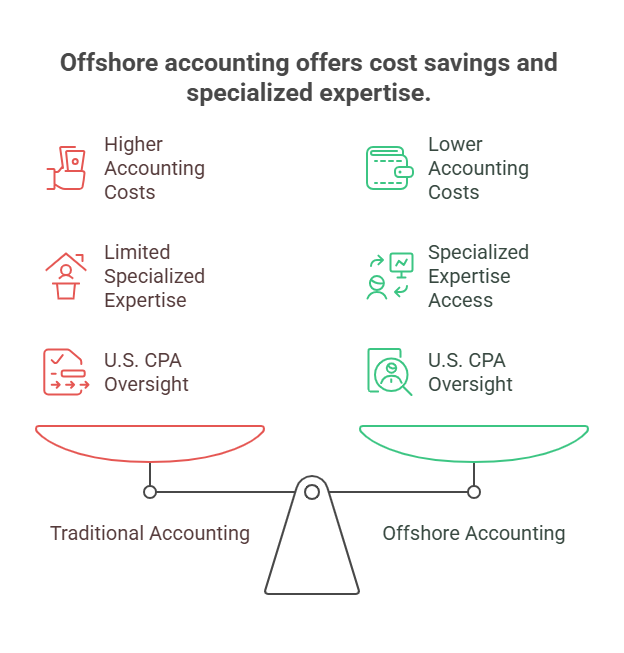
A growing segment of real estate investors and CPA firms serving property clients leverage offshore accounting teams to access specialized expertise at reduced costs. This model combines U.S.-based oversight with offshore execution for bookkeeping, tax preparation, and financial reporting.
Firms like Madras Accountancy (founded 2015) represent this approach, delivering property-level bookkeeping, multi-entity consolidation, and investor reporting for real estate portfolios ranging from small investors to 500+ property operators. The typical engagement includes QuickBooks or Xero implementation, AppFolio or Buildium integration, partnership return preparation, and monthly financial packages with property-specific P&Ls and portfolio consolidations.
The economics work because offshore teams reduce accounting costs 40-50% while maintaining quality through U.S. CPA oversight. A mid-size operator paying $40,000 annually for traditional accounting might access similar services for $20,000-25,000 through offshore providers. The savings compound as portfolios grow, adding 10 properties doesn't require proportional accounting expense increases.
Technology integration becomes critical in this model. Direct connections to property management systems automate data imports, reducing manual reconciliation from 15-20 hours monthly to 2-3 hours of review. Monthly deliverables mirror what national firms provide: property-level income statements, consolidated balance sheets, and investor packages with capital account tracking.
The offshore model works best for operational accounting, bookkeeping, routine tax preparation, and standard reporting. Complex strategic work (entity restructuring, cost segregation studies, acquisition structuring) still benefits from U.S.-based CPA expertise. Many investors use hybrid approaches: offshore teams handle monthly operations while boutique U.S. CPAs provide strategic tax planning.
Understanding offshore accounting partnerships reveals how this model delivers specialized real estate expertise at costs enabling portfolio scaling without proportional administrative expense growth.
What's the difference between a real estate CPA and a regular accountant?
Real estate CPAs specialize in property-specific tax strategies including cost segregation, 1031 exchanges, passive activity loss rules, and rental real estate exceptions that general accountants rarely encounter. They understand multi-entity structures for liability protection and handle complex investor reporting requirements. Most real estate CPAs save clients 15-30% more in taxes annually through specialized knowledge unavailable from generalists who handle various business types.
How much can cost segregation studies actually save in taxes?
Cost segregation studies on properties over $500,000 typically identify $200,000-400,000 in accelerated depreciation opportunities. At a 35% combined federal and state tax rate, this creates $70,000-140,000 in tax savings from deductions taken in earlier years. Studies cost $5,000-15,000, delivering 5-15x returns on investment. The savings increase for larger properties, a $5 million building might generate $500,000+ in first-year depreciation.
Should each rental property be in a separate LLC?
Most real estate attorneys recommend separate LLCs for asset protection, lawsuits against one property don't threaten others. This creates accounting complexity requiring entity-level books and consolidated reporting. Real estate accounting firms handle multi-entity structures systematically. The protection generally justifies additional accounting costs ($500-1,000 per entity annually), especially for properties with significant equity or liability exposure.
What technology platforms do top real estate accounting firms use?
Leading firms integrate with property management platforms like Buildium, AppFolio, Yardi, and Rent Manager, importing transaction data automatically. For general ledger and reporting, they use QuickBooks Online, Xero, NetSuite, or Sage Intacct. Some firms employ specialized real estate consolidation software for portfolio-level reporting across dozens of entities. Technology integration reduces manual data entry by 15-20 hours monthly and improves accuracy.
How do real estate accountants handle multi-state properties?
Multi-state portfolios create nexus and filing requirements in each state where you own property. Real estate accounting firms handle nonresident state income tax returns, state partnership filings, and entity registrations in each jurisdiction. They track state-specific depreciation adjustments and apportionment calculations. Expect additional costs of $500-1,500 per state annually depending on complexity and filing requirements.
When should real estate investors consider fractional CFO services?
Fractional CFO services deliver value once portfolios exceed 10-15 properties or $10 million in total value. At this scale, strategic decisions about acquisitions, refinancing, and portfolio optimization significantly impact returns. CFOs analyze performance across properties, model acquisition opportunities, negotiate with lenders, and create capital allocation strategies. Monthly services ($3,000-8,000) typically identify opportunities worth 10x their cost.
What's the typical ROI from specialized real estate accounting services?
Specialized accounting delivers returns through tax savings, avoided errors, and strategic guidance. Cost segregation alone generates 5-15x returns. Proper 1031 exchange structuring defers hundreds of thousands in capital gains taxes. Portfolio-level analysis identifies underperforming properties worth selling and acquisition opportunities. Most investors investing $25,000-50,000 annually in specialized accounting services achieve 3-5x returns through tax savings and improved decision-making.
Can real estate accounting firms handle syndication and fund structures?
Top real estate accounting firms handle syndicated deals and private funds requiring partnership tax returns (Form 1065), capital account tracking, K-1 preparation for limited partners, and audited financial statements. They prepare quarterly investor reports showing cash distributions, property performance, and updated capital accounts. Syndication accounting costs $5,000-15,000 annually per deal depending on investor count and complexity, plus audit fees of $15,000-50,000 when required.
Real estate accounting sophistication should match portfolio complexity. Early-stage investors with 1-3 properties often manage fine with general accountants who understand Schedule E basics. Growth beyond 5-10 properties typically justifies specialized expertise, the tax savings from cost segregation alone covers specialized fees multiple times over.
The evaluation process matters more than finding a single "best" firm. Your ideal partner depends on portfolio size, geographic spread, entity complexity, and growth plans. A boutique firm perfect for a 15-property local operator might lack capacity for a 100-property multi-state fund. Conversely, national firms excel with complex syndications but may deliver slow response times for straightforward questions.
Consider hybrid approaches mixing different service levels. Offshore providers handle routine bookkeeping and compliance at reduced costs while boutique U.S. CPAs provide strategic planning for acquisitions and tax structuring. This combination delivers operational efficiency without sacrificing strategic expertise on critical decisions.
Technology integration separates modern firms from legacy practices. Direct connections to property management systems eliminate manual data entry, reduce errors, and accelerate monthly close. Real-time financial dashboards let you check property performance without waiting for month-end reports. Firms resisting technology adoption create unnecessary friction as portfolios scale.
The relationship quality ultimately drives results. Responsive communication, proactive tax planning, and genuine expertise in real estate taxation transform accounting from necessary expense into strategic advantage. Whether choosing national firms, regional specialists, or offshore partnerships, prioritize firms demonstrating real estate depth through specific examples rather than generic capability claims.
Start evaluation conversations by asking about recent cost segregation studies they've coordinated, complex 1031 exchanges they've structured, or multi-state compliance challenges they've solved. Strong candidates provide specific scenarios demonstrating depth. Hesitation or generic responses signal limited real estate focus despite marketing materials suggesting otherwise.
Related read: accounting usa.

Section 4960's 21% excise tax now reaches far more nonprofit employees. See who is a covered employee in 2026 and what changed.

The Section 45S paid family leave credit is permanent for 2026 with new options. See who qualifies, the amounts, and how to claim it.

Opportunity zones become permanent in 2027 under the One Big Beautiful Bill. See the new deferral, rural bonus, and the 2026 handoff.



