


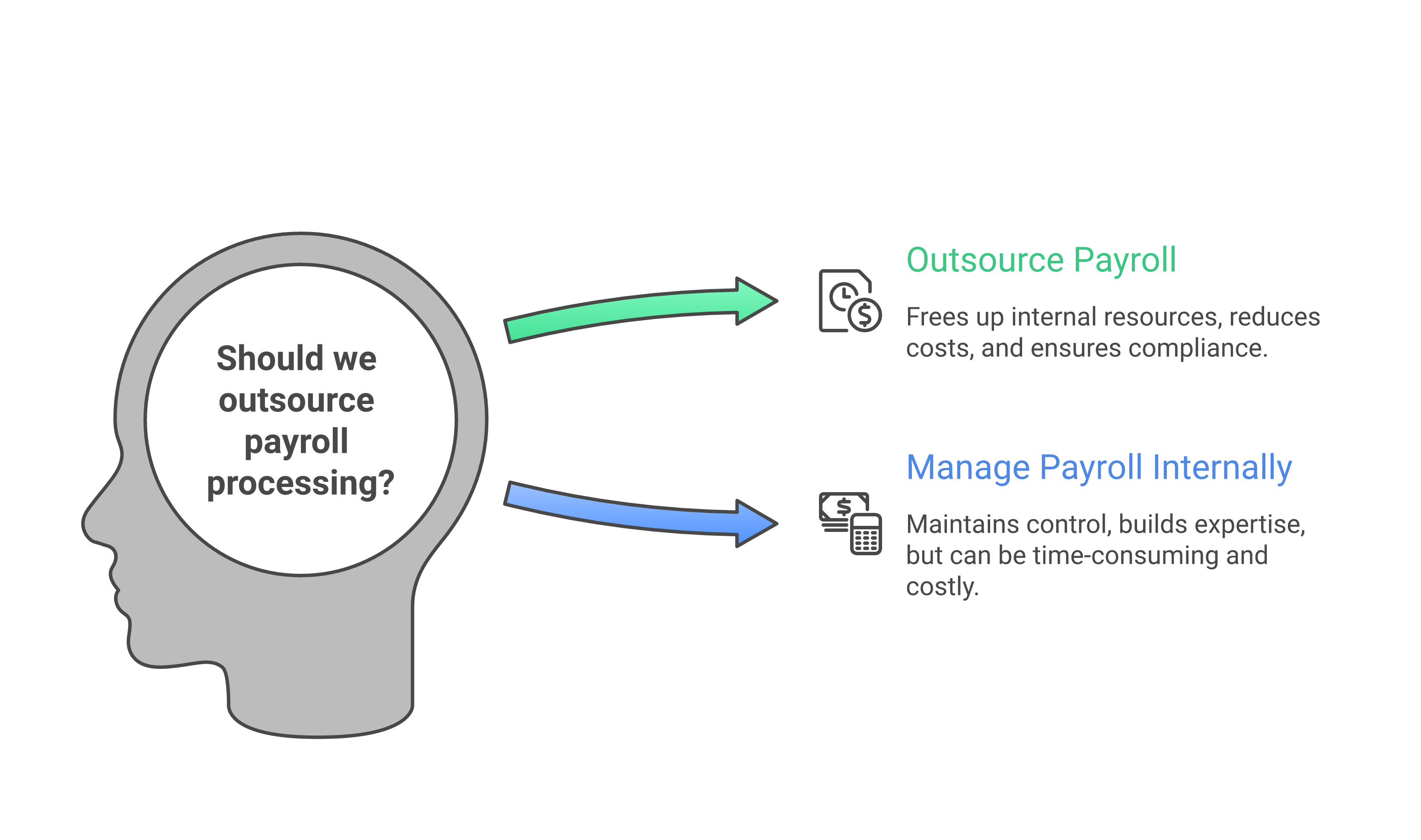
Payroll is the service line that nobody loves but everybody needs. It is repetitive, deadline-driven, compliance-heavy, and the consequences of getting it wrong are immediate and expensive. Late filings, incorrect withholdings, missed state registrations. One slip and your client is facing penalties, and your firm is fielding angry phone calls.
And yet, payroll is incredibly sticky revenue. Clients who rely on you for payroll rarely leave. The switching costs are high, the relationship runs deep, and it naturally feeds into tax, bookkeeping, and advisory work. Dropping payroll means risking the entire client relationship.
The problem is that payroll chews through staff time like nothing else. Processing runs, tax deposits, quarterly filings, year-end W-2s and 1099s, new state registrations, wage garnishments, benefits deductions. The sheer volume of recurring tasks makes payroll a perfect candidate for outsourcing.
We have processed payroll for hundreds of clients through our CPA firm partners, and the pattern is always the same. Firms that outsource payroll free up 15 to 25 hours per week of staff time while maintaining (or improving) compliance accuracy. The ROI is straightforward.
Not all payroll outsourcing is the same. It is important to understand what you actually need before evaluating providers.
W-2 Payroll Processing. This is the core. Calculating gross-to-net pay, federal and state tax withholdings, benefit deductions, garnishments, and generating pay stubs. It includes quarterly payroll tax filings (941, state equivalents) and annual W-2 preparation. Multi-state payroll adds complexity because each state has its own withholding rules, unemployment tax rates, and filing requirements.
1099 Processing. Increasingly, CPA firms handle 1099 reporting for clients who use independent contractors. This involves tracking payments, verifying TINs, preparing 1099 forms, and filing with the IRS and state agencies. The compliance requirements shifted significantly with the lower reporting threshold discussions, and keeping current requires ongoing attention. Our guide on outsourcing payroll and 1099 services covers this in detail.
Payroll Administration Support. Beyond the numbers, there is the operational side. New hire onboarding, termination processing, PTO tracking, benefits enrollment changes, workers' compensation reporting. Some providers handle all of this. Others focus narrowly on the processing and leave administration to you.
Multi-State Capability. If your clients have employees in multiple states (and increasingly, they do thanks to remote work), your provider must handle state registrations, varying withholding calculations, and state-level filing requirements. This is not optional anymore. It is standard.
Integration Compatibility. Your clients use payroll platforms like Gusto, ADP, Paychex, OnPay, and others. Your provider needs to work within these systems, not force everyone onto a single platform. Flexibility here prevents client disruption.
Compliance Accuracy. Payroll errors carry penalties. Federal trust fund penalties are particularly nasty. Your provider's error rate matters enormously. Ask for their accuracy metrics and what their correction process looks like when mistakes happen.
Turnaround Time. Payroll has hard deadlines. Payday is payday. Tax deposits have due dates. Your provider needs to deliver consistently within your processing windows, accounting for time zone differences if they are offshore.
Data Security. Payroll data includes Social Security numbers, bank account details, salary information. The data security requirements are among the highest of any outsourced function. SOC 2 compliance, encrypted data transfer, strict access controls. All non-negotiable.
Overview: We handle payroll processing as a core service line for CPA firms across the US. Our team processes payroll for clients ranging from 5-employee single-state businesses to 500-employee multi-state operations. We work within your clients' existing payroll platforms rather than forcing a platform change.
What We Cover: Our payroll processing service includes the full W-2 payroll cycle. We calculate payroll based on timesheets or salary schedules your clients provide, process withholdings across all applicable federal, state, and local jurisdictions, and generate pay stubs. We handle quarterly tax filings (941, 940, state unemployment, state withholding returns) and prepare year-end W-2s.
For 1099 processing, we track contractor payments throughout the year, verify TINs via W-9 collection, prepare 1099-NEC and 1099-MISC forms, and handle electronic filing with the IRS and state agencies.
We integrate with Gusto, ADP Run, Paychex Flex, OnPay, QuickBooks Payroll, and several other platforms. When a new client uses a platform we have not worked with before, we learn it. We do not ask you to migrate the client.
Multi-state payroll is a particular strength. We currently process payroll across all 50 states and handle the nuances of reciprocal agreements, supplemental wage tax rates, and state-specific requirements like Oregon's transit tax or California's SDI.
Pricing: $15 to $30 per employee per month for W-2 payroll processing. 1099 processing at $8 to $15 per contractor per filing cycle. Volume discounts available.
Contract Terms: Month-to-month after initial 90-day onboarding. No annual commitment required.
Best For: CPA firms wanting a fully managed payroll processing service that works across multiple platforms and states.
Overview: QX offers payroll processing as part of their broader accounting outsourcing services. Their India-based team can handle the operational aspects of payroll processing while your firm maintains the client relationship.
What They Cover: QX provides W-2 payroll processing including calculation, tax withholding, and filing. They support most major payroll platforms and can handle multi-state payroll for clients with employees across several jurisdictions. Quarterly and annual filings are included.
Their 1099 processing covers contractor payment tracking and year-end filing. They also offer payroll reconciliation services to tie payroll expenses back to the general ledger.
Pricing: $18 to $35 per employee per month. Annual contracts typical with volume-based pricing.
Limitations: Platform flexibility can be limited for less common payroll systems. Onboarding new clients may take longer than with specialized payroll providers. Their payroll team also handles other accounting services, which can create capacity pressure during busy periods.
Best For: Firms already using QX for other accounting services wanting to consolidate payroll with the same provider.
Overview: PABS provides payroll processing services from India, targeting US and UK accounting firms. Their payroll offering covers the standard processing cycle and basic compliance filings.
What They Cover: PABS handles payroll calculations, tax withholdings, pay stub generation, and quarterly tax filings. They work primarily with QuickBooks Payroll and Gusto. Their team can process multi-state payroll, though their experience is deeper with clients operating in fewer than 10 states.
Year-end processing includes W-2 preparation and distribution coordination. 1099 processing is available as an add-on service.
Pricing: $12 to $25 per employee per month. Lower price points reflect their competitive positioning. Minimum of 50 employees across your client base.
Limitations: Platform support is narrower than some competitors. Complex payroll scenarios (heavy garnishment processing, union payroll, multi-jurisdiction local taxes) may require additional onshore support from your team. Their payroll-specific training is still developing compared to their bookkeeping and tax capabilities.
Best For: Smaller firms with straightforward payroll needs looking for competitive pricing.
Overview: ADP is not an outsourcing provider in the traditional sense. They are a payroll platform. But many CPA firms use ADP as their payroll infrastructure and then outsource the processing labor to a provider like Madras. It is worth understanding where ADP fits in the ecosystem.
What They Offer: ADP provides the payroll platform (ADP Run for small business, Workforce Now for mid-market), the tax filing engine, the compliance updates, and the employee self-service portal. They handle the technology layer. Your outsourced team (or in-house staff) handles the data entry, verification, and processing layer.
ADP's compliance engine automatically calculates federal, state, and local taxes, handles tax deposits, and files returns. This offloads the compliance complexity to the platform, which means your outsourced processing team can focus on data accuracy rather than tax calculation logic.
Pricing: ADP platform fees are $4 to $12 per employee per month for Run, higher for Workforce Now. This is in addition to whatever you pay your processing team. Total cost is platform plus processing labor.
Integration Note: Most outsourced payroll providers, including Madras, work well with ADP. The combination of ADP's platform with offshore processing labor is one of the most cost-effective models for CPA firms.
Best For: Firms wanting a robust payroll platform handled by an outsourced processing team.
Overview: Gusto is the most popular payroll platform among small to mid-sized businesses, and CPA firms are increasingly standardizing their clients on Gusto through the Gusto Partner program. Like ADP, Gusto is a platform, not an outsourcing provider.
What They Offer: Gusto handles payroll calculations, tax filings, direct deposits, benefits administration, and employee self-service. Their CPA partner program provides accountant-specific tools including a partner dashboard, client management features, and payroll data that flows directly into QuickBooks or Xero.
The platform is well-designed and relatively intuitive, which makes it easier for outsourced teams to process payroll efficiently. Gusto's automated tax filing reduces the compliance burden on your processing team.
Pricing: Gusto platform fees range from $6 to $12 per employee per month plus a base fee of $40 to $80 per month per client. Processing labor is additional.
Integration Note: At Madras, Gusto is the platform we work with most frequently. Roughly 60 percent of the payroll clients we process for CPA firms use Gusto. The platform's design makes offshore processing efficient and reduces the likelihood of errors.
Best For: CPA firms standardizing small business clients on a single, modern payroll platform.
It is worth separating these two because they require different skill sets and have different timelines.
W-2 Payroll is a recurring, time-sensitive workflow. Every pay period (weekly, biweekly, semi-monthly, monthly), your processing team needs to collect timesheets or salary data, enter it into the payroll system, verify calculations, and submit for processing. Then there are quarterly filings and year-end W-2 preparation. The rhythm is constant and unforgiving.
1099 Processing is more project-based. Throughout the year, your team tracks contractor payments and collects W-9s. The heavy lifting happens in January when you prepare and file 1099 forms. The January 31 deadline is immovable, and the volume can be enormous if your clients use many contractors.
The best outsourcing arrangements handle both but with different staffing approaches. W-2 payroll needs consistent, dedicated attention throughout the year. 1099 processing needs surge capacity in December and January.
Remote work has made multi-state payroll the norm rather than the exception. A 20-employee company that used to operate in one state now might have employees in eight states. Each state means a new registration, new withholding rates, new filing requirements, and new compliance risks.
Here is what your outsourcing provider needs to handle for multi-state payroll:
We typically see CPA firms underestimate the complexity of multi-state payroll until they are already committed. The compliance risks are significant, and the penalties for getting it wrong fall on your client.
Integration compatibility matters because forcing a client to switch payroll platforms creates friction, risks data loss, and can damage the client relationship. Your outsourcing provider should adapt to whatever platform the client already uses.
Payroll transitions require more care than most other outsourced functions because the deadlines are absolute and the penalties for errors are immediate. Here is how we approach it at Madras.
Week 1-2: Documentation and Access. We document the client's payroll setup: employee roster, pay rates, deductions, garnishments, tax registrations, pay schedule, and platform access. We review the last three months of payroll runs to understand the client's specific patterns.
Week 3-4: Shadow Processing. We process payroll in parallel with your current process. You run payroll as usual. We run it independently and compare results. This catches any setup issues before we go live.
Week 5+: Live Processing with Review. We take over processing with your team reviewing our output before submission. After two to three clean payroll cycles, most firms reduce review to spot-checking.
The first 90 days set the trajectory. Invest in a thorough transition and you will save yourself months of corrections later.
Year-End Processing Capacity. Every payroll provider gets slammed in January. W-2s, 1099s, and annual filings all converge. Ask your provider how they handle this surge. At Madras, we begin year-end preparation in November and maintain dedicated year-end processing teams to avoid the January scramble.
State Registration Gaps. When a client hires in a new state, someone needs to register with that state's tax authority. Does your provider handle this, or do they expect you to? Unclear ownership here leads to missed registrations and penalties.
Garnishment Processing. Wage garnishments (child support, tax levies, creditor garnishments) add complexity to every payroll run. Not all outsourced providers handle garnishments well. The calculations vary by state, and the processing requires careful attention to priority rules when multiple garnishments exist.
Benefits Integration. Health insurance, retirement plan contributions, HSA/FSA deductions, all of these need to flow correctly through payroll. Your provider should be comfortable working with the benefit administration platforms your clients use.
For a broader set of things to evaluate, our outsourcing dos and don'ts guide covers the principles that apply across all service lines.
If payroll processing is eating into your team's capacity, we should talk. Visit madrasaccountancy.com to schedule a conversation about your specific payroll volume, platforms, and multi-state requirements. We will give you a clear picture of how the transition works and what the ongoing cost looks like.
Who is liable if the outsourced provider makes a payroll tax error? Your firm and your client remain liable for payroll tax accuracy. The outsourcing provider may reimburse penalties caused by their errors (check your SLA), but the legal liability stays with the employer. This is why choosing a provider with strong accuracy metrics and quality controls is critical. At Madras, our payroll error rate is below 0.1 percent, and we cover penalty costs for errors attributable to our processing.
Can an outsourced provider handle direct deposit processing? The outsourced team processes the payroll (data entry, verification, calculations) within the payroll platform. The platform itself (Gusto, ADP, etc.) handles the actual direct deposit transmission. Your outsourced provider does not need access to client bank accounts for direct deposit purposes.
How do you handle payroll for clients with tipped employees or commission-based pay? Tipped employees, commission calculations, and other variable compensation structures are standard for us. We work with the client's compensation structure, however complex, and ensure correct calculations including tip credit compliance, overtime on blended rates, and commission clawback processing.
What about workers' compensation reporting? We track payroll data by workers' compensation classification code and prepare the reports needed for annual audits and policy renewals. We do not administer the workers' comp policies themselves, but we ensure the payroll data feeding into those policies is accurate and properly classified.
Can I outsource payroll for just my most complex clients? Absolutely. Many CPA firms start by outsourcing their most time-consuming payroll clients (multi-state, high employee count, complex deductions) while keeping simpler clients in-house. This lets you test the relationship with the highest-impact clients first. Over time, most firms end up outsourcing all payroll processing once they see the time savings.
Related read: outsource payroll.
Section 4960's 21% excise tax now reaches far more nonprofit employees. See who is a covered employee in 2026 and what changed.

The Section 45S paid family leave credit is permanent for 2026 with new options. See who qualifies, the amounts, and how to claim it.
Opportunity zones become permanent in 2027 under the One Big Beautiful Bill. See the new deferral, rural bonus, and the 2026 handoff.