



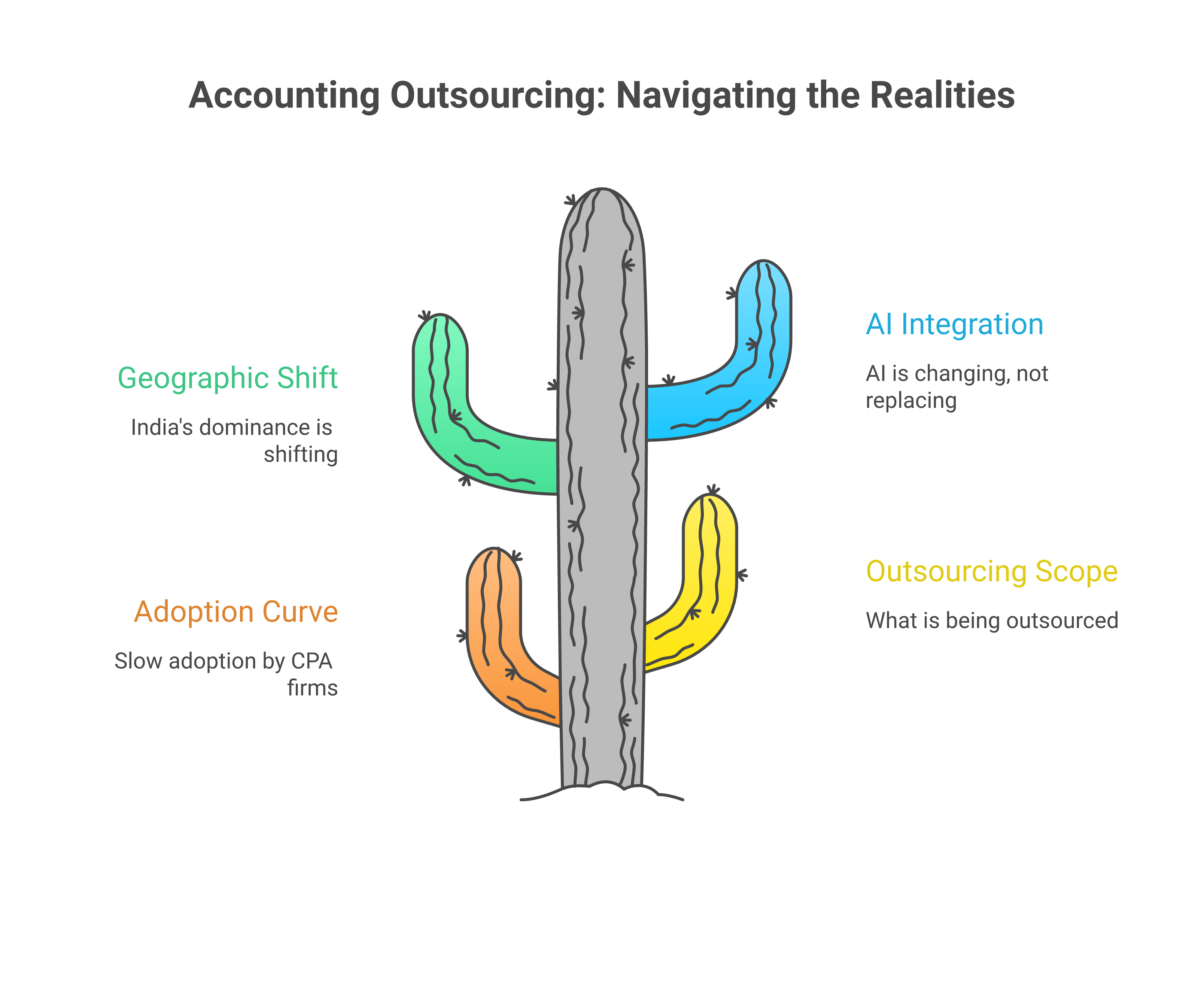
Grand View Research says the global accounting outsourcing market is $53 billion in 2026, growing at 8.2 percent annually. Deloitte's outsourcing survey says 70 percent of companies outsource at least one finance function. These are real numbers from real research firms, and they are completely useless if you are a CPA firm owner trying to decide whether to outsource your bookkeeping to an offshore team.
The market size data tells you outsourcing is big. It does not tell you why some CPA firms thrive with outsourcing and others fail. It does not tell you which service lines are being outsourced fastest, or which geographies are winning and losing market share, or how AI is changing the outsourcing value proposition.
We are going to give you the practitioner version of this report. Not the version a consulting firm sells for $5,000. The version we see from inside the industry at Madras Accountancy, working with CPA firms every day across the US. Our outsourced accounting guide covers the basics. This report covers the trends.
In 2020, maybe 10 to 15 percent of small and mid-size US CPA firms used offshore outsourcing for any service line. In 2026, that number is closer to 30 to 35 percent, and it is accelerating. Reuters reported in 2025 that US accounting firms are tapping India at unprecedented rates to address the talent shortage. The AICPA's own surveys show increasing acceptance of offshore service delivery among member firms.
But the adoption is not evenly distributed. Large firms (top 100) have been outsourcing for a decade. Mid-size firms ($5M to $20M revenue) are the fastest-growing segment of adopters right now. Small firms (under $2M) are the most hesitant, often because the managing partner has concerns about quality, data security, or client reaction.
The firms that adopted early have a structural advantage. Their processes are documented. Their offshore teams are trained. Their margins are better. The firms starting now are playing catch-up, but the gap is closable. We wrote about how outsourcing reduces burnout and turnover as one of the drivers pushing mid-size firms to adopt.

The service lines being outsourced follow a clear hierarchy based on volume, standardization, and judgment requirements.
Bookkeeping and transaction processing is the most outsourced service. High volume, low judgment per transaction, highly standardizable. An estimated 40 to 50 percent of CPA firms that outsource started with bookkeeping. The work is straightforward to quality-check, the error impact per transaction is low, and the cost savings are immediately measurable.
Tax preparation is the second most outsourced service, driven primarily by busy season capacity constraints. The accounting talent shortage has made this near-mandatory for firms that cannot hire enough seasonal preparers. Individual returns (1040s) are the entry point. Business returns (1120S, 1065, 990) follow once the firm is comfortable with the quality.
Accounts payable processing is growing fast as a standalone outsourcing service, particularly for CPA firms serving mid-size businesses with high invoice volumes. The combination of AP automation software and offshore processing has created a service model that barely existed 5 years ago.
Audit support (workpaper preparation, testing schedules, PBC list management) is being outsourced by larger firms but has not penetrated the small firm market yet. The judgment requirements are higher and the regulatory oversight is stricter.
Advisory and CFO services are NOT being outsourced in the traditional sense, but the production work underneath them (financial modeling, dashboard maintenance, report preparation) increasingly is. A fractional CFO supported by an offshore production team can deliver more analytical depth at a lower cost than a solo fractional CFO working alone.
What is not being outsourced: client relationships, audit opinions, tax planning strategy, IRS representation, and any work requiring direct client communication. These stay onshore. The boundary is judgment and relationships on one side, production and processing on the other.
India accounts for an estimated 60 to 70 percent of accounting outsourcing to US CPA firms. The reasons are structural: India produces 300,000 or more commerce graduates annually, the CA (Chartered Accountant) qualification is rigorous, English fluency is high in the educated workforce, and labor costs are 60 to 75 percent lower than the US.
But the landscape is evolving.
The Philippines (15 to 20 percent market share) is gaining ground on English fluency, cultural alignment with US business norms, and time zone overlap with the US West Coast. Costs are 20 to 30 percent higher than India but still 50 to 65 percent below the US. TOA Global has been the biggest driver of Philippine adoption among US accounting firms.
Latin America (5 to 10 percent and growing) is the nearshore play. Mexico, Colombia, and Argentina offer same-time-zone or near-same-time-zone delivery at costs that are higher than India but lower than the US. The nearshore model appeals to firms that want real-time collaboration without the 10 to 12 hour offset. Our nearshoring guide covers the country-by-country comparison.
Eastern Europe (Romania, Poland, Ukraine) has a small but growing presence in US accounting outsourcing, primarily for firms with European operations that need multi-GAAP capability.
The trend we see at Madras is that India remains the cost and scale leader, but firms are increasingly building multi-geography teams. A CPA firm might use India for bookkeeping and tax prep, the Philippines for audit support, and a nearshore team in Colombia for work requiring real-time US collaboration.
The narrative that AI will eliminate the need for offshore accountants is popular in tech vendor marketing. The reality is more nuanced. AI is changing WHAT gets outsourced, not WHETHER outsourcing happens.
Bank transaction categorization is being automated. AI tools like Vic.ai and Docyt handle 80 to 90 percent of routine transaction categorization with acceptable accuracy. That means the offshore bookkeeper's job is shifting from "categorize every transaction" to "review AI categorizations, handle exceptions, and process the 10 to 20 percent the AI gets wrong."
Document extraction is being automated. OCR and machine learning extract data from receipts, invoices, and tax documents faster than humans. But the data still needs to be verified, exceptions need to be researched, and the results need to be posted to the correct accounts.
The net effect: AI is making offshore teams MORE productive, not replacing them. A bookkeeper who manually processed 200 transactions per hour now reviews 500 AI-processed transactions per hour, catching the exceptions the AI misses. The per-transaction cost drops. The volume each person can handle increases. But the human is still in the loop because AI is not yet reliable enough for financial data that must be accurate. Our guide on outsourcing vs automation covers where each approach works best.
At Madras, we use AI tools in our own production workflow. Our team is more productive because of AI, which means we can offer better pricing to our CPA firm clients. The firms that combine AI and outsourcing are seeing cost reductions that neither approach delivers alone.
The accounting outsourcing provider market is going through two simultaneous shifts.
First, consolidation. Larger providers are acquiring smaller ones. Private equity has entered the space, buying up mid-size providers and combining them into larger platforms. The result is fewer independent providers, more standardized service offerings, and in some cases, quality changes as acquired teams get reorganized. We wrote about what happens when your provider gets acquired and how to protect your firm.
Second, specialization. New providers are entering the market with specific focus areas rather than trying to be all things to all firms. Some focus exclusively on tax preparation. Others specialize in bookkeeping for specific industries (ecommerce, construction, healthcare). Others build their value proposition around technology, positioning themselves as "AI plus human" providers rather than pure labor arbitrage.
In our experience, the specialized providers tend to deliver better quality than the generalist mega-providers because their teams develop deeper expertise. The tradeoff is that a specialized provider may not cover all of your outsourcing needs, which means you may need relationships with multiple providers as your outsourcing scope expands.
Understanding the talent pipeline in India is important context for any CPA firm evaluating outsourcing. India produces approximately 2.5 million commerce graduates per year. Of those, roughly 100,000 pursue the CA (Chartered Accountant) qualification, which is substantially more rigorous than a US undergraduate accounting degree. The CA exam pass rate hovers around 10 to 15 percent, producing a selective cohort of qualified accountants.
This talent pool is what makes the accounting outsourcing model viable. But it is also getting more competitive. Indian IT services companies, domestic accounting firms, and the growing number of US outsourcing providers are all competing for the same pool of qualified accountants. Starting salaries for CAs in India have been rising 8 to 12 percent annually, which is faster than general inflation.
The practical implication for CPA firms: outsourcing prices from India will continue to rise modestly (3 to 5 percent per year in real terms), but the cost advantage versus US labor will remain significant for the foreseeable future. A US staff accountant costs $55,000 to $75,000 per year. An equivalent role in India costs $12,000 to $20,000. Even with annual increases, the gap remains wide enough to drive the economic case for outsourcing.
Outsourcing prices have been remarkably stable over the past 3 years despite inflation in India and the Philippines. The reason is competition. The number of providers has grown faster than demand, which keeps pricing pressure on.
Current market rates for CPA firm outsourcing from India are $10 to $18 per hour for staff-level bookkeepers, $15 to $25 for experienced accountants with US GAAP training, $20 to $35 for tax preparers handling complex returns, and $25 to $45 for senior accountants and team leads.
Per-FTE pricing ranges from $1,200 to $2,000 per month for staff accountants and $1,800 to $3,000 for seniors.
Pricing from the Philippines runs 20 to 30 percent higher across all categories.
For a detailed pricing analysis, our outsourcing cost guide covers the full breakdown.
Three predictions from our vantage point.
First, outsourcing adoption will cross 50 percent of US CPA firms by 2028. The talent shortage is not improving, starting salaries keep climbing, and the economic argument for outsourcing gets stronger every year that onshore labor costs increase. Our analysis of outsourcing vs hiring at current salary levels shows the math is increasingly one-sided.
Second, the AI plus outsourcing combination will become the standard delivery model. Pure outsourcing (humans doing everything) and pure AI (software doing everything) will both lose market share to the hybrid model where AI handles structured tasks and human teams handle exceptions, judgment, and quality control.
Third, client acceptance of offshore delivery will become a non-issue. Five years ago, CPA firms worried about client reaction to offshore teams. In 2026, clients have been interacting with offshore customer service, offshore tech support, and offshore professional services for years. The stigma is fading because results matter more than geography.
If you want to discuss where outsourcing fits in your firm's strategy, reach out at madrasaccountancy.com.
Growing. The 8 percent annual growth rate reflects both new firm adoption and existing firms expanding the scope of work they outsource. Most firms start with bookkeeping and add tax prep, AP, and audit support over time. Saturation is not a near-term concern because the majority of US CPA firms have not yet adopted outsourcing.
Not in the foreseeable future. AI handles structured, rules-based tasks well. Accounting involves significant judgment, exception handling, and client-specific context that AI cannot replicate. The more realistic future is AI handling 50 to 60 percent of transaction-level work, with human teams handling the rest. Our article on AI and offshore teams covers the intersection in detail.
Stable to slightly increasing. Indian labor costs are rising 5 to 8 percent annually, but productivity improvements (from AI tools and process optimization) are offsetting most of the increase. Most CPA firms are seeing flat or low single-digit annual price increases from their providers.
Regulatory changes. If the US imposed restrictions on offshore processing of taxpayer data (similar to GDPR's data localization provisions in the EU), the model would need to adapt. This risk is low in the current regulatory environment but not zero. Diversifying across geographies (India plus Philippines or nearshore) provides some hedge against single-country regulatory risk.
The market is actually more favorable for new adopters now than it was five years ago. Provider quality has improved because competition has weeded out the weakest operators. Pricing is stable, so you are not entering at a high point. The technology infrastructure (cloud accounting, VDI, communication tools) is mature and well-tested. And the playbook for successful outsourcing has been refined through thousands of firm engagements. The firms starting now have the advantage of learning from the early adopters' mistakes rather than making those mistakes themselves.
Related read: global accounting.
Section 4960's 21% excise tax now reaches far more nonprofit employees. See who is a covered employee in 2026 and what changed.

The Section 45S paid family leave credit is permanent for 2026 with new options. See who qualifies, the amounts, and how to claim it.

Opportunity zones become permanent in 2027 under the One Big Beautiful Bill. See the new deferral, rural bonus, and the 2026 handoff.